
Overview & Design Features
The Cadillac GM 331 engine represents a pivotal moment in American automotive engineering, marking Cadillac’s departure from its long-standing flathead V8 architecture. Introduced in 1949, this overhead valve (OHV) V8 engine was an entirely new design, showcasing advancements that propelled Cadillac to a leadership position in performance and luxury. Its development was a closely guarded secret, aimed at delivering superior power and efficiency over its predecessor. The 331 cubic inch (approximately 5.42 liters) displacement, combined with its compact and robust design, became the foundation for Cadillac’s V8 engines for over a decade, profoundly influencing the post-war automotive landscape and solidifying Cadillac’s reputation for innovation and sophistication.
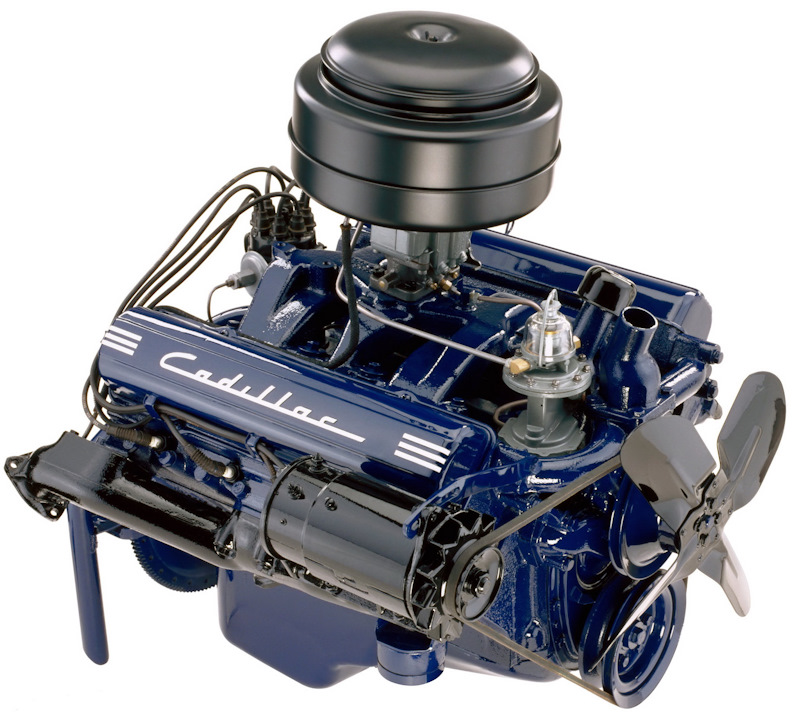
Constructed primarily from cast iron for both the cylinder block and cylinder heads, the GM 331 featured a conventional yet highly effective pushrod overhead valve arrangement. This design allowed for better breathing and higher compression ratios compared to flathead engines, directly contributing to its impressive power output for the era. Fuel delivery was managed by a single two-barrel carburetor in its initial iteration, evolving to four-barrel carburetors in later high-performance versions, enhancing both power and responsiveness. The valvetrain utilized solid lifters, a common practice at the time, without the presence of variable valve timing (VVT) or direct fuel injection technologies, which would only emerge much later in automotive history. Its five-main-bearing crankshaft ensured durability and smooth operation, reflecting Cadillac’s commitment to refinement.
The GM 331 engine was extensively deployed across Cadillac’s prestigious model range from its introduction in 1949 through 1954. Key models featuring this powerplant included the Cadillac Series 61, Series 62, Series 75 Fleetwood, and the iconic Coupe de Ville. It powered the first production Cadillac Eldorado models, particularly from 1953, underscoring its role in Cadillac’s most luxurious and performance-oriented offerings. Throughout its production run, various horsepower ratings were achieved through carburetor and compression ratio enhancements, allowing the 331 to remain competitive and desirable across different trims and successive model years.
Technical Specifications
| Specification | Value |
|---|---|
| Displacement (cc) | 5424 cc (331 cu in) |
| Max Power (hp (kW) @ RPM) | 210 hp (157 kW) @ 4100 RPM (1953 model year) |
| Max Torque (Nm (kg*m) @ RPM) | 447 Nm (45.6 kg*m) @ 2700 RPM (1953 model year) |
| Fuel Type | Gasoline (regular/premium, leaded) |
| Fuel Consumption (l/100 km) | Refer to manufacturer’s technical documentation |
| Engine Type | V8, Overhead Valve (OHV), Pushrod |
| Compression Ratio | 8.25:1 (1953 model year) |
| Cylinder Bore (mm) | 96.8 mm (3.8125 in) |
| Piston Stroke (mm) | 92.1 mm (3.625 in) |
| Valvetrain | Pushrod OHV with solid lifters |
| Valves per Cylinder | 2 |
| Additional Info | Cast iron block and cylinder heads, five main bearings |
Common Problems & Reliability
- Oil Leaks: Due to aged gaskets and seals, particularly around the valve covers, oil pan, and rear main seal, oil seepage is a common issue. Over time, original cork or rubber components degrade, leading to external leaks.
- Carburetor Issues: As a carbureted engine, the GM 331 is susceptible to common carburetor problems such as fuel delivery inconsistencies, clogging from fuel contaminants, worn throttle shafts, and improper tuning. This can lead to rough idling, poor performance, and difficult starting.
- Ignition System Wear: The points-and-condenser ignition system is prone to wear and requires regular maintenance. Worn points, a failing condenser, or deteriorated spark plug wires can cause misfires, reduced power, and ignition timing issues.
- Valve Seat Recession: Original valve seats were designed for leaded gasoline. Prolonged use of unleaded fuel without proper lead substitutes or hardened valve seats can lead to valve seat recession, impacting compression and engine performance.
With proper care and maintenance, a Cadillac GM 331 engine can offer significant longevity, with many examples surpassing 100,000 miles before requiring a major overhaul. However, reaching this mileage often necessitates proactive component replacement and adherence to period-correct service practices.
Maintenance Tips & Service Schedule
- Oil Changes: Engine oil should be changed every 2,000-3,000 miles or every 3-6 months, whichever comes first. Given the engine’s age and design, a modern high-quality conventional or semi-synthetic oil, typically 10W-30 or 15W-40, formulated with zinc (ZDDP) for flat-tappet camshaft protection, is recommended.
- Ignition System Service: Inspect and replace spark plugs every 10,000-15,000 miles, ensuring correct gap. Points and condenser in the distributor require inspection and adjustment or replacement every 10,000 miles. Ignition timing should be checked and set periodically.
- Cooling System: The cooling system requires flushing and refilling with a 50/50 mixture of suitable automotive coolant and distilled water every 2 years or 30,000 miles to prevent corrosion and maintain heat transfer efficiency. Hoses and belts should be inspected for cracks or wear annually.
- Fuel System Maintenance: The carburetor should be inspected and serviced as needed, typically every 20,000-30,000 miles, including cleaning and gasket replacement. Fuel filters, if present, should be changed annually.
- Valve Adjustment: Due to solid lifters, valve lash adjustment may be necessary periodically, often every 20,000-30,000 miles, to maintain optimal engine performance and prevent valve train noise.
Conclusion
The Cadillac GM 331 engine stands as a robust and historically significant powerplant, a testament to post-war American automotive innovation. For a used vehicle buyer, an engine of this vintage, if properly maintained and free of significant underlying issues, can offer a remarkably reliable and characterful driving experience. Its straightforward design allows for relatively accessible repairs and parts availability within the classic car community. However, potential buyers should be prepared for the realities of vintage engine ownership, which includes more frequent and specialized maintenance compared to modern engines, particularly regarding the ignition system, carburetion, and the need for appropriate fuel. A thorough pre-purchase inspection by a specialist familiar with period-correct engines is highly recommended to ascertain its condition and ensure a safe and enjoyable classic vehicle acquisition.