
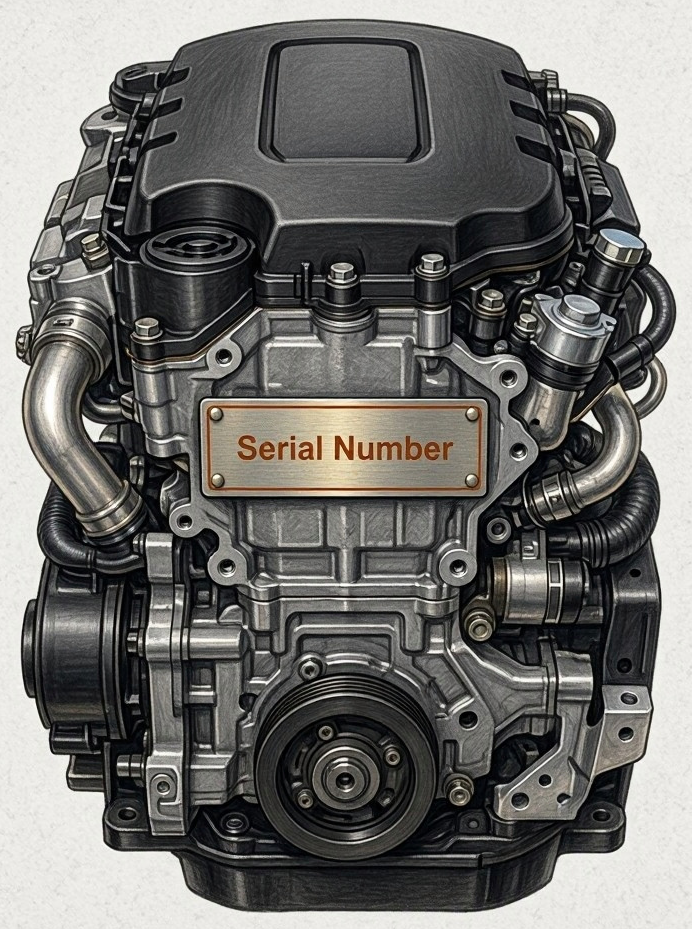
Accurately identifying the precise engine code and serial number on a BMW is not merely a bureaucratic formality; it is an absolutely critical step for a multitude of automotive service and ownership functions. This unique identifier provides an immutable blueprint of the engine’s specifications, manufacturing details, and history. Without it, the correct sourcing of OEM replacement parts becomes a speculative gamble, often leading to incompatible components and wasted effort. Furthermore, verifying an engine’s code and serial is paramount for cross-referencing applicable technical service bulletins (TSBs), safety recalls, and ensuring compliance with regional emissions standards. For potential buyers of used vehicles or replacement engines, authenticating these numbers against vehicle documentation or a donor engine’s history is the sole method to confirm originality, detect undisclosed swaps, or identify stolen powertrains. This comprehensive guide, crafted by an expert automotive engineer, vehicle identification specialist, and master powertrain technician, will illuminate the intricacies of BMW engine identification, from physical location to detailed decoding.
Where to Find the Engine Serial Number and Code on BMW Engines
| Engine Series / Layout | Physical Stamp Location | Secondary Sticker / Plate |
|---|---|---|
| M10/M20/M30/M40/M42/M43/M44 (Older I4/I6) | Machined vertical or horizontal pad on the lower left (intake) side of the crankcase, typically adjacent to the engine mount arm or directly below the cylinder head gasket line. May be near the oil filter housing on some M20/M30. | Often a metallic data plate riveted to the valve cover or intake manifold, or a sticker on the timing cover or near the oil filler cap showing basic engine type and sometimes serial range. |
| M50/M52/M54 (Modern I6) | Machined vertical pad on the lower left (intake) side of the crankcase, typically below the exhaust manifold or near the engine mount bracket. The serial number is typically stamped directly into this pad. | A barcode sticker with the engine code and serial number often found on the valve cover (e.g., plastic cover on M54) or the intake manifold. |
| M60/M62 (V8) | On the left cylinder bank (passenger side in LHD vehicles), locate a machined flat pad on the crankcase, typically below the cylinder head near the engine mount arm. Can be challenging to access due to accessories. | Less common to find secondary stickers on these older V8s, but sometimes a small label on the valve cover or behind the intake manifold provides the base engine code. |
| N42/N45/N46 (I4) & N52/N53/N54/N55 (I6) | Stamped on a machined vertical or horizontal pad on the lower left (intake) side of the crankcase, typically near the engine mount arm or below the exhaust manifold. Modern N-series blocks often feature a laser-etched or dot-peen matrix etching. | Barcode sticker with full engine code and serial number prominently located on the valve cover (e.g., plastic N-series valve covers) or the front timing chain cover. |
| N20/N26 (Turbo I4) | Laser-etched or dot-peen matrix on a machined pad on the lower left (intake) side of the crankcase, often close to the front of the block near the engine mount. | Barcode sticker affixed to the plastic engine cover, valve cover, or the front timing chain cover, containing the full engine code and serial. |
| N62/N63 (V8) | On the left cylinder bank (passenger side in LHD vehicles), look for a dot-peen matrix etching on a machined pad on the crankcase, usually accessible near the engine mount arm area. | Barcode sticker found on the valve cover or front timing cover area, particularly on the left bank. |
| B38/B48/B58 (Modular I3/I4/I6) | Dot-peen matrix etching on a machined pad on the lower left (intake) side of the crankcase, often very close to the transmission bell housing flange or the front timing cover area. Location can vary slightly based on specific chassis application. | Prominent barcode sticker with the complete engine code and serial number, typically on the plastic engine cover, valve cover, or the front section of the intake manifold. |
| M47/M57/N47/N57/B47/B57 (Diesel I4/I6) | Similar to their gasoline counterparts, these diesel engines have the serial number dot-peen etched or stamped on a machined pad on the lower left (intake) side of the crankcase, near the engine mount or below the intake manifold. | Barcode sticker usually present on the valve cover or the front timing cover, detailing the engine code and serial number. |
| S50/S54/S65/S85/S55/S58/S63 (M-Power) | Typically found on a dedicated, clearly machined pad on the lower left (intake) side of the crankcase, often below the cylinder head. These high-performance engines often have very clear stampings or etchings due to their specific assembly processes. Location can be unique for each M-series block, but generally adheres to the “lower left” rule. | M-specific metal data plates or durable stickers on the valve cover (especially carbon fiber M-covers) or prominently on the intake manifold, indicating the specific S-code and sometimes production number for limited-run engines. |
Physically locating the engine code and serial number on a BMW engine requires patience and careful inspection. The primary identification is almost universally stamped or etched onto a dedicated, machined pad on the cylinder block itself. For most BMW inline engines (I4, I6), this pad is consistently found on the lower left (intake) side of the crankcase, often located near the engine mount arm or just below the cylinder head gasket line. On V8 engines, the serial number is typically found on the left cylinder bank’s crankcase, in a similar accessible location relative to the engine mount. Earlier M-series engines (M10, M20, M30, M40, M50, M60) predominantly feature deep, cast-in or stamped characters. As engine generations advanced to the N-series and more recently the B-series modular engines, the identification method evolved. Newer B-series engines, in particular, utilize a precise dot-peen matrix etching or laser etching, which creates a series of small, closely spaced dots forming the characters. These modern etchings can be shallower and thus more susceptible to obscurity from grime or corrosion than older stampings. To properly read these markings, it is often necessary to clean the area thoroughly. Use a stiff wire brush (brass bristled is safer for aluminum blocks) and a degreaser or brake cleaner. Always ensure adequate ventilation and wear appropriate safety gear. Avoid abrasive grinding or harsh chemicals that could damage the engine material or obscure the markings permanently. In some instances, a flashlight and a small mirror may be indispensable tools to gain a clear view of the stamping, especially in cramped engine bays.
How to Decode BMW Engine Codes and Serial Numbers
BMW engine codes adhere to a logical, standardized structure that provides a wealth of information about the engine’s design, displacement, fuel type, and power output. The accompanying sequential serial number uniquely identifies each individual engine produced. Understanding this structure is key to accurate identification.
- Engine Family & Generation Prefix: The initial letter (e.g., ‘M’, ‘N’, ‘S’, ‘B’) broadly categorizes the engine’s architecture, generation, and sometimes its block material or core design philosophy. ‘M’ denotes older generation engines (pre-2000s), ‘N’ indicates newer generation engines (post-2000s), ‘S’ is reserved for high-performance BMW M GmbH engines, and ‘B’ signifies the latest modular engine family introduced in the mid-2010s. The two-digit number following often denotes the specific engine variant within that family (e.g., M54, N55, B58).
- Displacement & Cylinder Configuration: The subsequent two digits typically represent the engine’s displacement in deciliters (e.g., ’30’ for 3.0 liters, ’20’ for 2.0 liters). While not directly encoded in the visible code, the engine family prefix and displacement inherently imply the cylinder configuration (e.g., N55 for inline-six, N47 for inline-four, N63 for V8, B38 for inline-three).
- Fuel System, Aspiration & Valvetrain: A letter following the displacement often indicates the fuel type and other key features. ‘B’ typically stands for Gasoline (Benzin), ‘D’ for Diesel. Subsequent characters or the engine variant number within the family often implicitly denote aspiration (e.g., turbocharging is standard on most N- and B-series engines) and valvetrain technologies (e.g., Valvetronic, VANOS, direct injection).
- Power Output, Revision & Emissions Spec: Trailing letters or numbers within the engine code (e.g., ‘A’, ‘M0’, ‘C’) often denote specific power output levels (e.g., standard, medium, high), minor technical revisions, or compliance with particular regional emissions standards (e.g., ULEV, SULEV). These can distinguish variants of the same core engine with different tunes or hardware.
- Sequential Serial Number String: The numeric string that follows the engine code is the unique sequential serial number. This multi-digit number provides a unique identifier for that specific engine block, allowing it to be traced through manufacturing, vehicle installation, and service history. It does not typically encode plant or production date directly within the digits themselves but serves as a key to database records containing this information.
Real-World BMW Engine Code Examples
Here we will break down several real-world BMW engine codes and their associated serial numbers, demonstrating the decoding principles character by character.
- N55B30A 08429174:
- N55: Denotes the engine family and specific variant. ‘N’ signifies a newer generation engine (post-2000s), and ’55’ is the specific variant, identifying it as a 3.0-liter inline-six engine with a single twin-scroll turbocharger, Valvetronic, and direct injection.
- B: Indicates ‘Benzin’ (Gasoline) fuel type.
- 30: Represents a 3.0-liter displacement.
- A: Denotes a specific technical revision or power output level for this N55 variant. Often signifies the initial or a specific standard output tune.
- 08429174: This is the unique sequential production serial number for this specific N55B30A engine.
- Typical Applications: BMW 1-Series (E82/E88), 3-Series (E90/E92/E93, F30/F31), 5-Series (F10/F11), X3 (F25), X5 (E70), X6 (E71), Z4 (E89).
- B58B30M0 19482710:
- B58: Denotes the engine family and specific variant. ‘B’ signifies the latest modular engine generation (introduced mid-2010s), and ’58’ identifies it as a 3.0-liter inline-six engine with a single twin-scroll turbocharger, Valvetronic, and direct injection, sharing modular components with 3-cylinder B38 and 4-cylinder B48 engines.
- B: Indicates ‘Benzin’ (Gasoline) fuel type.
- 30: Represents a 3.0-liter displacement.
- M0: Denotes a specific power output level, in this case, a ‘Medium Output’ variant. Other common codes include O0 (Overt Output) for higher performance or U0 (Under Output) for lower tiers.
- 19482710: This is the unique sequential production serial number for this specific B58B30M0 engine.
- Typical Applications: BMW 1-Series (F20/F21), 2-Series (F22/F23), 3-Series (F30/F31, G20/G21), 4-Series (F32/F33/F36), 5-Series (G30/G31), 6-Series (G32), 7-Series (G11/G12), X3 (G01), X4 (G02), Z4 (G29), Toyota Supra (A90).
- N47D20C 73910482:
- N47: Denotes the engine family and specific variant. ‘N’ signifies a newer generation engine, and ’47’ is the specific variant, identifying it as a 2.0-liter inline-four diesel engine, typically with common rail direct injection and a turbocharger.
- D: Indicates ‘Diesel’ fuel type.
- 20: Represents a 2.0-liter displacement.
- C: Denotes a specific technical revision or power output level for this N47 variant. Common in a series of revisions addressing timing chain issues.
- 73910482: This is the unique sequential production serial number for this specific N47D20C engine.
- Typical Applications: BMW 1-Series (E81/E82/E87/E88, F20/F21), 3-Series (E90/E91/E92/E93, F30/F31), 5-Series (E60/E61, F10/F11), X1 (E84), X3 (E83, F25).
- M54B30 24819204:
- M54: Denotes the engine family and specific variant. ‘M’ signifies an older generation engine (late 1990s/early 2000s), and ’54’ is the specific variant, identifying it as a 3.0-liter naturally aspirated inline-six engine with double VANOS.
- B: Indicates ‘Benzin’ (Gasoline) fuel type.
- 30: Represents a 3.0-liter displacement.
- (No trailing letter): For this older M-series code, the lack of a trailing letter often implies the standard or primary output version for this displacement within the M54 series.
- 24819204: This is the unique sequential production serial number for this specific M54B30 engine.
- Typical Applications: BMW 3-Series (E46), 5-Series (E39, E60/E61), 7-Series (E65/E66), X3 (E83), X5 (E53), Z3 (E36/7/8), Z4 (E85/E86).
How to Identify Production Year and Manufacturing Plant
While the sequential serial number itself does not directly encode the manufacturing year or plant for BMW engines in the same way some other manufacturers do, this information is nonetheless traceable. The primary method for determining the exact manufacturing year and typically the month (or even Julian day) is through a combination of the engine serial number cross-referenced with official BMW databases. These databases link the unique serial number to its production batch, date, and assembly plant. For physical inspection, older engines and components often feature “casting date clocks” – small dials molded into the cast iron or aluminum parts (block, cylinder head, intake manifold) indicating the year and month of the component’s manufacture. These casting dates provide a strong indicator of the earliest possible production date for the assembled engine. However, the definitive production date for the complete engine assembly is best verified via the vehicle’s Vehicle Identification Number (VIN) decoder, which can often provide the engine’s original specification and approximate build month/year when the vehicle left the factory. In some cases, a small metal plate or sticker within the engine bay, usually on the firewall or strut tower, may contain a VIN-to-engine cross-reference or engine details, especially for vehicles originally exported to markets with strict identification requirements. For engineering revisions, BMW maintains internal documentation linked to engine code variants and serial number ranges, which service centers can access to determine specific hardware or software versions applicable to a given engine.
Common Mistakes When Checking BMW Engine Numbers
- Confusing Casting Numbers with the Serial Number: A frequent error is misidentifying the raised alphanumeric characters found on various cast components (e.g., “7547101” on a cylinder head, “1703290” on an M50 block) as the engine serial number. These are foundry part numbers or casting marks, indicating the component’s design revision or mold number. The true engine serial number is always found on a flat, machined pad on the block, characterized by its distinct stamping or dot-peen etching, not as part of the rough casting.
- Corrosion, Paint, and Road Grime Obscuration: The engine serial number, particularly the shallower dot-peen etched marks on newer N- and B-series engines, can be easily obscured by years of road grime, oil residue, rust, or even layers of paint from engine bay detailing. Attempting to read these without proper cleaning can lead to misinterpretation. Always use a soft wire brush (brass or nylon), a degreaser, and a strong flashlight to ensure optimal visibility. Never use abrasive grinders or harsh chemicals that could permanently damage or erase the markings.
- Short-Block or Remanufactured Engine Swaps: It is crucial to be aware that a vehicle might not have its original factory engine. If a short-block or complete engine has been replaced with a factory service unit, remanufactured engine, or a used engine from another vehicle, the serial number on the block will not match the vehicle’s original VIN records. Factory replacement short-blocks may come with a new, distinct serial number or, in some rare cases, might have a non-production service block identifier. Always cross-reference the physical engine serial with service records and VIN decoders when verifying engine originality.
- Misreading Similar Alphanumeric Characters: The specific font styles used for stamping or etching BMW engine numbers, especially on older engines, can lead to confusion between visually similar characters. Common examples include mistaking ‘0’ (zero) for ‘O’ (letter O), ‘1’ (one) for ‘I’ (letter I), ‘5’ (five) for ‘S’ (letter S), or ‘8’ (eight) for ‘B’ (letter B). Carefully scrutinize each character, perhaps taking a photo from multiple angles, to avoid critical transcription errors that can invalidate parts ordering or history checks.