
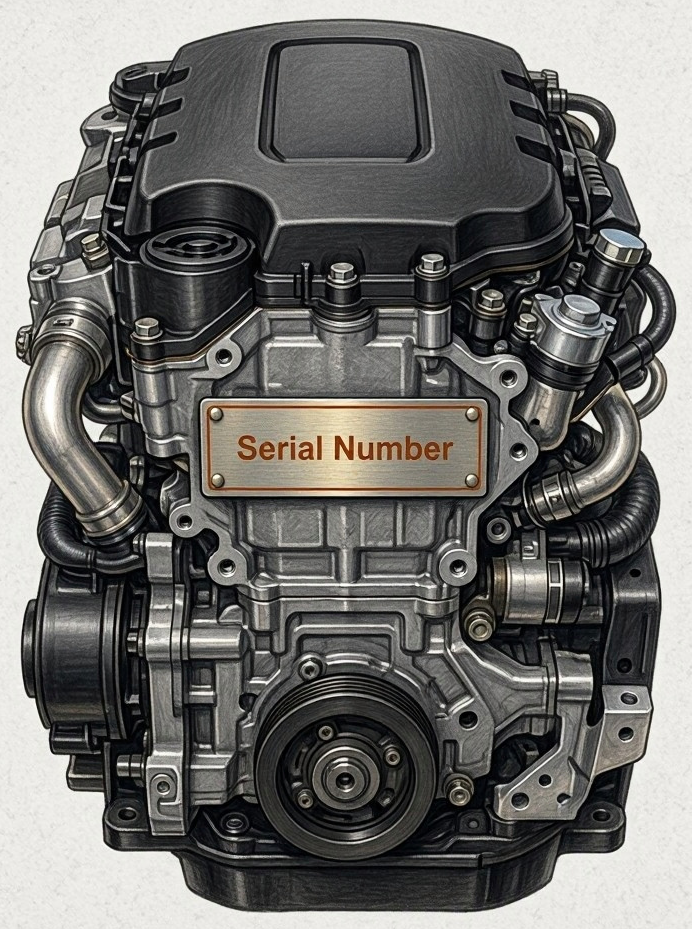
Accurate identification of a Fiat engine’s specific code and serial number is paramount for any automotive professional, vehicle owner, or prospective buyer. This comprehensive guide provides the authoritative knowledge necessary to precisely locate and meticulously decode these critical identifiers. From ensuring the procurement of correct OEM parts and verifying the comprehensive service history of a vehicle to assessing applicability for recalls or technical service bulletins, the exact engine variant dictates compatibility and performance. Furthermore, for those evaluating a used vehicle or a replacement engine, confirming the engine’s identity against documentation is an indispensable step in safeguarding against misrepresentation and ensuring longevity and regulatory compliance. This guide serves as the ultimate reference for technicians, parts specialists, and enthusiasts navigating the intricacies of Fiat powertrain identification.
Where to Find the Engine Serial Number and Code on Fiat Engines
| Engine Series / Layout | Physical Stamp Location | Secondary Sticker / Plate |
|---|---|---|
| FIRE (Fully Integrated Robotized Engine) Series (e.g., 1.1L, 1.2L, 1.4L – 188A4000, 169A4000, 198A4000) |
Typically stamped on a machined flat pad located on the front-right side of the cylinder block, often near the oil filter housing or below the timing cover/belt area. The engine type code precedes the 7-digit sequential serial number. | A barcode label or data plate is frequently found on the plastic engine cover, valve cover, or the timing belt cover. The vehicle’s VIN tag (usually on the dashboard or door jamb) will also cross-reference the engine type. |
| TwinAir 0.9L Turbo | The engine code and serial number are laser-etched or stamped on a machined pad on the front of the cylinder block, typically below the exhaust manifold or near the alternator mount on the right-hand side (when viewed from the front of the vehicle). | A sticker with the engine code and serial number can be present on the top of the valve cover, or on a specific tag attached to the wiring harness or engine lifting eye. The vehicle’s VIN data sheet contains the engine code. |
| MultiAir / T-Jet 1.4L Turbo (e.g., 955A2000, 198A1000, EAM) |
Engraved on a machined pad on the front-right side of the cylinder block, typically located near the junction with the transmission bell housing or below the exhaust manifold heat shield. The engine code is followed by the serial. | May have a data plate or barcode sticker affixed to the plastic engine cover or the front of the cylinder head/valve cover. Vehicle VIN decoder information is essential for full specification matching. |
| FireFly / GSE (Global Small Engine) 1.0T/1.3T | Stamped on a machined flat surface on the front of the cylinder block, typically low down towards the oil pan, often on the right-hand side beneath the accessory drive area. May be dot-peen marked. | A printed label or sticker is usually present on the plastic engine cover, or on the intake manifold. Reference to the vehicle’s VIN is critical for confirming the specific variant and build date. |
| Pratola Serra (Torque) Series 1.8L/2.0L/2.4L | Generally stamped on a machined pad on the front-left side of the cylinder block, often just above the oil pan rail or near the transmission mating surface. This location can vary slightly by displacement. | A sticker can be found on the valve cover or on the upper timing belt cover. Older engines might have a small metal plate riveted to the block. |
| MultiJet Diesel Series (e.g., 1.3L 199A3000, 1.6L 198A2000, 2.0L, 2.3L/3.0L Ducato F1AE0481/F1CE0481) |
Typically found on a machined flat pad on the front-right side of the cylinder block, often adjacent to the oil filter housing, near the coolant pump, or below the intake manifold. On larger Ducato engines (F1A/F1C), it’s often more prominent on the front of the block near the crankcase breather. The engine type code precedes the serial number. | A barcode label or data plate is commonly affixed to the plastic engine cover, valve cover, or the timing chain/belt cover. For Ducato engines, a metal plate may also be riveted to the block or intake plenum. |
Physically locating the engine identification markings on a Fiat engine requires careful visual inspection and, occasionally, some minor preparation. The primary identification, consisting of the engine type code and its unique sequential serial number, is almost universally stamped or laser-etched onto a machined, flat pad on the cylinder block itself. For most modern Fiat engines, especially transverse-mounted units, this pad is commonly found on the front-right side of the cylinder block when viewing the engine from the front of the vehicle (i.e., the passenger side in left-hand drive vehicles). This location is often in close proximity to the oil filter housing, the timing belt/chain cover, or below the exhaust manifold. On larger commercial engines like the F1A/F1C MultiJet units found in the Ducato, the pad might be more prominently positioned on the upper front face of the block.
To access and read these markings, it is often necessary to use a strong light source, such as an LED flashlight, and a small wire brush or degreaser to carefully clean away accumulated road grime, oil residue, or paint overspray. Exercise caution not to abrade the metal too aggressively, especially if the markings are shallow laser-etched or dot-peen characters. The format you will observe is typically the alphanumeric engine type code (e.g., 198A4000, 199A3000, F1AE0481D) immediately followed by a unique, sequential serial number string, which is usually 6 or 7 digits long. For example, you might see “198A4000 1849201”. Secondary identification, such as barcode stickers or metal data plates, may be found on engine covers, valve covers, or timing covers, providing supplementary information that can be cross-referenced with the primary block stamping and the vehicle’s VIN.
How to Decode Fiat Engine Codes and Serial Numbers
Fiat engine codes are structured logically to convey essential technical specifications, allowing for precise identification of the engine’s architecture, characteristics, and application. While the exact character sequencing can vary slightly between engine families and generations, a general pattern facilitates decoding.
- Engine Family & Generation Prefix: The initial digits and sometimes letters often define the fundamental engine architecture or platform. For example, “188,” “169,” and “198” frequently denote specific generations or vehicle platforms associated with the FIRE engine family. “955” or “EAM” might indicate a particular MultiAir/T-Jet variant, while “F1A” or “F1C” are specific to Fiat’s industrial engine family. These prefixes help identify the block material (e.g., cast iron, aluminum) and the overall design series.
- Displacement & Cylinder Configuration: Characters within the code, often in conjunction with the family prefix, implicitly indicate the engine’s volumetric capacity (e.g., 0.9L, 1.2L, 1.4L, 1.6L, 2.0L, 2.3L) and its cylinder count and layout (e.g., 2-cylinder in-line for TwinAir, 4-cylinder in-line for FIRE/MultiAir/MultiJet, 5-cylinder in-line for some older Pratola Serra). Explicit displacement figures are rarely part of the code itself but are derived from the overall type.
- Fuel System, Aspiration & Valvetrain: Specific letters or digits denote key powertrain technologies. For instance, ‘A’ following a numeric platform code often signifies a gasoline engine, while ‘B’ or ‘D’ might indicate a diesel. Turbos are implied by codes often associated with “T-Jet” or “MultiAir” (which includes turbocharging on most applications). Valvetrain technology, such as Variable Valve Timing (VVT) or MultiAir electro-hydraulic actuation, is inherent to the engine type designated by the code. Common Rail Direct Injection (CRDi) is standard for MultiJet diesels.
- Power Output, Revision & Emissions Spec: The trailing digits, often a four-digit sequence like “4000,” “3000,” “2000,” etc., typically differentiate specific power output levels, technical revisions, or regional emissions standards (e.g., Euro 4, Euro 5, Euro 6). A single engine type might have multiple “tuning” or emissions variants distinguished by these final numbers. Letters following the numbers, such as ‘D’ in F1AE0481D, can indicate a specific revision or power level within that family.
- Sequential Serial Number String: The digits that follow the primary engine type code constitute the unique production serial number. This string is a sequential number assigned during the manufacturing process. It serves as a unique identifier for that specific engine block, allowing Fiat to track its production, assembly, and any subsequent warranty or recall information. While some manufacturers embed date or plant codes within their serials, Fiat’s block serial numbers are generally purely sequential production numbers, with specific production details often derived from the vehicle’s VIN or separate casting date marks.
Real-World Fiat Engine Code Examples
Understanding the structure becomes clearer with real-world examples. Here, we break down common Fiat engine codes and their associated serial numbers.
- 198A4000 1849201: This code identifies a 1.4L 8V FIRE (Fully Integrated Robotized Engine) gasoline engine.
- 198: Denotes the vehicle platform or engine family generation, commonly associated with models like the Fiat Grande Punto or Fiat Linea.
- A: Confirms it as a gasoline engine variant.
- 4000: Specifies the particular variant, typically indicating a specific power output (e.g., 77 HP / 57 kW) and emission standard (e.g., Euro 4/5 compliant) for the 1.4L 8V FIRE engine.
- 1849201: This is the unique, sequential 7-digit production serial number assigned to this specific engine block during manufacturing.
Typical Vehicle Applications: Fiat Grande Punto, Fiat Linea, Fiat Bravo (some markets), Fiat Panda (later generations), Fiat 500 (earlier 1.4L 8V). This engine is known for its robustness and widespread use.
- 199A3000 4920184: This code identifies a 1.3L 16V MultiJet Diesel engine.
- 199: Denotes the engine family or vehicle platform, often associated with models like the Fiat Punto (Mk3), Fiat Grande Punto, or Fiat 500L.
- A: Indicates it is a diesel engine variant.
- 3000: Specifies the particular variant, typically corresponding to a specific power output (e.g., 75 HP / 55 kW or 90 HP / 66 kW) and emission standard for the 1.3L 16V MultiJet.
- 4920184: This is the unique, sequential 7-digit production serial number for this specific engine block.
Typical Vehicle Applications: Fiat Punto, Grande Punto, Fiat 500, Fiat Panda, Fiat Idea, Fiat Qubo, Alfa Romeo Mito, Opel Corsa, Suzuki Swift (due to powertrain sharing). This engine is renowned for its fuel efficiency and compact design.
- F1AE0481D 094821: This code identifies a 2.3L 16V MultiJet Diesel engine, part of Fiat’s commercial vehicle engine family.
- F1A: Designates the specific engine family for light commercial vehicles, primarily used in the Fiat Ducato.
- E: A specific generation or major revision within the F1A family.
- 0481: Denotes the specific displacement (2.3L) and fundamental configuration.
- D: A suffix indicating a specific power output variant (e.g., 130 HP / 96 kW) or an emission standard revision (e.g., Euro 5 / Euro 6).
- 094821: This is the unique, sequential 6-digit production serial number for this specific engine block.
Typical Vehicle Applications: Fiat Ducato, Iveco Daily, Peugeot Boxer, Citroën Jumper (shared platforms). These engines are designed for durability and high torque output in commercial applications.
- 55282151 104829: This code represents an OEM part number for a specific engine assembly (e.g., 1.0L FireFly GSE or similar) and its serial.
- 55282151: This is an 8-digit Fiat/FCA OEM part number that uniquely identifies a complete or long-block engine assembly. While not a conventional “engine type code” like 198A4000, it functions as an identifier that, when looked up in Fiat’s parts catalog, points to a specific engine model, displacement, and power variant (e.g., a FireFly 1.0L Turbo or a MultiAir 1.4L). Part numbers starting with ’55’ or ’71’ are common for powertrain components and assemblies in modern Fiat/FCA vehicles.
- 104829: This is the unique, sequential 6-digit production serial number specifically assigned to this particular engine assembly identified by part number 55282151.
Typical Vehicle Applications (inferred from part number range): Fiat Panda, Fiat 500, Fiat Tipo, Alfa Romeo Giulietta (depending on the actual engine model identified by the part number). This method is often used for replacement engines supplied through official channels.
How to Identify Production Year and Manufacturing Plant
While Fiat engine block serial numbers are primarily sequential and typically do not directly embed explicit production dates or manufacturing plant codes in a universally consistent format across all engine families, there are several methods to deduce this crucial information:
- Vehicle Identification Number (VIN) Decoding: The most reliable method for determining the engine’s approximate production year and original manufacturing plant is through the vehicle’s VIN. The 10th character of the VIN (since 1981) indicates the model year, and the 11th character usually denotes the assembly plant. Official Fiat or Stellantis VIN decoders can provide comprehensive vehicle information, including the original engine installed and its specifications. While this provides the vehicle’s production date, the engine was typically manufactured shortly before.
- Casting Date Clocks: Many major engine components, including the cylinder block, cylinder head, and sometimes the intake manifold, feature “casting date clocks” or date stamps. These are typically circular markings with numbers around the perimeter (representing the month) and a central two-digit number (representing the year). These dates indicate when the raw component was cast, which precedes the final engine assembly. This is useful for identifying the component’s age, especially in cases of engine replacement.
- Sticker and Label Dates: Secondary labels or barcode stickers found on the engine (e.g., on the valve cover, timing cover, or wiring harnesses) often contain production dates in a YYYY-MM-DD or Julian date format, alongside the engine code and serial. These dates typically correspond to the engine’s final assembly date.
- Engineering Revision Codes: Some engine type codes, particularly the trailing digits or letters, can indicate specific engineering revisions or updates. Tracking these revisions against Fiat’s technical service bulletins or parts catalogs can sometimes narrow down the production period during which that specific revision was active.
- Manufacturer Internal Data: For detailed plant and precise production date information associated with a specific engine serial number, direct consultation with Fiat (or Stellantis) through authorized dealerships or service centers, using specialized diagnostic tools and databases, is usually required. This is particularly true for warranty tracking and recall campaigns.
Common Mistakes When Checking Fiat Engine Numbers
- Confusing Casting Numbers with the Serial Number: A frequent error is mistaking the raised, cast-in part numbers found on the rough surfaces of the cylinder block or cylinder head for the official engine serial number. These casting numbers are foundry part identifiers for the raw component itself, indicating its design and revision, but they are not the unique, sequentially assigned engine serial number. The true engine serial is always stamped or laser-etched onto a smooth, machined flat pad, not a rough cast surface.
- Corrosion, Paint, and Road Grime Obscuration: The machined pad where the engine code and serial are located is exposed to the elements, engine fluids, and road spray. Over time, rust, layers of paint, accumulated oil, or thick road grime can completely obscure the shallow stamped or etched characters. Attempting to read through this without proper cleaning can lead to misinterpretation. Always use a gentle wire brush (brass is often preferred for softer metals) and a degreaser to carefully clean the area without damaging the markings.
- Short-Block or Remanufactured Engine Swaps: When an engine is replaced with a factory short-block, a remanufactured unit, or a used engine, the engine serial number on the block will no longer match the original engine listed on the vehicle’s VIN documentation. Factory service replacement short-blocks may come with a different serial numbering scheme or be unnumbered, requiring diligent record-keeping of the replacement. Always cross-reference the installed engine’s number with any service records and be aware that the VIN will still reflect the original engine specifications.
- Misreading Similar Alphanumeric Characters: The fonts used for stamping or etching can sometimes make similar-looking alphanumeric characters difficult to distinguish, especially with wear or dirt. Common confusions include ‘0’ (zero) and ‘O’ (letter O), ‘1’ (one) and ‘I’ (letter I), ‘5’ (five) and ‘S’ (letter S), or ‘8’ (eight) and ‘B’ (letter B). Take multiple readings, use different lighting angles, and compare against known character sets if available. A magnifying glass can be very helpful.