
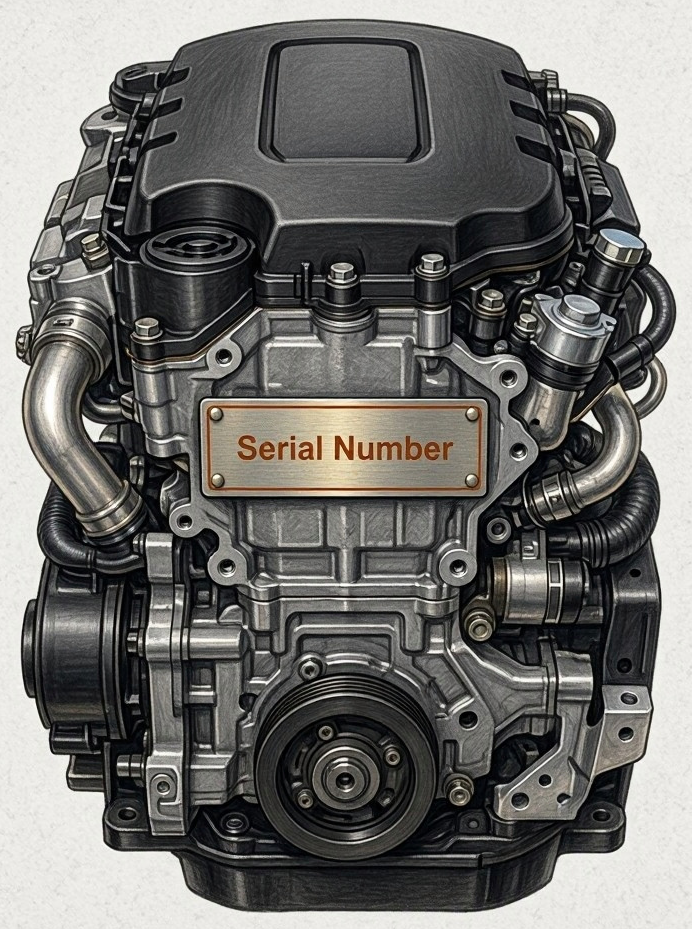
Accurately identifying a Dodge engine through its unique code and serial number is an indispensable practice for any automotive professional or enthusiast. This critical information serves as the foundational key for a multitude of essential tasks, ranging from ordering correct original equipment manufacturer (OEM) replacement parts, verifying a vehicle’s or engine’s historical lineage, and determining the applicability of technical service bulletins (TSBs) or safety recalls, to conducting thorough pre-purchase inspections of used vehicles or standalone replacement engines. Without precise engine identification, discrepancies can lead to incorrect part installations, compatibility issues, and significant diagnostic challenges, underscoring the paramount importance of this decoding guide.
Where to Find the Engine Serial Number and Code on Dodge Engines
| Engine Series / Layout | Physical Stamp Location | Secondary Sticker / Plate |
|---|---|---|
| LA/Magnum V8 (318/5.2L, 360/5.9L) | Generally stamped on a machined pad on the passenger side of the block, either near the oil pan rail (front or middle) or sometimes on the rear bellhousing flange area. | Emissions label on radiator support or under hood, VIN tag on dashboard, or sometimes a paper label on valve cover. |
| HEMI V8 (5.7L EZH, 6.1L ESF, 6.2L Hellcat ESD, 6.4L Apache ESG) | Laser-etched or stamped on a machined pad on the lower driver’s side of the engine block, just above the oil pan rail, often towards the front. Also commonly found on the rear bellhousing flange. | Emissions label under hood (often specifies engine family/displacement), build sheet in glovebox, or VIN decoder information. |
| Pentastar 3.6L V6 | Laser-etched on a machined pad on the lower passenger side of the engine block, above the oil pan rail, often towards the front or middle. Can also be found on the rear bellhousing flange. | Emissions label on hood underside or radiator support, VIN decoder information. |
| Viper 8.0L/8.4L V10 | Stamped on a machined pad on the passenger side of the engine block, typically above the oil pan rail, towards the front or middle. | Vehicle production sheet, specialized build labels, VIN tag, or occasionally a metal plate near the intake manifold. |
| 2.4L World/Tigershark I4 | Stamped or laser-etched on the front or rear side of the block, often towards the lower section near the oil pan rail, or on the transmission bellhousing flange side. | Emissions label under hood or on strut tower, VIN decoder, or engine identification sticker on valve cover or timing cover. |
| Cummins 5.9L & 6.7L Turbo Diesel | A metal dataplate is affixed to the front timing gear housing on the driver’s side. On some models, a laser-etched serial may be on the side of the block above the oil pan. | Cummins dataplate on timing housing is primary source; supplemental vehicle emissions labels. |
Physically locating and interpreting the engine code and serial number on a Dodge engine requires a methodical approach. The primary identification markers are typically stamped or laser-etched onto a flat, machined pad on the lower side skirt of the engine block, often situated just above the oil pan rail. Alternatively, these crucial numbers may be found on the rear bellhousing flange, where the engine mates to the transmission. For Ram trucks equipped with Cummins Turbo Diesel engines (5.9L and 6.7L), the primary engine identification is found on a dedicated Cummins timing housing dataplate, usually located on the front of the engine. When searching for these markings, it is essential to prepare the area by carefully cleaning any accumulated road grime, grease, or corrosion. Use a stiff brush, non-abrasive solvent, and a shop rag. Avoid harsh abrasive tools or chemicals that could damage or obscure the shallow markings. A flashlight and a small inspection mirror can be invaluable for accessing tight spaces. Modern laser-etched numbers can be quite faint, requiring optimal lighting and viewing angles. Always double-check the location and characters to ensure accurate transcription, as these numbers are vital for proper identification.
How to Decode Dodge Engine Codes and Serial Numbers
Dodge engine codes and serial numbers follow a structured logic, though the exact format can vary slightly by engine family and production era. Generally, the initial characters represent the engine model and its fundamental specifications, while a subsequent string of alphanumeric characters denotes a unique sequential production serial number, often incorporating manufacturing plant and date codes.
- Engine Family & Generation Prefix: The initial letters or a combination of letters and numbers often serve as a broad identifier for the engine’s architectural family, internal design series, or primary block material. For instance, “EZH” identifies a specific variant of the 5.7L HEMI V8, while “ESD” denotes the 6.2L Hellcat HEMI.
- Displacement & Cylinder Configuration: Within the prefix or immediately following it, characters may implicitly or explicitly indicate the engine’s displacement (e.g., 5.7L, 3.6L) and its cylinder configuration (e.g., V8, V6, I4). Sometimes, this is more apparent in the marketing designation than the strict engine code itself.
- Fuel System, Aspiration & Valvetrain: Subsequent characters can denote specific powertrain technologies. This might include indicators for gasoline direct injection (GDI), port fuel injection, naturally aspirated versus forced induction (turbocharging or supercharging), and valvetrain designs such as variable valve timing (VVT) or cylinder deactivation systems.
- Power Output, Revision & Emissions Spec: Trailing letters or digits can signify different power output tiers within the same engine family, denote minor technical revisions or engineering updates, or indicate compliance with specific regional emissions standards (e.g., California emissions vs. federal emissions).
- Sequential Serial Number String: Following the engine model code is a unique, sequential serial number. This string typically includes digits representing the manufacturing plant, the year of production, and a unique numerical sequence assigned to each engine as it rolls off the assembly line. Some formats may also include a Julian date code for the specific day of manufacture.
Real-World Dodge Engine Code Examples
Understanding the structure of Dodge engine codes becomes clearer when examining specific examples. Below is a character-by-character breakdown of actual codes and serial numbers, illustrating their typical composition and meaning.
- EZH 17A492018:
- EZH: This is the internal engine code for the 5.7L HEMI V8 engine, specifically denoting a variant with Multi-Displacement System (MDS) technology, commonly found in Ram 1500, Dodge Charger, Challenger, and Durango models.
- 17: Indicates the model year of engine production, representing 2017.
- A: Denotes the specific assembly plant where the engine was manufactured. The exact plant code varies internally within Stellantis (formerly FCA).
- 492018: This is the sequential production serial number, uniquely identifying this specific engine built at the designated plant in 2017.
- ESD 19M048291:
- ESD: This is the internal engine code for the 6.2L Supercharged HEMI V8 engine, famously known as the Hellcat engine, used in high-performance Dodge Challenger, Charger, and Durango SRT Hellcat models.
- 19: Indicates the model year of engine production, representing 2019.
- M: Denotes the specific assembly plant responsible for the engine’s manufacture.
- 048291: This is the sequential production serial number, uniquely identifying this particular Hellcat engine.
- 58291044:
- 58291044: This format is characteristic of an older, purely sequential production serial number, often found on pre-Mopar era or early Chrysler/Dodge engines where a distinct engine family prefix might be less formalized or separate. It is a unique identifier, with the digits often encoding the manufacturing plant, year of production (e.g., first few digits could denote year/month, with the remainder being the sequential unit), and the unique production unit. This type of serial is typical for early LA-series V8s or older 2.2/2.5L I4 engines. It would typically be cross-referenced with the vehicle VIN for full context.
- ERB 15C492018:
- ERB: This is an internal engine code for the 3.6L Pentastar V6 engine. Specifically, “ERB” might designate a particular revision or application variant of the Pentastar, often with specific calibrations or hardware differences, used across a wide range of Dodge, Chrysler, and Jeep vehicles.
- 15: Indicates the model year of engine production, representing 2015.
- C: Denotes the specific assembly plant where this particular engine was manufactured.
- 492018: This is the sequential production serial number, uniquely assigned to this 2015 ERB Pentastar V6.
How to Identify Production Year and Manufacturing Plant
Determining the exact manufacturing year, month, and assembly plant for a Dodge engine involves decoding specific characters within the serial number string and cross-referencing with other vehicle data. Many Dodge serial numbers embed a two-digit year code, typically at the beginning of the sequential part (e.g., ’17’ for 2017, ’19’ for 2019). The next character (often a letter) frequently corresponds to the specific manufacturing plant where the engine was assembled. While Mopar does not publicly release a universal decoder for all plant codes, internal service manuals and VIN decoders can often link these characters to a specific facility. For older engines, casting date clocks, which are circular dials cast into the block or cylinder heads, indicate the month and year of the component’s original manufacture. These are typically outside the serial number sequence but can help narrow down the engine’s approximate production window. The vehicle’s 10th VIN character also provides the vehicle model year, which almost always aligns with or immediately follows the engine’s production year. Always cross-reference the engine serial number with the vehicle’s VIN and any available build sheets or under-hood labels for a comprehensive identification.
Common Mistakes When Checking Dodge Engine Numbers
- Confusing Casting Numbers with the Serial Number: A frequent error is mistaking large, raised characters found on the engine block or cylinder heads as the serial number. These are foundry casting numbers, which identify the specific part design for manufacturing purposes. The actual engine serial number is always found on a flat, machined surface, either stamped into the metal with individual character dies or laser-etched, never raised.
- Corrosion, Paint, and Road Grime Obscuration: Engine identification numbers, especially those laser-etched, can be shallow and easily obscured by years of exposure to the elements, rust, paint overspray, or accumulated grease and dirt. Attempting to read these without proper cleaning often leads to misidentification. Always clean the area thoroughly with a non-abrasive solvent and a brush before attempting to read the numbers.
- Short-Block or Remanufactured Engine Swaps: When an engine has been replaced with a factory short-block, a remanufactured engine, or an unnumbered service block, the serial number on the block may not match the vehicle’s original documentation or VIN. Factory replacement blocks sometimes have unique service part numbers or entirely new serial number sequences, or may even be delivered without a serial number, requiring a transfer of the old serial if legally mandated. Always investigate the engine’s replacement history if a discrepancy exists.
- Misreading Similar Alphanumeric Characters: The stamping fonts used by manufacturers can sometimes make similar-looking characters difficult to distinguish, particularly on older, less precisely stamped blocks. Common confusions include ‘0’ (zero) and ‘O’ (letter O), ‘1’ (one) and ‘I’ (letter I), ‘5’ and ‘S’, or ‘8’ and ‘B’. Careful observation under good lighting is crucial to avoid such errors.