
Since 2015, the 1.0-liter Renault B4D or 1.0 SCe engine has been manufactured in Brazil and India. It is found in low-cost Renault and Dacia models as well as Nissan and Datsun vehicles that fall under the BR10DE index. The motor comes in two versions: the SCe 75 with phase regulators and the SCe 70 without.
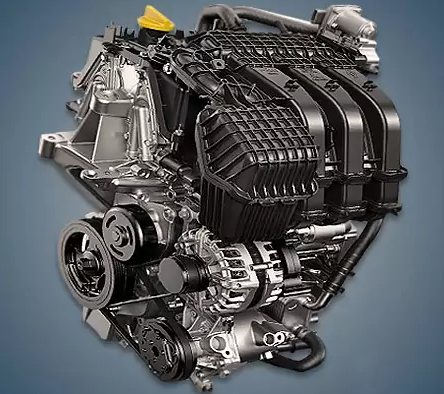
B4A, B4D, H4D, H4M, M4R, M5R, 2TR, V4U, and V4Y are the SCe line.
Specifications
| Production years | since 2015 |
| Displacement, cc | 999 |
| Fuel system | distributed injection |
| Power output, hp | 70 (B4D LS or SCe 70) 73 (B4D HS or SCe 75) |
| Torque output, Nm | 91 (B4D LS or SCe 70) 95 (B4D HS or SCe 75) |
| Cylinder block | aluminum R3 |
| Block head | aluminum 12v |
| Cylinder bore, mm | 71 |
| Piston stroke, mm | 84.1 |
| Compression ratio | 10.5 (B4D LS or SCe 70) 11.0 (B4D HS or SCe 75) |
| Features | DOHC |
| Hydraulic lifters | no |
| Timing drive | chain |
| Phase regulator | no (B4D LS or SCe 70) yes (B4D HS or SCe 75) |
| Turbocharging | no |
| Recommended engine oil | 5W-40 |
| Engine oil capacity, liter | 3.0 |
| Fuel type | petrol |
| Euro standards | EURO 5 (B4D LS or SCe 70) EURO 6 (B4D HS or SCe 75) |
| Fuel consumption, L/100 km (for Dacia Logan 2018) — city — highway — combined |
6.1 4.4 5.0 |
| Engine lifespan, km | ~300 000 |
| Weight, kg | 67 |
The engine was installed on:
- Dacia Logan 2 (L52) in 2016 – 2020;
- Dacia Logan 2 MCV (R52) in 2016 – 2020;
- Dacia Sandero 2 (B52) in 2016 – 2020;
- Dacia Sandero 2 Stepway (B52x) in 2016 – 2020;
- Renault Kiger 1 (HBC) since 2021;
- Renault Kwid 1 (BW) since 2015;
- Renault Triber 1 (RBC) since 2019;
- Datsun redi-Go 1 (CD0) since 2016 (as BR10DE);
- Nissan Magnite 1 (DD0) since 2020 (as BR10DE);
- Nissan Micra 4 (K13) in 2015 – 2017 (as BR10DE).
Disadvantages of the Renault B4D engine
No common issues have been observed on the specialized forums thus far;
Because aluminum engines are prone to overheating, pay close attention to the cooling system;
There are no hydraulic lifters, and the valve clearance needs to be adjusted every 100,000 kilometers. The owners also lament the lack of spare parts, as only consumables are readily accessible.