
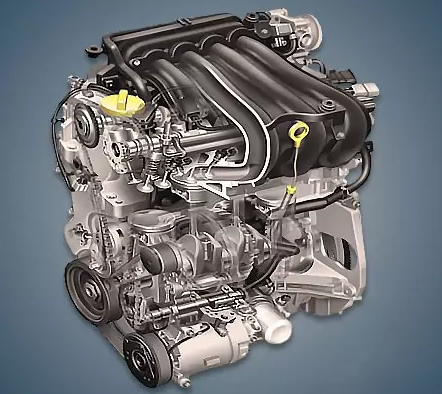
Since 2004, the Franco-Japanese company has assembled and installed the 1.6-liter Renault H4M gasoline engine on its most well-known models, including the Logan, Duster, Kaptur, and Arkana. This engine is basically a version of the popular Nissan HR16DE.
B4A, B4D, H4D, H4M, M4R, M5R, 2TR, V4U, and V4Y are the SCe line.
Originally known as the HR16DE, this motor was created by Nissan for its European Tiida and Note models and debuted at the 2004 Paris Motor Show. The design, which included a timing chain drive, a 4-cylinder in-line aluminum block, and a 16-valve cylinder head without hydraulic lifters, was traditional for Japanese power units of that era. There were two versions of the distributed injection system: the standard one for low-cost models and the two nozzles per cylinder for Megane and Fluence. The throttle valve had an electric drive. The engine’s ability to meet the stringent Euro 5 environmental standards was its main advantage.
Specifications
| Production years | since 2004 |
| Displacement, cc | 1598 |
| Fuel system | injector |
| Power output, hp | 110 – 115 |
| Torque output, Nm | 150 – 155 |
| Cylinder block | aluminum R4 |
| Block head | aluminum 16v |
| Cylinder bore, mm | 78 |
| Piston stroke, mm | 83.6 |
| Compression ratio | 10.7 |
| Hydraulic lifters | no |
| Timing drive | chain |
| Turbocharging | no |
| Recommended engine oil | 5W-30, 5W-40 |
| Engine oil capacity, liter | 4.6 |
| Fuel type | petrol |
| Euro standards | EURO 5 |
| Fuel consumption, L/100 km (for Renault Logan 2017) — city — highway — combined |
8.5 5.6 6.7 |
| Engine lifespan, km | ~300 000 |
| Weight, kg | 98 |
The engine was installed on:
- Renault Arkana 1 (LCM) since 2019;
- Renault Duster 1 (HS) since 2016;
- Renault Fluence 1 (L38) in 2012 – 2017;
- Renault Kaptur 1 (H5) since 2016;
- Renault Logan 2 (L52) since 2016;
- Renault Logan 2 Stepway (L52S) since 2018;
- Renault Megane 3 (X95) in 2013 – 2016; Megane 4 (XFB) since 2016;
- Renault Sandero 2 (B52) since 2016;
- Renault Sandero 2 Stepway (B52S) since 2016;
- Nissan Terrano 3 (D10) since 2016;
- Lada Vesta sedan 2180 since 2019;
- Lada Vesta Cross 2180 since 2019;
- Lada Vesta SW 2181 since 2019;
- Lada Vesta SW Cross 2181 since 2019;
- Lada X-Ray hatchback since 2016;
- Lada X-Ray Cross since 2019.
Disadvantages of the Renault H4M engine
Lubricant consumption is the most well-known issue with this incredibly dependable engine. When the engine mileage reaches 120–150 thousand kilometers, oil consumption may become apparent. In the first scenario, selecting the appropriate oil will be beneficial; in the second, only a significant overhaul will be necessary.
Although the chain is intended to last the entire engine life, it can go up to 150,000 kilometers for adventurous drivers. Although replacement is cheap, it is frequently necessary to replace the phase shifter, which doubles the cost.
Unadjusted valves are the most common cause of loud knocks under the hood. However, a worn motor mount – typically the right one – might be the cause of the noise.
The alternator belt’s constant whistling, the ignition unit relay’s gentleness, and the muffler exhaust pipe gasket’s burnout are common issues with the unit.