
From 2008 to 2018, the 1.4-liter Volkswagen CAVD engine was manufactured in Mladá Boleslav and fitted to the company’s well-known models, including the Golf, Jetta, Tiguan, and Scirocco. The combination of a mechanical supercharger and a traditional turbine sets this power unit apart.
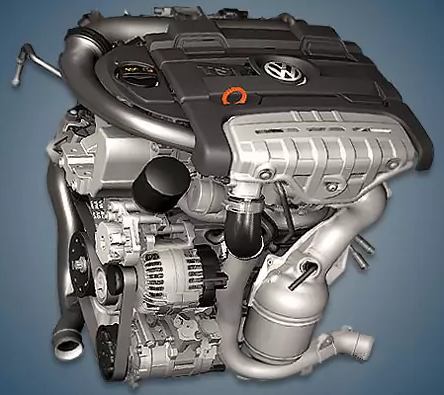
CBZA, CBZB, BMY, BWK, CAVA, CAVD, CAXA, CDGA, and CTHA are all part of the EA111-TSI series.
Specifications
| Production years | 2008-2018 |
| Displacement, cc | 1390 |
| Fuel system | direct injection |
| Power output, hp | 160 |
| Torque output, Nm | 240 |
| Cylinder block | cast iron R4 |
| Block head | aluminum 16v |
| Cylinder bore, mm | 76.5 |
| Piston stroke, mm | 75.6 |
| Compression ratio | 10.0 |
| Features | turbo+compressor |
| Hydraulic lifters | yes |
| Timing drive | chain |
| Phase regulator | on the intake shaft |
| Turbocharging | KKK K03 & Eaton TVS |
| Recommended engine oil | 5W-30 |
| Engine oil capacity, liter | 3.6 |
| Fuel type | petrol |
| Euro standards | EURO 5 |
| Fuel consumption, L/100 km (for VW Scirocco 2012) — city — highway — combined |
8.7 5.4 6.6 |
| Engine lifespan, km | ~220 000 |
| Weight, kg | 130 |
The engine was installed on:
- Volkswagen Beetle 2 (5C) in 2011 – 2016;
- Volkswagen Eos 1 (1F) in 2008 – 2015;
- Volkswagen Golf 5 (1K) in 2008 – 2009; Golf 6 (5K) in 2008 – 2013;
- Volkswagen Jetta 5 (1K) in 2008 – 2010; Jetta 6 (1B) in 2010 – 2018;
- Volkswagen Scirocco 3 (137) in 2008 – 2017;
- Volkswagen Tiguan 1 (5N) in 2011 – 2018.
Disadvantages of the VW CAVD engine
This turbo engine is prone to detonation and has very high fuel quality requirements.
It has carbon buildup on the valves, just like all direct injection units.
The timing chain is characterized by a small resource that is frequently altered up to 100,000 kilometers.
Although burning oil is not as common here, there are still enough grievances regarding oil use.
The intercooler’s frequent leak and the turbine’s wastegate are the motor’s weak points.