
The DAF XF280M is a six-cylinder in-line, four-stroke, water-cooled diesel engine with an intercooled turbocharger and four valves per cylinder. The XF series employs an in-line injection pump, which sets it apart from its competitors. It should be mentioned that DAF developed the injection and intercooler based on the diesel engine from the previous generation.
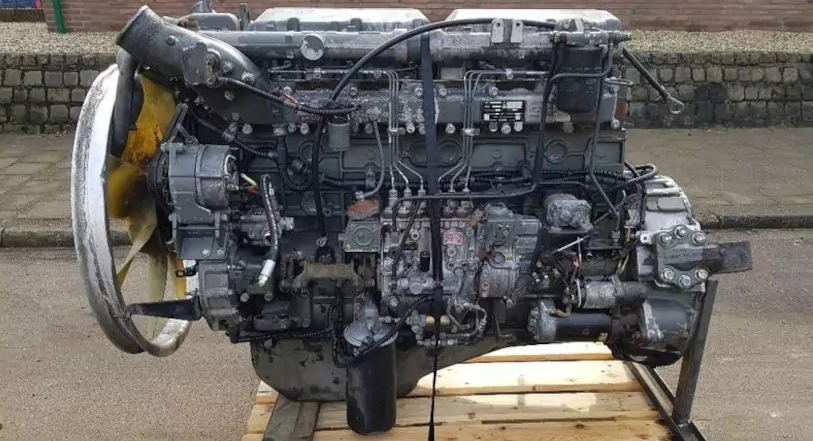
The 380 horsepower engine uses 196 grams of fuel per kWh at 1200 rpm, demonstrating the high fuel efficiency of all DAF engines. Furthermore, when it comes to fuel quality, which is crucial for domestic operating conditions, DAF diesels are very modest. An excellent in-line mechanical high pressure fuel pump is part of the engine.
Specifications
| Manufacturer | DAF |
| Also called | XF 280 M |
| Configuration | 4 Stroke Water Cooled Diesel Engine |
| Number of cylinders | 6 |
| Piston stroke, mm | 158 |
| Cylinder bore, mm | 130 |
| Displacement, cc | 12580 |
| Power output, hp | 381 |
| Torque output, Nm / rpm | 1750 |
| Euro standards | Euro 2 |
| Weight, kg | 1050 |
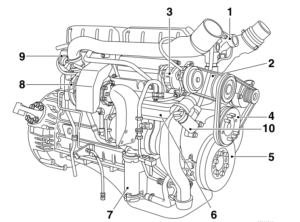
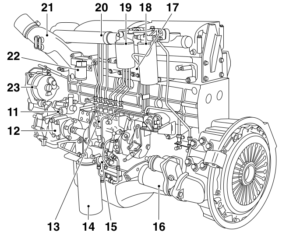
- Thermostat housing
- Water pump
- Air conditioning compressor
- Fan drive
- Vibration damper
- Pneumatic compressor
- Oil cooler
- Turbocharger
- Centrifugal filter
- Oil filler neck
- Steering pump
- Fuel pump drive housing
- Fuel pump
- Oil filter
- Engine brake valve
- Starter
- Engine data plate
- Fuel filter
- Cooling system filter
- Coolant line
- Intake manifold
- Glow relay
- Generator
The DAF XF280M engine has certain operational quirks. Specifically, since the engine is highly thermally loaded and coolant can seep through the head gasket, it is thought that you shouldn’t stop it right away after stopping the vehicle. This implies that it is preferable to let the engine idle for a short while, which will also extend the turbocharger’s operating time. Pay close attention to the engine’s weak points, such as the pump drive and leaking crankshaft oil seals.
These engines are also thought to have issues with the roller pushers of the rods. Therefore, after half a million runs, the roller axis punctures the pusher eyes, causing the roller to skew, jam, and ultimately saw the camshaft cam’s groove. The advance replacement of the pushers is the only viable solution.
Loss of engine power
Inadequate engine thrust can occur for a number of reasons. The primary ones and strategies for getting rid of them:
| Possible Cause | Remedy |
| Inappropriate fuel priming pump performance | Check fuel pump pressure |
| Fuel priming pump banjo bolt strainer clogged | Check for clogged strainer |
| Water in the fuel system | Check water separator |
| Fuel filter silting | Replace the fuel filter with a new one |
| Incorrect or clogged fuel injectors installed | Check the correspondence of the installed injectors. Clean dirty nozzles and refit. |
| Incorrect injection timing or incorrect high pressure fuel pump settings | Check injection timing and / or fuel pump settings. |
| Compression too low in the engine cylinders | Check cylinder compression |
| Air in the fuel system | Bleed fuel system |
| High pressure fuel lines damaged | Check high pressure fuel lines (replace if necessary) |
| Clogged fuel tank breather | Check / clean breather |
| Clogged air filter | Clean or replace air filter element |
| Blocked air supply from turbocharger to intake manifold | Check air duct (clean if necessary) |
| Depressurization of the intake system in the boost area | Check engine intake for leaks |
| Discharge part of turbocharger dirty | Clean the discharge section with a mild cleaning agent or a soft brush. Check inlet side for carbon deposits or other contamination. |
| Blocked exhaust manifold, exhaust muffler, exhaust pipe. Malfunction of the exhaust system. | Check engine exhaust system. Clean if necessary |
| Exhaust gas leaks between exhaust manifold and cylinder head | Check mounting bolts and gaskets |
| Incorrect installation or damage to the wastegate | Check setting and status of wastegate |
| Damaged turbocharger | Replace turbocharger |
| Incorrect setting of valve clearances | Check valve clearances. Adjust if necessary |
| Incorrect DEB installation | Check DEB backlash. Adjust if necessary |
| DEB won’t shutdown | Check DEB function |
| Clogged air filter | Clean with compressed air or replace air filter element |
| Air leaks between intake manifold and cylinder head | Check tightness. If you need to replace the gasket with a new one |
| Malfunction of the cooling system | Check engine cooling system |
| Lubrication failure | Check engine lubrication system |
| Damaged valve springs | Check valve springs. Replace if necessary |
| Excessive piston-to-bore clearance | Check piston-to-cylinder clearance |
| Turning the crankshaft or crankshaft bearing pads | Check crankshaft bearing shells. Eliminate the problem |
| Fuel System Malfunction | Check fuel system |
| Intake system malfunction | Check intake system |
| Mounting the pneumatic compressor, fan drive, air conditioning compressor | Check that the pneumatic compressor, fan drive, air conditioning compressor or other attachments are securely attached to the engine |
| Inappropriate tension or displacement of the V-belt | Check the tension and correct installation of the V-belts |
| Excessive water pump radial play | Check water pump radial play |
| Damaged fan or fan touching the radiator | Check fan and heatsink |
| Damaged or weakened engine mounts | Check the condition of the engine mounts |
| Excessive valve clearance | Adjust valve clearance |
| Damage to the valve train and / or tappets, rocker arms or their axles | Check valve train for damage |
| Damage to vibration damper | Check vibration damper for damage |
| Damage to pistons and / or cylinder liners | Check condition of pistons and cylinder liners |
| Timing gears | Check the timing gears for play and / or damage |
| Loose or destroyed flywheel or connecting bolts | Check condition of flywheel / connecting bolts |
Explanation of marking DAF XF280M
| XF | Extra Forte, heavy truck series (18-36 tons) |
| 280 | Engine power, kW – 280 |
| M | Upgraded |