
From 1999 to 2002, the company assembled the 2.7-liter boxer Porsche M96.22 engine, which was only fitted to redesigned first-generation Boxster convertibles in the rear of the 986. Under its M96.21 index, this power unit underwent a 3.2-liter modification.
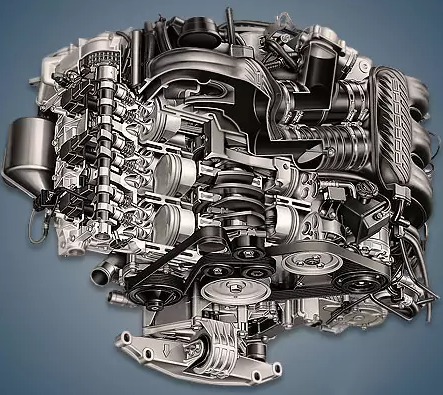
M96-line engines: M96.20, M96.22, and M96.26.
Specifications
| Production years | 1999-2002 |
| Displacement, cc | 2687 |
| Fuel system | distributed injection |
| Power output, hp | 220 |
| Torque output, Nm | 260 |
| Cylinder block | aluminum H6 |
| Block head | aluminum 24v |
| Cylinder bore, mm | 85.5 |
| Piston stroke, mm | 78 |
| Compression ratio | 11.0 |
| Features | no |
| Hydraulic lifters | yes |
| Timing drive | chain |
| Phase regulator | VarioCam |
| Turbocharging | no |
| Recommended engine oil | 5W-40 |
| Engine oil capacity, liter | 8.7 |
| Fuel type | petrol |
| Euro standards | EURO 3 |
| Fuel consumption, L/100 km (for Porsche Boxster S 2001) — city — highway — combined |
14.3 7.4 9.9 |
| Engine lifespan, km | ~220 000 |
| Weight, kg | 182 |
The engine was installed on:
- Porsche Boxster 1 (986) in 1999 – 2002.
Disadvantages of the Porsche M96.22 engine
The intermediate shaft bearing is the most well-known issue with these units;
Additionally, these engines require a lot of lubrication, and liner rotation is a common occurrence;
Even after 150,000 kilometers, the timing chain drive frequently needs to be replaced;
A weak pump, reservoir, and cooling system as a whole are among the engine’s weak points;
It’s best to avoid overdoing it on the track because there isn’t a dry sump lubrication system.