
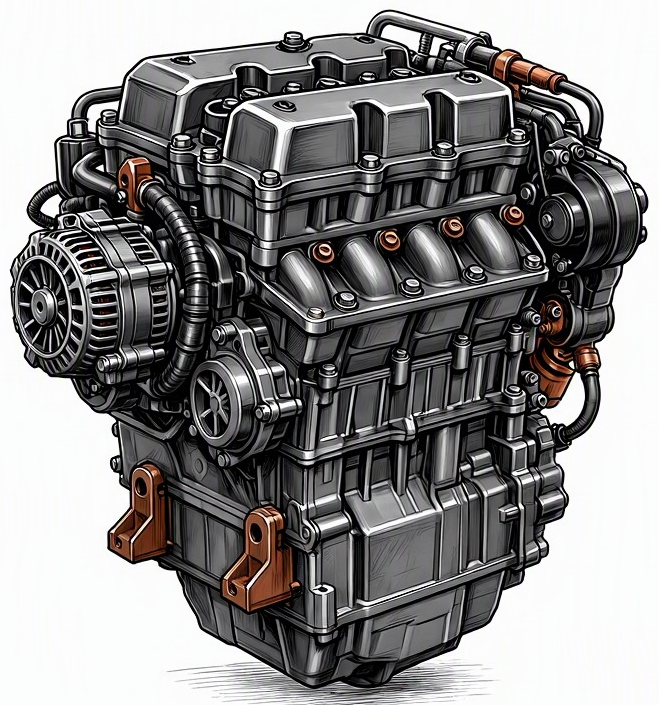
Problem Overview & Engine Systems
Piston crown thermal cracking is a critical engine malfunction characterized by the initiation and propagation of cracks within the material of the piston crown. This structural failure typically results from localized thermal stress exceeding the fatigue limits of the piston alloy, often exacerbated by mechanical loading. The piston crown is the uppermost surface of the piston, forming the lower boundary of the combustion chamber. When thermal cracking occurs, the integrity of this crucial component is compromised, leading to a direct breach in the combustion chamber sealing.
This malfunction primarily affects components within the Cylinder Block Assembly, specifically the Piston itself. Its presence directly impacts the functionality of the Combustion System, leading to a loss of combustion efficiency and increased blow-by. Indirectly, it can affect the Lubrication System through increased oil consumption and potential contamination, and the Exhaust System due to unburnt fuel or oil entering the catalytic converter. Furthermore, thermal cracking is often a symptom of underlying issues within the Fuel Injection System, the Ignition System, or the Turbocharger/Supercharger System, all of which contribute to the thermal and pressure environment within the combustion chamber.
Common Symptoms
- Primary Signs:
-
Illumination of the Check Engine Light (CEL), frequently accompanied by specific Diagnostic Trouble Codes (DTCs) related to misfires (e.g., P030X for a specific cylinder misfire, or P0300 for random/multiple cylinder misfire).
-
A distinctive knocking, rattling, or slapping noise originating from the engine, particularly noticeable under load or during acceleration, indicative of severe blow-by or potential piston component contact.
-
Abnormal exhaust smoke coloration: commonly blue smoke (indicating oil burning due to increased blow-by and oil consumption), or black smoke (signaling incomplete combustion due to misfires or rich conditions from damaged combustion). In severe cases, white smoke may indicate coolant contamination if head gasket failure accompanies piston damage.
-
Noticeable increase in engine oil consumption, requiring frequent top-ups.
-
- Engine Behavior Changes:
-
Significant loss of engine power and reduced acceleration capability.
-
Rough engine running and noticeable vibrations, especially at idle or under load, due to compromised combustion in one or more cylinders.
-
Intermittent or constant misfires, particularly evident during cold starts, acceleration, or high-load conditions.
-
Fluctuating or unstable idle speed.
-
Hesitation or stalling during deceleration or when coming to a stop.
-
Difficulty starting the engine, or complete failure to start in severe cases where compression is critically low.
-
Root Causes & Failure Mechanisms
- Detonation or Pre-ignition: This is the most prevalent cause. Detonation (uncontrolled, spontaneous combustion of the end-gas) and pre-ignition (ignition of the air-fuel mixture prior to the timed spark event) generate extreme pressure waves and localized thermal spikes that vastly exceed the piston’s design limits. These events create intense thermal shock and mechanical stress concentrations, initiating micro-cracks that propagate over time.
- Sustained Lean Fuel Mixture: An inadequate fuel-to-air ratio reduces the crucial cooling effect that fuel evaporation provides within the combustion chamber. This leads to significantly elevated combustion temperatures, increasing thermal stress on the piston crown. Causes include faulty fuel injectors, low fuel pressure, vacuum leaks, or an improperly calibrated engine control unit (ECU).
- Faulty Fuel Injectors: Clogged, leaking, or improperly atomizing injectors can lead to localized hot spots on the piston crown due to uneven fuel distribution, washing away the protective oil film, or creating a lean condition in specific areas. A “trickling” injector can create particularly damaging hot spots.
- Excessive Boost Pressure or Over-tuning: Aggressive aftermarket ECU tunes that dramatically increase boost pressure or alter ignition timing and fuel mapping without adequate consideration for thermal management can push combustion pressures and temperatures beyond the piston’s fatigue threshold, accelerating thermal cracking.
- Overadvanced Ignition Timing: If ignition occurs too early in the compression stroke, the piston is subjected to extreme pressure and heat for a longer duration, increasing the thermal and mechanical load. This can be caused by faulty sensors, an incorrectly programmed ECU, or an aftermarket tune.
- Insufficient Piston Cooling: Blocked or malfunctioning oil spray jets (piston cooling nozzles) that typically spray oil onto the underside of the piston crown are critical for heat dissipation. If these are compromised, the piston retains excessive heat, making it more susceptible to thermal fatigue.
- Material Defects or Manufacturing Flaws: Though less common, inherent defects in the piston material (e.g., inclusions, porosity) or microscopic stress risers from manufacturing processes can serve as nucleation points for crack initiation under normal or slightly elevated operating conditions.
How to Diagnose and Troubleshoot
Diagnosing piston crown thermal cracking requires a systematic approach employing various specialized tools and inspection techniques:
-
OBD-II Scan and DTC Analysis: Connect an OBD-II scanner to retrieve any stored or pending Diagnostic Trouble Codes (DTCs). Misfire codes (P0300, P0301-P0308) are highly indicative. Analyze freeze frame data to determine engine operating conditions (RPM, load, temperature, fuel trims) at the time the fault occurred, which can provide clues about the root cause (e.g., detonation under heavy load).
-
Compression Test (Wet and Dry): Perform a standard compression test on all cylinders. A cylinder with a thermally cracked piston crown will exhibit significantly lower compression pressure compared to healthy cylinders. A subsequent “wet” compression test (introducing a small amount of oil into the cylinder) will show little to no improvement in compression, differentiating it from worn piston rings which typically show improvement with oil.
-
Leak-Down Test: This is a highly effective diagnostic tool. Introduce compressed air into each cylinder at Top Dead Center (TDC) of the compression stroke and monitor the pressure drop. For a thermally cracked piston, air leakage will often be heard escaping into the crankcase via the oil filler cap or dipstick tube, and potentially into the exhaust or intake manifold if the crack extends further or compromises ring lands. A high percentage of leakage (typically >10-15%) indicates a significant internal issue.
-
Borescope/Endoscope Inspection: Remove the spark plug or fuel injector from the suspect cylinder and insert an automotive borescope. Carefully rotate the crankshaft to position the piston at TDC. Visually inspect the piston crown surface for direct evidence of cracking, erosion, pitting, signs of detonation (melted edges or shiny spots), or foreign object damage. This non-invasive inspection can often confirm the diagnosis without engine disassembly.
-
Crankcase Pressure Test (Blow-by Measurement): Excessive blow-by, caused by combustion gases escaping past the compromised piston crown into the crankcase, can be measured using a specialized manometer connected to the dipstick tube or oil filler cap. High crankcase pressure indicates poor cylinder sealing, consistent with piston damage.
-
Fuel System Analysis: If root causes like lean mixture or faulty injectors are suspected, perform fuel pressure tests, check fuel injector resistance and pulse width, and consider having injectors professionally flow-tested and visually inspected for proper spray patterns. Live data analysis of fuel trims can reveal persistent lean conditions.
-
Ignition System Verification: Check spark plug condition (electrode wear, insulator cracks, signs of overheating or detonation), ensure proper spark plug heat range, and test ignition coils for proper operation.
Recommended Repairs and Solutions
Repairing piston crown thermal cracking is a significant undertaking, often requiring extensive engine disassembly. The appropriate solution depends on the severity of the damage and whether secondary components have been affected.
-
Piston Replacement: This is the primary and most direct repair. The affected piston(s) must be replaced. This invariably necessitates removal of the cylinder head, oil pan, and connecting rod caps to access and remove the piston and connecting rod assembly. Often, it’s prudent to replace all pistons if multiple cylinders show signs of stress or if the engine has high mileage, to ensure balanced performance and longevity.
-
Engine Overhaul/Rebuild: If the thermal cracking has led to secondary damage, such as cylinder wall scoring, connecting rod damage, main bearing wear from increased blow-by, or if multiple pistons are affected, a full engine overhaul is typically required. This involves:
-
Disassembly of the entire engine.
-
Cylinder block inspection and potentially honing or boring to oversized dimensions.
-
Replacement of all pistons, piston rings, and connecting rod bearings.
-
Inspection and potential replacement of crankshaft and camshaft bearings.
-
Cylinder head inspection, resurfacing if warped, and valve guide/seal replacement.
-
Replacement of all gaskets and seals.
-
-
Engine Replacement: In cases of severe, widespread damage (e.g., multiple cracked pistons, significant cylinder block damage, or connecting rod failure), or if the cost of an overhaul approaches or exceeds the value of a replacement engine, installing a new or remanufactured long block or complete engine assembly is often the most economically viable and reliable solution.
-
Address Root Causes: Crucially, merely replacing the piston without identifying and rectifying the underlying cause will inevitably lead to a recurrence of the failure. This involves:
-
Diagnosing and repairing fuel system issues (e.g., replacing faulty injectors, fuel pump, or pressure regulator).
-
Correcting ignition timing issues or replacing faulty ignition components.
-
Re-evaluating or removing aggressive aftermarket ECU tunes.
-
Inspecting and potentially replacing turbocharger/supercharger components if over-boosting was a factor.
-
Verifying the proper function of piston cooling jets and oil circulation.
-
Driving Safety Risk Factors: Continued operation of an engine with piston crown thermal cracking is extremely dangerous. It significantly increases the risk of catastrophic engine failure, such as the piston disintegrating, a connecting rod breaking and piercing the engine block (a “thrown rod”), or severe damage to the crankshaft. These failures can result in sudden loss of power, vehicle immobilization, potential fire hazards from leaking fluids onto hot components, and the creation of dangerous road debris. Prompt repair is essential for both vehicle integrity and occupant safety.
Maintenance Recommendations
Preventing piston crown thermal cracking hinges on meticulous adherence to manufacturer specifications and proactive engine management:
-
Strict Adherence to Manufacturer’s Service Intervals: Follow the recommended schedule for oil changes, spark plug replacement, and fuel filter changes. Fresh oil provides optimal lubrication and aids in piston cooling. New spark plugs ensure efficient combustion and reduce the risk of pre-ignition. Clean fuel filters ensure consistent fuel delivery and pressure.
-
Use Correct Fuel Octane Rating: Always utilize the fuel octane specified by the vehicle manufacturer, especially for high-compression, direct-injection, or turbocharged/supercharged engines. Using lower octane fuel than required significantly increases the risk of detonation, the primary cause of thermal cracking.
-
Utilize Correct Engine Oil Viscosity and Specification: Use engine oil that meets or exceeds the manufacturer’s specified viscosity and API/ACEA ratings. High-quality oil ensures efficient lubrication and critical heat transfer from the piston, especially via the piston cooling oil jets. Ensure oil levels are consistently maintained.
-
Monitor and Maintain the Cooling System: While piston cooling is primarily internal (oil-based), a robust engine cooling system helps manage overall engine operating temperatures. Ensure coolant levels are correct, and inspect components like the radiator, water pump, and thermostat for proper function and potential leaks.
-
Avoid Aggressive or Unverified ECU Tuning: Exercise extreme caution with aftermarket performance tunes or modifications that significantly increase boost pressure, alter ignition timing, or lean out the air-fuel mixture. Such modifications can push the engine’s components beyond their design limits if not expertly calibrated and monitored.
-
Regular Inspection of Fuel Injectors: Consider periodic professional inspection, cleaning, or flow testing of fuel injectors, especially on direct-injection engines which are prone to carbon buildup. Ensuring proper fuel atomization and delivery is crucial for preventing lean spots and hot spots on the piston crown.
-
Promptly Address Engine Warning Lights and Abnormal Symptoms: Do not ignore the Check Engine Light, misfires, knocking noises, or changes in exhaust smoke. Early diagnosis and repair of underlying issues (e.g., minor misfires, lean conditions) can prevent minor problems from escalating into piston crown thermal cracking.
-
Use OEM or High-Quality Aftermarket Components: When replacing engine parts, particularly pistons and related assemblies, ensure they meet or exceed original equipment manufacturer (OEM) specifications to guarantee material integrity and design efficacy.
