
Popular concern models like the Golf, Jetta, Passat, and Tiguan were equipped with the 2.0-liter Volkswagen CAWB 2.0 TSI gasoline engine, which was manufactured between 2008 and 2011. This motor’s adaptation for the US market had its own CCTA index.
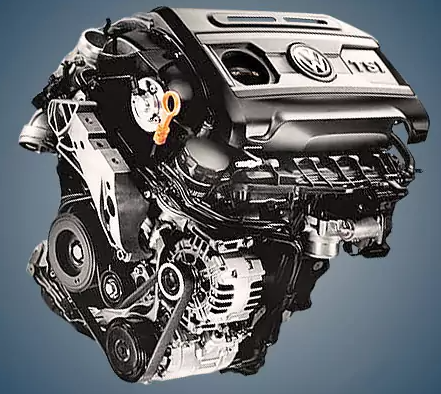
BYT, BZB, CABA, CABB, CABD, CAWA, CAWB, CBFA, CCTA, and CCTB are all part of the EA888 gen1 series.
Specifications
| Production years | 2008-2011 |
| Displacement, cc | 1984 |
| Fuel system | direct injection |
| Power output, hp | 200 |
| Torque output, Nm | 280 |
| Cylinder block | cast iron R4 |
| Block head | aluminum 16v |
| Cylinder bore, mm | 82.5 |
| Piston stroke, mm | 92.8 |
| Compression ratio | 9.6 |
| Features | DOHC |
| Hydraulic lifters | yes |
| Timing drive | chain |
| Phase regulator | on the intake shaft |
| Turbocharging | KKK K03 |
| Recommended engine oil | 5W-30 |
| Engine oil capacity, liter | 4.6 |
| Fuel type | petrol |
| Euro standards | EURO 4 |
| Fuel consumption, L/100 km (for VW Tiguan 2008) — city — highway — combined |
13.7 7.9 10.1 |
| Engine lifespan, km | ~250 000 |
| Weight, kg | 152 |
The engine was installed on:
- Audi A3 2 (8P) in 2008 – 2010;
- Skoda Octavia 2 (1Z) in 2008 – 2010;
- Volkswagen Eos 1 (1F) in 2008 – 2009;
- Volkswagen Golf 5 (1K) in 2008 – 2009;
- Volkswagen Jetta 5 (1K) in 2008 – 2010;
- Volkswagen Passat B6 (3C) in 2008 – 2010;
- Volkswagen Passat CC (35) in 2008 – 2010;
- Volkswagen Scirocco 3 (137) in 2008 – 2009;
- Volkswagen Tiguan 1 (5N) in 2008 – 2011.
Disadvantages of the VW CAWB engine
The timing chain, which frequently extends up to 100,000 kilometers, is the subject of the majority of complaints here;
Large lubricant consumption brought on by a clogged oil separator comes in second;
When pistons are destroyed by detonation, it is helpful to replace them with forged ones;
The engine speed may start to float at idle due to soot on the intake valves;
The wedge of dampers in the intake is another factor contributing to the motor’s unstable operation;
The resource consumption of ignition coils is low, particularly if you don’t frequently replace candles.