
Overview & Design Features
The Cadillac GM V-8 365, often simply referred to as the “365,” represents a significant step in Cadillac’s post-war engineering, serving as a foundational powerplant for the brand’s luxury vehicles during the mid-to-late 1950s. Introduced in 1956, this engine superseded the earlier 331 cubic inch V8, offering increased displacement and performance to match the growing demands for more powerful and feature-rich automobiles. Its robust design and smooth operation underscored Cadillac’s reputation for premium motoring, embodying the era’s emphasis on displacement and horsepower as benchmarks of automotive luxury and prowess.
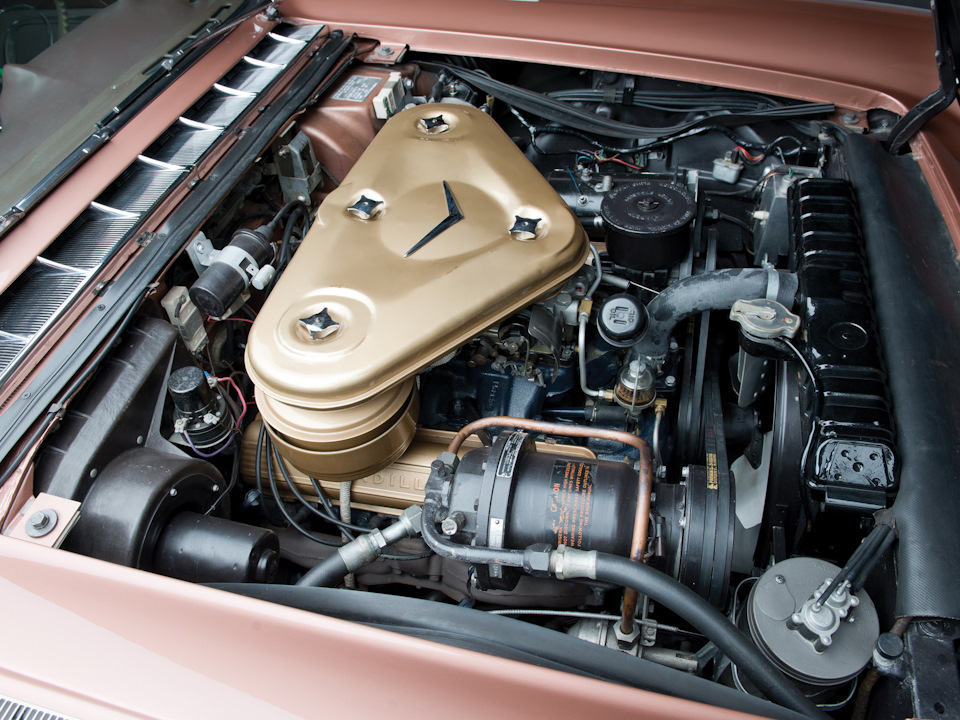
Engineered with durability and refinement in mind, the 365 V-8 features a traditional overhead valve (OHV) pushrod design with a cast iron block and cylinder heads. This architecture was standard for American V8 engines of the period, chosen for its strength, cost-effectiveness, and ease of manufacture. Fuel delivery was managed through a single or dual downdraft carburetor system, typically a Rochester 4GC or Carter AFB, without the use of modern fuel injection technologies. The valvetrain utilized hydraulic lifters, contributing to smoother, quieter operation and reducing the need for frequent valve lash adjustments, a significant refinement for a luxury vehicle engine of its time.
The Cadillac 365 V-8 engine was prominently featured across Cadillac’s entire model lineup from 1956 through 1958. Its primary applications include the luxurious Cadillac Coupe de Ville, Sedan de Ville, and Fleetwood models, as well as the Eldorado Brougham, Eldorado Seville, and Eldorado Biarritz trims. Production years for this specific iteration were confined to these three model years, after which it was superseded by the larger 390 cubic inch Cadillac V-8 engine.
Technical Specifications
| Specification | Value |
|---|---|
| Displacement (cc) | 5981 cc (365 cu in) |
| Max Power (hp (kW) @ RPM) | 300 hp (224 kW) @ 4800 RPM (1957 Standard) |
| Max Torque (Nm (kg*m) @ RPM) | 542 Nm (55.3 kg*m) @ 3100 RPM (1957 Standard) |
| Fuel Type | Gasoline (Premium recommended for higher compression variants) |
| Fuel Consumption (l/100 km) | Refer to manufacturer’s technical documentation |
| Engine Type | Overhead Valve (OHV) V8 |
| Compression Ratio | 10.0:1 (Varied from 9.75:1 to 10.25:1 by year/model) |
| Cylinder Bore (mm) | 101.6 mm |
| Piston Stroke (mm) | 92.08 mm |
| Valvetrain | Pushrod, Hydraulic Lifters |
| Valves per Cylinder | 2 |
| Additional Info | Cast Iron Block & Heads, Downdraft Carburetor (Rochester or Carter) |
Common Problems & Reliability
The Cadillac 365 V-8 is known for its fundamental robustness, characteristic of its era’s heavy-duty engineering. However, specific wear points and potential issues are common with age and prolonged use. One frequent concern involves oil leaks, primarily from the rear main seal, valve covers, and oil pan gaskets, due to the less advanced gasket materials available at the time. Over time, these materials degrade, leading to seepage that can be challenging to fully resolve without extensive engine removal and resealing.
Another common issue is wear in the valvetrain components, particularly the hydraulic lifters and camshaft lobes. Neglecting regular oil changes or using incorrect oil viscosity can accelerate this wear, leading to ticking noises and potential loss of performance. Carbon buildup on the valves and combustion chambers is also prevalent due to the carbureted fuel system and lower octane fuel formulations historically used, which can contribute to pre-ignition and reduced engine efficiency.
Under proper care and maintenance, including regular fluid changes and addressing minor issues promptly, a Cadillac 365 V-8 engine can achieve a service life of 100,000 to 150,000 miles before requiring a major overhaul. Major overhauls typically involve replacing worn bearings, piston rings, regrinding the crankshaft, and servicing cylinder heads and valvetrain components.
Maintenance Tips & Service Schedule
Effective maintenance is crucial for preserving the longevity and performance of the Cadillac 365 V-8. Adherence to a strict service schedule helps mitigate age-related issues. Engine oil and filter changes should occur every 3,000 miles or every 6 months, whichever comes first. A high-quality conventional or semi-synthetic 10W-30 or 10W-40 oil is generally recommended, particularly formulations with appropriate zinc content (ZDDP) to protect the flat-tappet camshaft and lifters.
Spark plugs should be inspected and replaced approximately every 10,000 to 15,000 miles. For carbureted engines, regular carburetor adjustment and cleaning are advisable to maintain optimal fuel-air mixture and prevent carbon buildup. The cooling system requires attention; coolant flushes and refills with a 50/50 mix of approved ethylene glycol antifreeze and distilled water should be performed every 2 years or 30,000 miles to prevent corrosion and maintain cooling efficiency. Ignition system components, including the distributor points, condenser, and ignition wires, should be inspected and replaced as necessary, typically every 15,000 to 20,000 miles, unless an electronic ignition conversion has been performed.
Conclusion
The Cadillac 365 V-8 engine, while a product of its era, remains a fundamentally robust and capable powerplant. For a used vehicle buyer seeking a classic Cadillac from the 1956-1958 period, this engine presents a reliable choice, provided the vehicle has been maintained adequately throughout its life. Its straightforward design allows for relatively accessible repairs and parts availability within the classic car community. Prospective owners should anticipate the need for routine maintenance, attention to oil leak prevention, and potential valvetrain upkeep. With proper care, the 365 V-8 delivers a smooth, powerful, and authentic driving experience, making it a desirable engine for enthusiasts and collectors.