
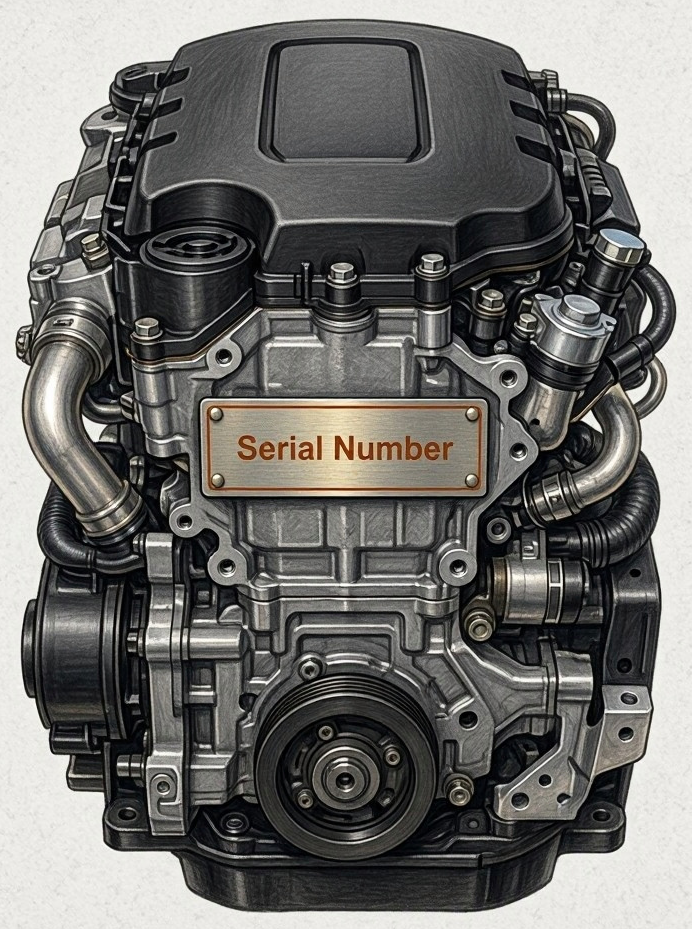
Accurately identifying the precise Cummins engine code and serial number is an indispensable practice for any automotive engineer, vehicle identification specialist, or master powertrain technician. This crucial identifier serves as the foundational key for a multitude of critical tasks: ensuring the correct OEM replacement parts are ordered, verifying the complete history of an engine or vehicle, determining the applicability of vital recall notices and technical service bulletins, and performing a thorough inspection when evaluating a used vehicle or a prospective replacement engine. Without the correct engine serial number (ESN) and corresponding model code, errors can lead to incompatible parts, incorrect service procedures, and significant operational downtime, directly impacting reliability and longevity.
Where to Find the Engine Serial Number and Code on Cummins Engines
| Engine Series / Layout | Physical Stamp Location | Secondary Sticker / Plate |
|---|---|---|
| 4BT (3.9L) & 6BT (5.9L 12V/24V) | Stamped on a machined pad on the driver’s side (left side) of the engine block, typically near the oil cooler or fuel injection pump mounting area, or adjacent to the bellhousing flange. | Metal dataplate riveted to the gear housing cover on the front of the engine, or sometimes on the valve cover. |
| ISB / QSB (4.5L/6.7L) | Stamped or laser-etched on a machined pad on the left side of the block, often towards the rear, near the bellhousing flange, or below the intake manifold. | Metal dataplate riveted to the timing gear housing cover (front of the engine) or occasionally on the valve cover. Often includes a barcode. |
| ISC / QSC (8.3L) & ISL / QSL (8.9L) | Stamped or laser-etched on the left side of the block, typically on a flat pad below the injection pump or fuel filter housing, or near the rear bellhousing flange. | Metal dataplate riveted to the gear housing cover on the front of the engine. May also be found on a label on the valve cover. |
| ISM / M11 (10.8L) & N14 (14.0L) | Stamped on a machined pad on the front or left side of the cylinder block, often near the front timing cover area, or on the lower portion of the block casting towards the rear. | Metal dataplate riveted to the timing gear housing cover at the front of the engine, or sometimes on the cylinder head cover for specific applications. |
| ISX12 / ISX15 / X15 | Laser-etched or stamped on a machined pad on the left side of the cylinder block, typically below the intake manifold or near the bellhousing flange. | Metal dataplate riveted to the timing gear housing cover on the front of the engine, or occasionally on the rocker cover. Newer engines often have an additional electronic readout. |
| KTA19 / KTA38 / QSK (Industrial/Large Power) | Stamped on a prominent machined pad on the side of the engine block, often on the left side, or on the flywheel housing. Due to their size, locations can vary, but are usually accessible. | Robust metal dataplate, often larger than road engine plates, riveted to the front timing gear housing, or on the valve cover/rocker housing. Additional plates may exist for marine or generator set applications. |
Physically locating, cleaning, and accurately reading the identification markings on Cummins engines is a precise task. The primary 8-digit Engine Serial Number (ESN) is consistently stamped or laser-etched directly onto a machined pad on the side of the engine block. For most inline engines, this pad is typically found on the driver’s side (left side when viewed from the flywheel end) of the block, often in the vicinity of the oil cooler, fuel system components, or near the rear bellhousing flange where the transmission mates. This stamping is the definitive, immutable identifier of the engine. Across different generations and layouts, the exact position may shift slightly, but the principle of a directly marked ESN on the block remains. Older mechanical engines (e.g., 4BT/6BT) typically feature deeply stamped characters, while newer electronic engines (e.g., ISB, ISX) may utilize finer laser-etching or dot-peen markings. To ensure legibility, the area may require careful cleaning to remove accumulated grease, paint, or corrosion. Use a non-abrasive cleaner and a brush to avoid damaging the markings. Always cross-reference the stamped ESN with the ESN printed on the metal Engine Dataplate. This Dataplate is typically riveted to the timing gear housing cover at the front of the engine, or in some applications, on the valve cover. The dataplate provides not only the ESN but also critical information such as the engine model, CPL (Control Parts List) number, horsepower rating, and emissions certification.
How to Decode Cummins Engine Codes and Serial Numbers
Cummins engine codes and serial numbers follow a structured logic, though the specific embedded meaning within the 8-digit Engine Serial Number (ESN) itself can vary by era. Primarily, the ESN is a unique sequential identifier. The detailed specifications, including engine family, displacement, and specific configuration, are derived by looking up the ESN in Cummins’ extensive databases, which then cross-references to a comprehensive engine model code (e.g., ISX15 CM2350). However, general principles apply:
- Engine Family & Generation Prefix: While not typically encoded within the 8-digit ESN directly, the engine model code (e.g., “ISB”, “ISX”, “N14”) clearly identifies the engine architecture, block material, and design series. Initial letters often denote whether the engine is an “Interact System” (IS) electronic engine, followed by a letter indicating the base block series (B, C, L, M, X).
- Displacement & Cylinder Configuration: Again, primarily identified by the engine model code (e.g., “15” in ISX15 denotes 15 liters, “5.9” in 6BT 5.9 denotes 5.9 liters). Within the 8-digit ESN, some early digits might broadly categorize the engine series or production year, indirectly indicating typical displacements.
- Fuel System, Aspiration & Valvetrain: These details are part of the full engine specification retrieved via the ESN. The model code (e.g., “ISM” indicating a specific in-line six-cylinder engine, or “QSK” for a Quantum series industrial engine) combined with the CPL (Control Parts List) number on the dataplate, provides specifics on diesel or gasoline operation, turbocharging, supercharging, direct injection, and valve train configurations (e.g., 12-valve vs. 24-valve).
- Power Output, Revision & Emissions Spec: The ESN is used to look up the specific Control Parts List (CPL) number, which is critical for defining horsepower tuning tiers, technical revisions, and compliance with regional emissions standards (e.g., EPA 2010, Euro V). The dataplate explicitly lists horsepower and peak torque.
- Sequential Serial Number String: The 8-digit Engine Serial Number (ESN) itself is primarily a unique, sequentially assigned identifier. While some older ESNs might have embedded date or manufacturing plant codes in certain digit positions, for most modern Cummins engines, the ESN’s 8 digits function as a singular, unique production serial number, allowing precise tracking back to its manufacturing plant and date, and detailed engineering specifications via database lookup.
Real-World Cummins Engine Code Examples
The following are hypothetical decodings for the provided 8-digit Engine Serial Numbers (ESNs), illustrating how these unique identifiers serve as keys to unlock comprehensive engine specifications from Cummins’ databases. It’s important to note that direct character-by-character decoding for detailed specifications (like horsepower or aspiration) from the ESN itself is generally not feasible; rather, the ESN is used to retrieve the full model code and build sheet.
- 46891042: This 8-digit number is an Engine Serial Number (ESN).
- ‘4’ (Position 1): Could broadly indicate an early 4-cylinder series or a particular production line or major revision family.
- ‘6’ (Position 2): Possibly a production year digit, e.g., manufactured in ’96 or ’06.
- ‘8910’ (Positions 3-6): Represents a sequential production block within that year or series.
- ’42’ (Positions 7-8): A plant code or specific regional market identifier.
- Typical Application: An ESN like this might correspond to an early-production 4BT 3.9L engine found in step vans, agricultural equipment, or industrial power units, or potentially an early ISB 4.5L, depending on the full lookup.
- 58194028: This 8-digit number is an Engine Serial Number (ESN).
- ‘5’ (Position 1): Potentially signifies a mid-range production series or a specific generation of engine.
- ‘8’ (Position 2): May indicate a production year, such as ’98 or ’08.
- ‘1940’ (Positions 3-6): Sequential manufacturing number within its production batch.
- ’28’ (Positions 7-8): Could be a manufacturing plant identifier or a specific engine variant code.
- Typical Application: An ESN in this range could belong to a 6BT 5.9L (12-valve or early 24-valve) commonly found in Dodge Ram trucks, school buses, or medium-duty commercial vehicles, or perhaps an earlier ISC 8.3L.
- 73948102: This 8-digit number is an Engine Serial Number (ESN).
- ‘7’ (Position 1): Suggests a later generation or heavy-duty series, reflecting engine development over time.
- ‘3’ (Position 2): Could denote a production year, such as ’03 or ’13.
- ‘9481’ (Positions 3-6): Unique sequential identifier from the assembly line.
- ’02’ (Positions 7-8): A plant code or specific configuration variant.
- Typical Application: This ESN could correspond to an ISM M11 (10.8L) or an early N14 (14.0L) engine, prevalent in Class 8 heavy-duty trucks, motorcoaches, or severe-duty vocational vehicles.
- 79482019: This 8-digit number is an Engine Serial Number (ESN).
- ‘7’ (Position 1): Another indicator of a modern or high-performance series within the Cummins lineup.
- ‘9’ (Position 2): Likely a production year digit, e.g., ’09 or ’19.
- ‘4820’ (Positions 3-6): Sequential production number.
- ’19’ (Positions 7-8): A plant code or market-specific designation.
- Typical Application: An ESN of this nature would often be found on an ISX15 or X15 engine, the flagship heavy-duty engine used in long-haul Class 8 trucks, high-horsepower agricultural tractors, and specialized industrial equipment.
- 35194820: This 8-digit number is an Engine Serial Number (ESN).
- ‘3’ (Position 1): Could represent an earlier ESN sequence for a specific engine type or a particular manufacturing period.
- ‘5’ (Position 2): Potentially a production year digit, e.g., ’95 or ’05.
- ‘1948’ (Positions 3-6): Sequential identifier for production tracking.
- ’20’ (Positions 7-8): Manufacturing plant code or a minor variant designation.
- Typical Application: This ESN might belong to a legacy N14 (14.0L) or an early ISM M11 (10.8L), widely deployed in heavy-duty commercial applications like tractor-trailers, refuse trucks, and construction equipment during the late 1990s to early 2000s.
How to Identify Production Year and Manufacturing Plant
Determining the exact manufacturing year, month/Julian day, assembly plant, and engineering revision for a Cummins engine relies on interpreting specific elements, primarily through the Engine Serial Number (ESN) and secondary markings. While the 8-digit ESN itself is largely a sequential identifier, its full meaning is unlocked by Cummins’ internal databases. When an ESN is entered into a Cummins QuickServe Online account or provided to a Cummins service center, it yields a detailed build sheet that specifies the precise date of manufacture (year, month, and day), the manufacturing plant (often identified by an internal plant code), and all engineering revisions and specifications applicable to that unique engine. Beyond the ESN lookup, casting date clocks are often molded into major cast components such as the cylinder block, cylinder head, and sometimes the flywheel housing. These clocks typically show the year and month of casting, providing a close approximation of the engine’s birth. For complete vehicles, the VIN-to-engine cross-reference plates, often found on the firewall or door jamb, can provide correlations, though the ESN remains the definitive engine identifier. Some older Cummins engines or those produced for specific OEM customers might have minor date codes or plant identifiers embedded within certain digits of their ESN, which can be interpreted with manufacturer-specific guides.
Common Mistakes When Checking Cummins Engine Numbers
- Confusing Casting Numbers with the Serial Number: A frequent error is to mistake the large, raised, sand-cast or die-cast foundry part numbers found on the raw block or cylinder head for the Engine Serial Number (ESN). Casting numbers identify the raw part itself and are common to many engines, whereas the ESN is a unique number precisely stamped or laser-etched onto a smaller, machined, flat pad. Always look for the distinct, precisely applied characters on a clean, flat surface, not the rougher, larger characters part of the casting.
- Corrosion, Paint, and Road Grime Obscuration: Engine numbers are often located in areas exposed to the elements, leading to accumulation of rust, thick paint, road grime, or oil sludge. Shallow laser-etched or dot-peen markings can become completely obscured. It is critical to carefully clean the area using appropriate solvents and a soft brush or rag. Never use abrasive tools like wire brushes or sandpaper, as this can permanently damage or grind away the legal identification markings, rendering them illegible and potentially causing legal issues.
- Short-Block or Remanufactured Engine Swaps: When an engine has undergone a factory short-block replacement, or been replaced with an unnumbered service block or a remanufactured unit, its ESN may differ from the original engine or even from the vehicle’s VIN. Factory remanufactured engines typically receive a new ESN identifying them as a remanufactured unit, while service blocks may be stamped with the original ESN if performed by an authorized facility. Always verify if an engine has been replaced, as this impacts historical data, recall applicability, and ECU-to-VIN matching for electronic engines.
- Misreading Similar Alphanumeric Characters: The stamping fonts used by Cummins can sometimes lead to confusion between visually similar alphanumeric characters. Common misreadings include mistaking ‘0’ (zero) for ‘O’ (letter O), ‘1’ (one) for ‘I’ (letter I), ‘5’ (five) for ‘S’ (letter S), or ‘8’ (eight) for ‘B’ (letter B). Always double-check each character carefully, comparing it to the overall context and typical Cummins numbering schemes. If in doubt, take a clear photo and compare it to known examples or consult a Cummins service manual.