
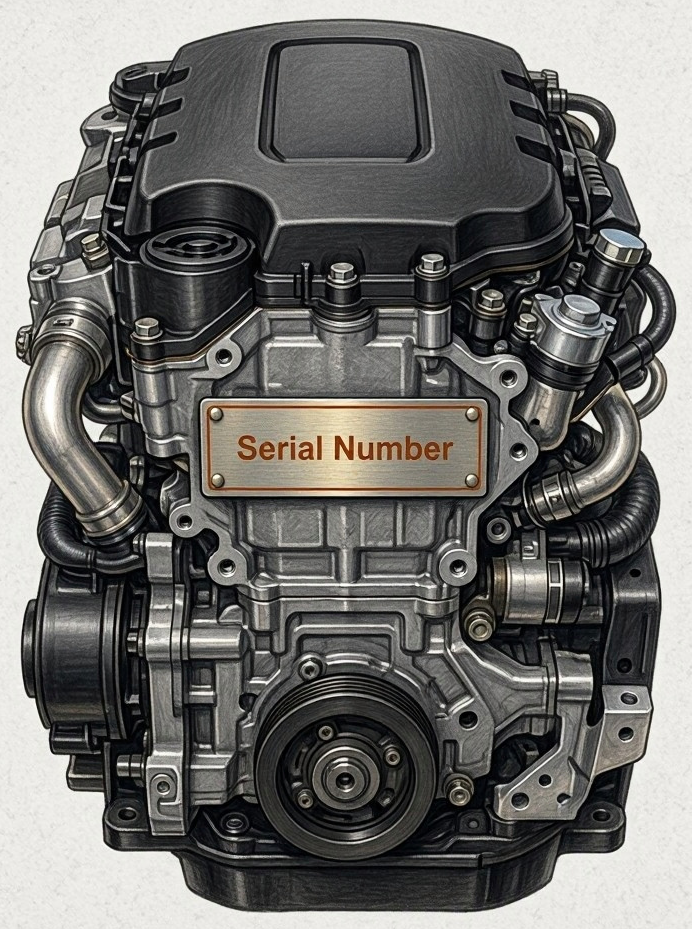
Accurate identification of a Daewoo engine’s specific code and serial number is paramount for any automotive professional, enthusiast, or vehicle owner. This precise information is critical for a multitude of essential tasks: ensuring the procurement of correct Original Equipment Manufacturer (OEM) parts, verifying the vehicle’s documented history, determining the applicability of technical service bulletins (TSBs) and safety recalls, and conducting thorough inspections of used vehicles or replacement engine assemblies. An incorrectly identified engine can lead to incompatible parts, extended repair times, and significant operational complications. This comprehensive guide provides the authoritative methodology for locating, deciphering, and understanding Daewoo engine identification markings across their most prominent engine series.
Where to Find the Engine Serial Number and Code on Daewoo Engines
| Engine Series / Layout | Physical Stamp Location | Secondary Sticker / Plate |
|---|---|---|
| G15MF / A15MF / A15SMS (Family 1, SOHC) | Stamped on a flat machined boss on the front side (often exhaust side on transverse setups) of the engine block, immediately below the cylinder head gasket seam, typically near the transmission bellhousing mating surface or dipstick tube. | Often a printed barcode sticker affixed to the timing belt cover or a metal plate riveted to the valve cover. |
| E-TEC / E-TEC II (A16DMS, F14D3, F16D3, F18D3) (Family 1, DOHC) | Precisely stamped on a flat machined boss on the engine block. For transverse installations, this is generally found on the front or exhaust side, positioned directly beneath the cylinder head gasket joint, close to the gearbox interface. | Adhesive label on the timing belt cover, a stamped plate on the intake manifold, or a sticker on the rocker cover. |
| S-TEC / S-TEC II (F8CV, B10S, B12S, B12D1) (Small-Displacement) | Located on a flat machined boss on the engine block, typically on the exhaust manifold side or front side for transverse mounting, directly below the cylinder head gasket seam, often positioned closer to the transmission bellhousing. | White adhesive label with barcode on the cam cover or air filter housing; older models may have a small metal plate on the cylinder head. |
| X20SED / X22SE (Family II, DOHC) | Stamped into a flat machined boss on the exhaust side of the engine block, directly below the cylinder head gasket line, generally positioned towards the rear of the engine block near the flywheel/transmission. | Printed sticker on the timing chain cover (front) or an adhesive label on the valve cover or intake manifold plenum. |
| D20DT / D27DT Diesel (VM Motori / Daewoo Collaboration) | Laser-etched or dot-peen stamped on a flat machined boss on the engine block, typically on the driver’s side or exhaust side (depending on vehicle orientation), below the cylinder head, often near the fuel pump or injector lines. | Metal data plate riveted to the engine block or rocker cover, or a prominent sticker on the turbocharger inlet pipe or intercooler hose. |
To physically locate the engine serial number and code on Daewoo engines, it is essential to understand the primary stamping convention. Across the vast majority of Daewoo gasoline and diesel engine families, the critical identification marks are stamped or laser-etched directly onto a dedicated, flat machined boss on the engine block. This pad is almost universally found on the front side or the exhaust side of the engine block, precisely positioned right below the cylinder head gasket seam, typically near the gearbox or transmission bellhousing interface. This location makes the stamping often visible from the front or side of the engine bay, though sometimes requiring careful inspection with a flashlight and mirror, particularly in confined spaces.
For transverse engine layouts, common in most Daewoo passenger vehicles, the “front side” generally refers to the side facing the front of the vehicle, or the side opposite the firewall. The “exhaust side” would be where the exhaust manifold connects. The exact position can vary slightly between engine generations and vehicle platforms, but the principle of a machined boss below the head gasket seam remains consistent. Before attempting to read the numbers, the area must be meticulously cleaned. Years of accumulated road grime, oil, grease, and corrosion can completely obscure the markings. Use a wire brush (brass or nylon to avoid damaging the surface), a degreaser, and a clean rag. Avoid abrasive tools that could inadvertently grind away the markings. Once clean, use strong, focused illumination – a bright LED flashlight is ideal – to clearly distinguish the characters, which may be deeply stamped, shallowly laser-etched, or dot-peened.
How to Decode Daewoo Engine Codes and Serial Numbers
Daewoo engine codes, largely inherited from General Motors’ global powertrain divisions (primarily Opel/Vauxhall), follow a structured alphanumeric logic that allows for detailed identification of the engine’s specifications and manufacturing lineage. The appended serial number provides unique production traceability.
- Engine Family & Generation Prefix: The initial letters or combination of letters and numbers typically denote the overarching engine architecture or family (e.g., ‘A’ for Family 1, ‘F’ for later Family 1 revisions, ‘B’ for S-TEC, ‘X’ for Family II, ‘D’ for Diesel). These prefixes often hint at the block material (e.g., cast iron vs. aluminum) or fundamental design generation.
- Displacement & Cylinder Configuration: Following the family prefix, a one or two-digit number almost universally represents the engine’s nominal displacement in liters (e.g., ’15’ for 1.5L, ’16’ for 1.6L, ’20’ for 2.0L). In some older codes, the displacement might be followed by a letter indicating the cylinder count or configuration, though this is less common in later Daewoo codes where the family and displacement are often sufficient to infer layout.
- Fuel System, Aspiration & Valvetrain: Subsequent letters often describe key technical features. ‘S’ or ‘M’ might indicate Single Point Injection (SPI) or Multi-Point Fuel Injection (MPFI). ‘D’ frequently denotes Dual OverHead Camshaft (DOHC) compared to SOHC. ‘T’ or ‘TD’ signifies Turbocharged Diesel engines. More specific characters can sometimes indicate other features like variable valve timing (VVT) or specific emissions control systems.
- Power Output, Revision & Emissions Spec: Trailing letters or digits can signify different power output tiers (e.g., a high-output variant vs. a standard tune), technical revisions to the engine design (e.g., ‘3’ for a third major revision), or compliance with specific regional emissions standards (e.g., Euro 2, Euro 3). These characters often denote minor modifications that don’t fundamentally change the core architecture.
- Sequential Serial Number String: After the engine model code, a string of typically 6 to 9 alphanumeric characters forms the unique production serial number. This sequence ensures traceability of individual engine units, often incorporating manufacturing plant codes, the year or month of production (though less explicit than in VINs), and a purely sequential production count for that specific engine variant at that plant.
Real-World Daewoo Engine Code Examples
Understanding the structure becomes clearer through real-world examples. Here, we break down specific Daewoo engine codes and their associated serial numbers, illustrating their comprehensive identification utility.
- F16D3 482910K:
- F: Denotes the engine belongs to the updated Family 1 (E-TEC II) architecture, derived from Opel/GM.
- 16: Indicates a displacement of 1.6 liters.
- D: Signifies a Dual OverHead Camshaft (DOHC) cylinder head design.
- 3: Represents a specific revision or iteration of the F16D engine, often indicating updates to emission controls, electronic systems, or minor mechanical enhancements.
- 482910K: This is the unique sequential serial number. The ‘K’ might sometimes indicate a manufacturing plant or a specific batch.
- Typical Applications: Daewoo Lacetti, Daewoo Nubira (J200), Daewoo Lanos (some markets), Chevrolet Aveo/Kalos (T200/T250) in some regions.
- B12S1 1940283:
- B: Identifies the engine as part of the S-TEC or S-TEC II family, a compact, economical design.
- 12: Indicates a displacement of 1.2 liters.
- S: Denotes a Single OverHead Camshaft (SOHC) cylinder head design.
- 1: Represents a specific revision or update to the B12S engine, often indicating minor improvements.
- 1940283: This is the unique sequential production serial number for this specific engine.
- Typical Applications: Daewoo Matiz (M100/M150), Daewoo Kalos (early models in some markets), Chevrolet Spark/Matiz (M200/M250).
- D20DT 048291:
- D: Clearly identifies this as a Diesel engine from the Daewoo/VM Motori collaboration.
- 20: Indicates a displacement of 2.0 liters.
- DT: Denotes Diesel and Turbocharged.
- 048291: This is the unique sequential serial number for this particular diesel engine. Diesel engine serials sometimes have a different structure due to their specialized manufacturing.
- Typical Applications: Daewoo Captiva, Daewoo Winstorm, Chevrolet Captiva (C100/C140).
- A15SMS 849201B:
- A: Denotes the engine as belonging to the original Family 1 (often referred to as ‘A-series’) architecture, typically an older generation.
- 15: Indicates a displacement of 1.5 liters.
- SM: Often signifies Single-Point Multi-port Injection, an early form of electronic fuel injection. In some contexts, ‘S’ could mean SOHC.
- S: Can specifically denote Single OverHead Camshaft (SOHC), reinforcing the architecture. The combination ‘SMS’ is common for early MPFI SOHC engines.
- 849201B: This is the unique sequential serial number. The ‘B’ could denote a manufacturing plant, a specific production batch, or a regional variant.
- Typical Applications: Daewoo Lanos, Daewoo Nexia, Daewoo Cielo (often replacing G15MF).
How to Identify Production Year and Manufacturing Plant
While Daewoo engine serial numbers themselves rarely contain explicit, easily decodable year/month codes like a vehicle’s VIN, there are several methods to infer production details:
- VIN-to-Engine Cross-Reference: The most reliable method is to cross-reference the engine’s serial number with the vehicle’s Vehicle Identification Number (VIN). The VIN, located on the dashboard, door jamb, or vehicle title, contains the specific model year and manufacturing plant. Official Daewoo (or later Chevrolet/GM Korea) service manuals and parts catalogs often provide tables linking VINs to the range of engine serial numbers installed during specific production periods.
- Casting Date Clocks: Many major engine components, particularly the engine block and cylinder head, feature circular “date clocks” or alphanumeric stamps indicating the casting date. These are typically embossed during the foundry process. A central number denotes the year (e.g., ‘0’ for 2000, ‘5’ for 2005), and an arrow or segment indicates the month. While these provide the component’s manufacturing date, the final engine assembly date would be slightly later.
- External Labels and Tags: Beyond the stamped block number, look for adhesive barcode stickers on the timing cover, valve cover, or intake manifold. These labels often contain more detailed manufacturing information, including a build date (YYYY/MM/DD) and a specific assembly plant code, often in a machine-readable format or beneath the barcode.
- Serial Number Ranges: For extremely high-volume engines, understanding the typical serial number ranges produced per year at specific plants can offer a rough estimate. This requires access to historical production data, usually available only to dealerships or specialized parts suppliers.
The manufacturing plant can sometimes be inferred from the initial characters of the serial number if a specific plant utilizes a dedicated sequence or prefix, though this is not universally applied across all Daewoo engine families. For instance, engines produced in South Korea versus those assembled in other regional plants might have subtly different serial number structures or character usages.
Common Mistakes When Checking Daewoo Engine Numbers
- Confusing Casting Numbers with the Serial Number: A frequent error is misidentifying the large, raised numbers and letters found on various parts of the engine block, cylinder head, or intake manifold as the official engine serial number. These are foundry casting numbers or part numbers, used for component identification during manufacturing. The actual engine serial number is always stamped or laser-etched onto a flat, machined pad, not cast in raised relief. Always look for the smooth, unpainted boss for the definitive ID.
- Corrosion, Paint, and Road Grime Obscuration: Engine numbers are highly susceptible to becoming unreadable due to layers of dirt, oil, grease, rust, or even overzealous repainting during previous repairs. Attempting to read obscured numbers without proper cleaning can lead to misinterpretation. Always clean the area thoroughly with degreaser and a non-abrasive brush before attempting to read. Never use harsh grinding tools that could destroy the identification.
- Short-Block or Remanufactured Engine Swaps: If an engine has been replaced with a factory short-block, a remanufactured unit, or a “crate engine,” the original serial number may no longer be present or might be a service-specific number rather than the original factory serial. Some replacement blocks are supplied un-stamped, requiring the installer to transfer the original number or mark it as a service replacement. This can complicate VIN-to-engine matching and vehicle history verification. Always check service records for details of engine replacement.
- Misreading Similar Alphanumeric Characters: The stamping fonts used on engine blocks can sometimes make similar-looking characters difficult to distinguish. Common confusions include ‘0’ (zero) and ‘O’ (letter O), ‘1’ (one) and ‘I’ (letter I), ‘5’ (five) and ‘S’ (letter S), or ‘8’ (eight) and ‘B’ (letter B). Always double-check by viewing the numbers from different angles with good lighting, and cross-reference with any secondary stickers or documentation if available.