
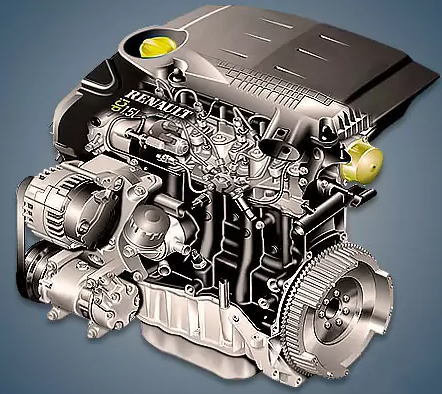
Since 2001, the company has been producing the 1.5-liter Renault K9K or 1.5 dCi diesel engine, which is installed on a large number of company models under the Renault, Nissan, or Dacia brands. The OM607 and OM608 front-wheel drive Mercedes have the same motor under the hood.
K4J, K7J, K4M, K7M, and K9K comprise the K-series.
The second generation of the well-liked Clio model introduced a 1.5-liter diesel engine in 2001. With a Common Rail fuel system, a 4-cylinder cast-iron block, an aluminum 8-valve head without hydraulic lifters, a timing belt drive, a KKK or BorgWarner turbine, and, of course, an intercooler, it was a fairly standard engine for its era.
These engines were equipped with fuel systems from three different manufacturers: until 2009, Delphi was installed on all models up to 100 horsepower, while Siemens was installed on more powerful models. In 2009, Bosch was replaced by Delphi, while Siemens remained but changed its name to Continental. This unit’s low-power versions had a standard BorgWarner KP35 turbocharger, while engine modifications with a BorgWarner BV39 variable geometry turbine produced more than 100 horsepower. According to Euro 3, 4, 5, and 6 environmental standards, there are four generations of such engines.
Specifications
| Production years | since 2001 |
| Displacement, cc | 1461 |
| Fuel system | Common Rail |
| Power output, hp | 64 – 101 (1 gen. 2001 – 2005) 68 – 106 (2 gen. 2005 – 2010) 75 – 110 (3 gen. 2008 – 2016) 75 – 115 (4 gen. since 2012) |
| Torque output, Nm | 160 – 200 (1 gen. 2001 – 2005) 160 – 240 (2 gen. 2005 – 2010) 180 – 260 (3 gen. 2008 – 2016) 200 – 260 (4 gen. since 2012) |
| Cylinder block | cast iron R4 |
| Block head | aluminum 8v |
| Cylinder bore, mm | 76 |
| Piston stroke, mm | 80.5 |
| Compression ratio | 18.8 (1 gen. 2001 – 2005) 15.9 (2 gen. 2005 – 2010) 15.2 (3 gen. 2008 – 2016) 15.5 (4 gen. since 2012) |
| Hydraulic lifters | no |
| Timing drive | belt |
| Turbocharging | yes |
| Recommended engine oil | 5W-30, 5W-40 |
| Engine oil capacity, liter | 4.5 |
| Fuel type | diesel |
| Euro standards | Euro 3 (1 gen. 2001 – 2005) Euro 4 (2 gen. 2005 – 2010) Euro 5 (3 gen. 2008 – 2016) Euro 6 (4 gen. since 2012) |
| Fuel consumption, L/100 km (for Renault Scenic 2011) — city — highway — combined |
5.8 4.4 4.9 |
| Engine lifespan, km | ~400 000 |
| Weight, kg | 145 |
The engine was installed on:
- Dacia Duster 1 (HS) in 2010 – 2018; Duster 2 (HM) since 2018;
- Dacia Dokker 1 (K67) since 2012;
- Dacia Lodgy 1 (J92) since 2012;
- Dacia Logan 1 (L90) in 2005 – 2013; Logan 2 (L52) since 2012;
- Dacia Sandero 1 (B90) in 2009 – 2012; Sandero 2 (B52) since 2012;
- Infiniti Q30 1 (H15) in 2015 – 2018
- Mercedes A-Class W176 in 2013 – 2018; A-Class W177 since 2018;
- Mercedes B-Class W246 in 2013 – 2018; B-Class W247 since 2018;
- Mercedes CLA-Class C117 in 2013 – 2019; CLA-Class C118 since 2019;
- Mercedes GLA-Class X156 in 2014 – 2018;
- Mercedes Citan W415 since 2012;
- Nissan Almera 2 (N16) in 2003 – 2006;
- Nissan Juke 1 (F15) in 2010 – 2019;
- Nissan Micra 3 (K12) in 2005 – 2010; Micra 5 (K14) in 2017 – 2018;
- Nissan Note 1 (E11) in 2006 – 2013; Note 2 (E12) in 2012 – 2020;
- Nissan NV200 1 (M20) since 2009;
- Nissan Tiida 1 (C11) in 2007 – 2008;
- Nissan Qashqai 1 (J10) in 2007 – 2013; Qashqai 2 (J11) since 2013
- Renault Clio 2 (X65) in 2001 – 2005; Clio 3 (X85) in 2005 – 2013; Clio 4 (X98) in 2012 – 2019; Clio 5 (BF) since 2019;
- Renault Captur 1 (J87) in 2013 – 2019; Captur 2 (JB) since 2019;
- Renault Fluence 1 (L38) in 2010 – 2012;
- Renault Duster 1 (HS) since 2010;
- Renault Kangoo 1 (KC) in 2002 – 2008; Kangoo 2 (KW) since 2008;
- Renault Kadjar 1 (HA) since 2015;
- Renault Laguna 3 (X91) in 2007 – 2015;
- Renault Latitude 1 (L70) in 2011 – 2012;
- Renault Modus 1 (J77) in 2004 – 2012;
- Renault Megane 2 (X84) in 2002 – 2009; Megane 3 (X95) in 2008 – 2016; Megane 4 (XFB) since 2016;
- Renault Scenic 2 (J84) in 2003 – 2009; Scenic 3 (J95) in 2009 – 2016; Scenic 4 (JFA) since 2016;
- Renault Symbol 1 (L65) in 2002 – 2008; Symbol 2 (L35) in 2008 – 2012; Symbol 3 (L52) since 2012;
- Renault Talisman 1 (L2M) in 2015 – 2018;
- Renault Twingo 2 (C44) in 2007 – 2014;
- Suzuki Jimny 3 (FJ) in 2004 – 2009.
Disadvantages of the Renault K9K engine
Cranking of the connecting rod bearings is the most well-known issue with these engines. This is particularly common with European engines, where the oil is changed every 30,000 kilometers.
Up until 2009, the Common Rail Delphi system, which is incompatible with airing, a clogged fuel filter, and poor diesel fuel, was installed in the majority of diesel engines. It starts to drive chips and mainly clogs the nozzles for any of these reasons. Additionally, this metal pollen drastically shortens the oil pump’s and turbine’s lifespan.
Although the fuel system made by Siemens or Continental is far more dependable, some piezo injectors are several times more expensive to repair. As a result, we cannot definitively state which company’s equipment is superior.
The EGR valve and particulate filter found in the majority of European diesel vehicles are prone to clogging.
Such motors fail much less frequently as a result of a decrease in the system’s lubricant pressure. The oil filter valve and the oil pump pressure-reducing valve spring are to blame for this.