
Produced since 2005, the 2.0-liter Nissan-Renault M9R, also known as the 2.0 dCi diesel engine, powers popular models like the Espace, Koleos, Talisman, Qashqai, and X-trail. Diesel comes in two generations, identified by their respective volumes of 1995 and 1997 cm³.
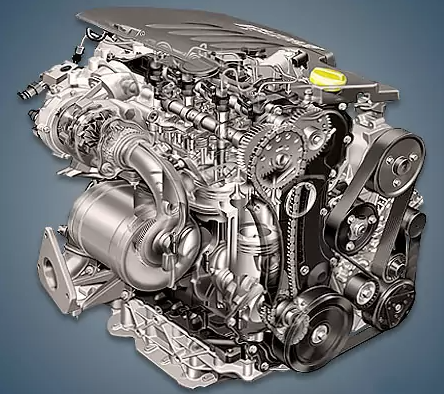
Among the M-series diesels are the M9T.
Renault and Nissan engineers collaborated to develop a 2.0-liter diesel engine that debuted in 2005. This contemporary device has a timing chain drive, a 16-valve head with hydraulic compensators, a cast-iron block, and a Bosch Common Rail fuel system with piezo injectors.
Initially, they provided three variations of these units, each with a different turbine model with varying geometry and boost pressure, as well as variations in power and torque:
- 130 hp / 320 Nm – turbine Garrett GTA1749V at 1.5 bar;
- 150 hp / 340 Nm – turbine Garrett GTA1752V at 1.6 bar;
- 175 hp / 360 Nm – turbine Garrett GTA1752V at 1.8 bar.
They started installing a different GTA1549V variable geometry turbocharger in 2007. For Trafic, Primastar, and Vivaro minibuses with a standard Garrett GT1549S turbine, such a power unit was modified to produce 90–115 horsepower.
A variable displacement oil pump and a Start-Stop system were added to the motor in 2011. Additionally, the company released the second generation of these engines in 2018; they can be easily identified by their different cylinder block, which measures 1997 cm³ rather than 1995 cm³.
The engine was mounted on:
- Renault Espace 4 (J81) in 2006 – 2014; Espace 5 (JFC) since 2018;
- Renault Koleos 1 (HY) in 2008- 2015; Koleos 2 (HC) since 2017;
- Renault Laguna 2 (X74) in 2005 – 2007; Laguna 3 (X91) in 2007 – 2015;
- Renault Latitude 1 (L70) in 2010 – 2015;
- Renault Talisman 1 (L2M) since 2018;
- Renault Megane 2 (X84) in 2005 – 2009; Megane 3 (X95) in 2009 – 2016;
- Renault Scenic 2 (J84) in 2006 – 2009; Scenic 3 (J95) in 2009 – 2016;
- Renault Trafic 2 (X83) in 2006 – 2014; Trafic 3 (X82) since 2019;
- Renault Vel Satis 1 (B73) in 2005 – 2009;
- Nissan Qashqai 1 (J10) in 2006 – 2013;
- Nissan Primastar 1 (X83) in 2006 – 2014;
- Nissan X-Trail 2 (T31) in 2007 – 2014; X-Trail 3 (T32) in 2016 – 2018;
- Opel Vivaro A (X83) in 2006 – 2014.
Specifications
| Production years | since 2005 |
| Displacement, cc | 1995 (1 gen. & minibus version) 1997 (2 gen.) |
| Fuel system | Common Rail |
| Power output, hp | 130 – 180 (1 gen.) 160 – 200 (2 gen.) 90 – 115 (minibus version) |
| Torque output, Nm | 320 – 400 (1 gen.) 360 – 400 (2 gen.) 240 – 290 (minibus version) |
| Cylinder block | cast iron R4 |
| Block head | aluminum 16v |
| Cylinder bore, mm | 84 (1 gen. & minibus version) 85 (2 gen.) |
| Piston stroke, mm | 90 (1 gen. & minibus version) 88 (2 gen.) |
| Compression ratio | 15.6 (1 gen. & minibus version) 15.1 (2 gen.) |
| Hydraulic lifters | yes |
| Timing drive | chain |
| Turbocharging | yes |
| Recommended engine oil | 5W-30, 5W-40 |
| Engine oil capacity, liter | 7.0 (1 gen. & minibus version) 7.8 (2 gen.) |
| Fuel type | diesel |
| Euro standards | EURO 4/5/6 (1 gen. & minibus version) EURO 6d-TEMP (2 gen.) |
| Fuel consumption, L/100 km (for Renault Laguna 2010) — city — highway — combined |
7.4 4.9 5.8 |
| Engine lifespan, km | ~500 000 |
| Weight, kg | 182 |
Disadvantages of the Renault M9R engine
The primary issues here are caused by unreliable fuel pressure regulators, but Bosch piezo injectors are demanding on the quality of diesel fuel and have poor repairability. They should be the first to be investigated for the reason behind a poor start or floating speed.
The timing chain was created in collaboration with Nissan engineers for this power unit. There are wildly divergent views on his resource on the forums: some claim to have driven 400,000 km on their home circuit, while others claim to have needed a replacement for 150,000 km.
Although all of these diesel engines have dependable Garrett turbines, boost errors frequently occur. Usually, the boost sensor, the vacuum system, or the system that modifies the turbocharger’s geometry just wedges in this situation.
This intricate throttle assembly has an integrated EGR valve and an electronic actuator. This design prefers to jam at the worst possible time and is terrified of pollution.
Although it is not as severe as it is on other engines made by the company, the issue with turning the liners, which is typical of all contemporary Renault diesel engines, has not been resolved in this unit either.
Additionally, the crankshaft pulley damper is frequently damaged, the particulate filter clogs easily, nozzles adhere to the block head, and the oil separator is comparatively weak.