
In 1994, the company’s racing division debuted the 2.0-liter 16-valve Renault F7R engine as a sports engine. However, it was also installed in civil modifications, such as the top versions of the original Megane.
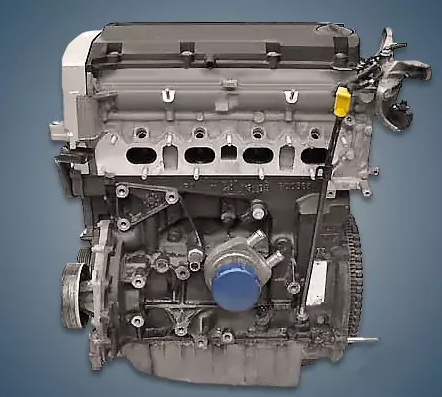
F3P, F4P, F7P, F2R, F3R, F4R, F4Rt, F5R, and F7R are all part of the F-series.
The engineers squandered the 1.8-liter F7P engine by upgrading it to 2 liters after they had run out of options. Additionally, they preserved the donor’s riding characteristics by increasing both the piston’s diameter and stroke.
These units are comparable in every other way. Thus, we have an advanced intake manifold, a timing belt drive, hydraulic lifters, an aluminum 16-valve head, an X-shaped lightweight piston, and a cast-iron block.
Its own oil cooler, control unit, larger valves, a two-liter 4-2-1 spider, a different exhaust, and other minor details are the differences.
The engine was mounted on:
- Renault Clio 1 (X57) in 1994 – 1997;
- Renault Megane 1 (X64) in 1995 – 1999.
Specifications
| Production years | 1994-2001 |
| Displacement, cc | 1998 |
| Fuel system | injector |
| Power output, hp | 145 – 150 |
| Torque output, Nm | 175 – 185 |
| Cylinder block | cast iron R4 |
| Block head | aluminum 16v |
| Cylinder bore, mm | 82.7 |
| Piston stroke, mm | 93 |
| Compression ratio | 9.8 |
| Hydraulic lifters | yes |
| Timing drive | belt |
| Turbocharging | no |
| Fuel type | petrol |
| Euro standards | EURO 2 |
| Engine lifespan, km | ~300 000 |
| Weight, kg | 150 |
Disadvantages of the Renault F7R engine
Engine tripping is mostly caused by unreliable ignition coils. Additionally, because they are constructed in a single module, a block of four will need to be completely replaced if one breaks down.
The crankshaft position sensor should be checked first if the car stalls while moving; this is usually the cause.
The failure of the MAP sensor or serious throttle contamination are typically linked to unstable motor operation.
Oil leaks are this power unit’s weak point; they frequently seep through the crankshaft oil seal.