
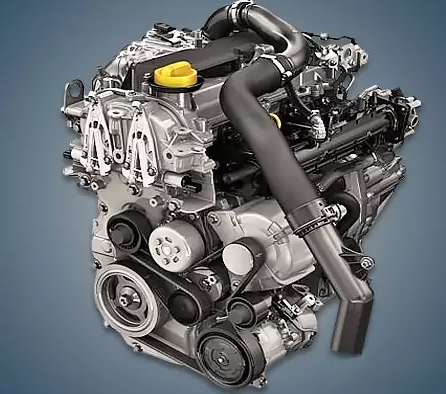
From 2012 to 2019, the company assembled and installed the 1.2-liter turbo engine Renault H5Ft or 1.2 TCe on popular models like the Clio, Megane, Scenic, Kadjar, and Kangoo. On Nissan cars, this power unit is referred to as HRA2DDT or HR12DDT.
The engines in the TCe line are H4Bt, H4Dt, H5Dt, D4Ft, H5Ft, H5Ht, H4Jt, M5Mt, M5Pt, and F4Rt.
A new 1.2 tce turbo unit made its debut on the third-generation Megane and Scenic in 2012. This four-cylinder, all-aluminum engine has a 16-valve cylinder head without hydraulic lifters, a timing chain drive, direct fuel injection, phase shifters on both shafts, a fast-acting turbine with an intercooler, and a variable displacement oil pump. All internal surfaces were coated with an anti-friction material to lessen friction.
Renault vehicles have three distinct engine modifications: TCe 115, TCe 120, and TCe 130.
Specifications
| Production years | 2012-2019 |
| Displacement, cc | 1197 |
| Fuel system | direct injection |
| Power output, hp | 114 – 132 |
| Torque output, Nm | 190 – 205 |
| Cylinder block | aluminum R4 |
| Block head | aluminum 16v |
| Cylinder bore, mm | 72.2 |
| Piston stroke, mm | 73.1 |
| Compression ratio | 9.25 – 10 |
| Hydraulic lifters | no |
| Timing drive | chain |
| Phase regulator | yes |
| Turbocharging | yes |
| Recommended engine oil | 5W-30, 5W-40 |
| Engine oil capacity, liter | 5.2 |
| Fuel type | petrol |
| Euro standards | EURO 5/6 |
| Fuel consumption, L/100 km (for Renault Clio 2017) — city — highway — combined |
6.8 4.5 5.4 |
| Engine lifespan, km | ~250 000 |
| Weight, kg | 109 |
The engine was installed on:
- Renault Captur 1 (J87) in 2013 – 2018;
- Renault Clio 4 (X98) in 2013 – 2018;
- Renault Kadjar 1 (HA) in 2015 – 2018;
- Renault Kangoo 2 (KW) in 2013 – 2018;
- Renault Megane 3 (X95) in 2012 – 2016; Megane 4 (XFB) in 2016 – 2018;
- Renault Scenic 3 (J95) in 2012 – 2016; Scenic 4 (JFA) in 2016 – 2017;
- Dacia Duster 1 (HS) in 2013 – 2018; Duster 2 (HM) in 2018 – 2019;
- Dacia Dokker 1 (K67) in 2013 – 2019;
- Dacia Lodgy 1 (J92) in 2012 – 2018.
Disadvantages of the Renault H5Ft engine
Numerous complaints regarding floating engine speeds, poor cold-weather starting, abrupt turbine shutdowns during gradual uphill climbing, and other engine malfunctions were made during the first year of production. One by one, the firmware was released by the manufacturer until everything eventually went back to normal.
Lubricant consumption, which frequently shows up in the first kilometers and occasionally reaches one liter per 1000 kilometers, is the second most common grievance of Renault owners with such an engine. An unsuccessful piston group with faulty oil scraper rings is the cause of this.
The timing chain and phase control system are not the motor’s largest resources. The chain has already covered 100,000 kilometers due to frequent high-speed engine operation. Phase regulators may crack at the same mileage, and replacing them will cost a lot of money.
The intake valves in many direct fuel injection units are overgrown with soot, but this is particularly noticeable here: the engine blunts and occasionally just stalls.
The crankshaft oil seals are the most common source of lubrication leaks in motors. Additionally, this is where the crankcase ventilation pipe’s sealing ring frequently bursts.