
In 1995, the 1.6-liter 8-valve Renault K7M engine was first made available. The engine was initially manufactured in Spain, but in 2004 its assembly was moved to Romania, where it was used as the primary engine for the low-cost Dacia Logan, Sandero, Stepway, and Lodgy models.
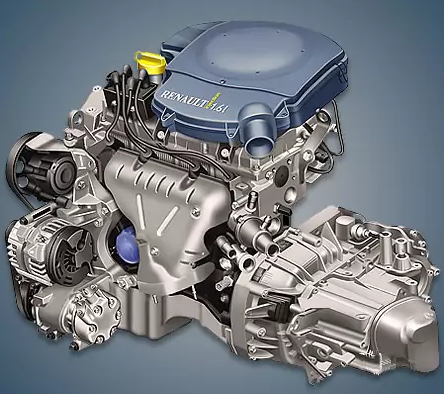
The K-series consists of K4J, K7J, K4M, K7M, and K9K.
The engine with multiport fuel injection, a cast-iron block, an 8-valve cylinder head without hydraulic lifters, a timing belt drive, and a single ignition coil for four cylinders made its debut on the first generation of the Megane model in 1995. Initially, a plant in Valladolid, Spain, assembled every unit in the series.
After the first generation Megane and Scenic were discontinued in 2004, the engine assembly was relocated to Romania, where it served as the primary power source for the low-cost Dacia brand. Such a motor soon started to be actively supplied to Russia, where it was installed on the Lada Largus station wagon in addition to the Renault Logan or Sandero.
Specifications
| Production years | since 1995 |
| Displacement, cc | 1598 |
| Fuel system | injector |
| Power output, hp | 82 – 90 75 |
| Torque output, Nm | 124 – 137 130 |
| Cylinder block | cast iron R4 |
| Block head | aluminum 8v |
| Cylinder bore, mm | 79.5 |
| Piston stroke, mm | 80.5 |
| Compression ratio | 9.5 – 9.7 9.0 |
| Hydraulic lifters | no |
| Timing drive | belt |
| Turbocharging | no |
| Recommended engine oil | 5W-30, 5W-40 |
| Engine oil capacity, liter | 3.6 |
| Fuel type | petrol |
| Euro standards | EURO 3/4/5 |
| Fuel consumption, L/100 km (for Renault Logan 2011) — city — highway — combined |
9.9 5.8 7.2 |
| Engine lifespan, km | ~400 000 |
| Weight, kg | 127 |
The engine was installed on:
- Renault Clio 2 (X65) in 1998 – 2000;
- Renault Dokker 1 (K67) since 2012; Dokker 1 Stepway (K67S) since 2019;
- Renault Logan 1 (L90) in 2005 – 2014; Logan 2 (L52) since 2012; Logan 2 Stepway (L52S) since 2018;
- Renault Megane 1 (X64) in 1995 – 1999;
- Renault Scenic 1 (J64) in 1996 – 2003;
- Renault Sandero 1 (B90) in 2009 – 2014; Sandero 2 (B52) since 2012;
- Renault Sandero 1 Stepway (B90S) in 2009 – 2014; Sandero 2 Stepway (B52S) since 2014;
- Dacia Dokker 1 (K67) since 2012;
- Dacia Lodgy 1 (J92) since 2012;
- Dacia Logan 1 (L90) in 2004 – 2013; Logan 1 MCV (R90) in 2006 – 2013;
- Dacia Sandero 1 (B90) in 2008 – 2012; Sandero 1 Stepway (B90x) in 2009 – 2012;
- Lada Largus station wagon in 2012 – 2015;
- Lada Largus van in 2012 – 2015.
Disadvantages of the Renault K7M engine
The ignition coil cracking is this motor’s most well-known issue. Moisture seeps into the gaps, causing motor tripping and other issues. A new coil that doesn’t have this flaw emerged around 2012.
This power unit’s belt-driven timing drive needs to be replaced every 60,000 kilometers. The valves almost always bend here when it breaks, which is typically caused by a pump wedge or a tensioner roller.
Idle motor speeds frequently float here, and the idle speed controller’s contamination is typically the cause. Clogged nozzles or air leaks through cracks or cracked intake manifold seals could also be the cause.
This series of motors has multiple weak points and is prone to oil and antifreeze leaks. Grease typically seeps through the front crankshaft oil seal or from the heat exchanger. Here, coolant leaks are caused by the thermostat housing, which is frequently cracked.
The low resource of the crankshaft position sensor and the absence of hydraulic compensators, which necessitates adjusting the valve clearances, are further drawbacks of this motor.