
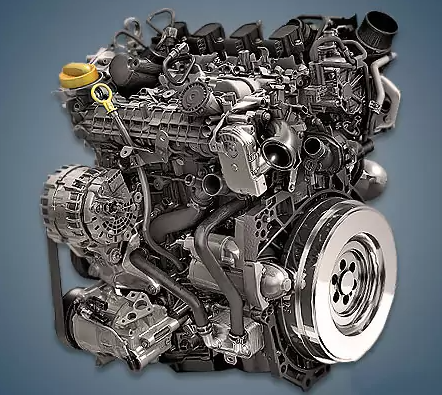
The Renault H5Ht, also known as the 1.3 TCe 150, is a 1.3-liter turbocharged engine that has been manufactured in Spain since 2017. It is found in models like the Arkana, Captur, and Duster, as well as Nissan’s HR13DDT. This motor, which was created in collaboration with Daimler, is referred to as the M282 on its models.
The engines in the TCe line are H4Bt, H4Dt, H5Dt, D4Ft, H5Ft, H5Ht, H4Jt, M5Mt, M5Pt, and F4Rt.
Renault-Nissan and Daimler collaborated to develop a new 1.3-liter turbo engine that debuted at the end of 2017 under the names H5Ht, HR13DDT, and M282, respectively. This includes a Garrett NGT1241MKSZ turbine with an intercooler, an aluminum block with plasma-sprayed steel on the cylinder walls in place of liners, an aluminum 16-valve cylinder head with hydraulic compensators, inlet and outlet phase shifters, a direct injection system, and a timing chain drive.
A variable displacement oil pump, an exhaust manifold built into the block’s head, and piston cooling oil nozzles are some other intriguing features.
Specifications
| Production years | since 2017 |
| Displacement, cc | 1332 |
| Fuel system | direct injection |
| Power output, hp | 115 – 163 |
| Torque output, Nm | 220 – 270 |
| Cylinder block | aluminum R4 |
| Block head | aluminum 16v |
| Cylinder bore, mm | 72.2 |
| Piston stroke, mm | 81.4 |
| Compression ratio | 10.5 |
| Features | no |
| Hydraulic lifters | yes |
| Timing drive | chain |
| Phase regulator | yes |
| Turbocharging | yes |
| Recommended engine oil | 0W-40, 5W-40 |
| Engine oil capacity, liter | 6.0 |
| Fuel type | petrol |
| Euro standards | EURO 5/6 |
| Fuel consumption, L/100 km (for Renault Arkana 2020) — city — highway — combined |
9.1 6.0 7.1 |
| Engine lifespan, km | ~300 000 |
| Weight, kg | 105 |
The engine was installed on:
- Renault Arkana 1 (LCM) since 2019;
- Renault Captur 1 (J87) in 2018 – 2019; Captur 2 (JB) since 2019;
- Renault Clio 5 (BF) since 2019;
- Renault Duster 2 (HM) since 2019;
- Renault Kadjar 1 (HA) since 2018;
- Renault Kaptur 1 (H5) since 2020;
- Renault Koleos 2 (HC) since 2020;
- Renault Megane 4 (XFB) since 2018;
- Renault Scenic 4 (JFA) in 2017 – 2022;
- Renault Talisman 1 (L2M) since 2019.
Disadvantages of the Renault H5Ht engine
This turbo engine’s floating speed is the only significant issue. This engine has carbon buildup on the intake valves, just like all direct injection combustion engines. On the other hand, they can be easily cleaned with specialized tools if the issue is not running.
Although the majority of owners of vehicles with this engine do not voice concerns about oil consumption, there are a few instances of this. You must realize that this aluminum block has an open cooling jacket, which increases mileage and the piston gap.
Additionally, there are complaints on the network regarding adsorber valve failure, spark plug and ignition coil wear, and traction loss caused by a flown turbine pipe.