
From 1998 to 2012, the company assembled the 1.9-liter Renault F9Q or 1.9 dCi diesel engine and installed it on models other than its own, including Suzuki, Mitsubishi, and Volvo. Traditionally, the motor is divided into three generations according to the environmental standards Euro 3, Euro 4, and Euro 5.
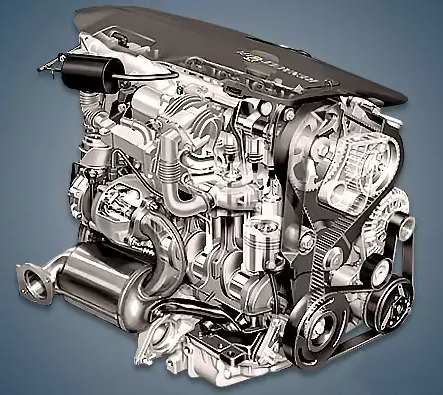
F8M, F8Q, and F9Qt are additional F-series diesels.
A new 1.9-liter diesel engine with a contemporary Bosch Common Rail fuel system made its debut at the redesigned Laguna in 1998. With an in-line cast-iron block, an 8-valve aluminum head devoid of hydraulic lifters, and a timing belt drive, its design was fairly conventional for the time. Every version had Garrett or KKK turbines, and there was no atmospheric modification.
The first engines with a Bosch CP1 fuel system and a traditional turbine produced between 80 and 107 horsepower. A 120 horsepower variant with a variable geometry turbine debuted in 2001. Beginning in 2005, the second generation of engines, which had Common Rail CP3 and an injection pressure of 1600 bar, supported stricter Euro 4 environmental regulations. These engines produced between 110 and 130 horsepower. Up until 2012, third-generation engines with 130 horsepower and 300 Nm that supported Euro 5 were available.
The engine was mounted on:
- Renault Espace 4 (J81) in 2002 – 2006;
- Renault Kangoo 1 (KC) in 2001 – 2005;
- Renault Laguna 1 (X56) in 1998 – 2001; Laguna 2 (X74) in 2001 – 2007;
- Renault Master 2 (X70) in 2000 – 2010;
- Renault Megane 1 (X64) in 2001 – 2003; Megane 2 (X84) in 2002 – 2009; Megane 3 (X95) in 2008 – 2012;
- Renault Scenic 1 (J64) in 2000 – 2003; Scenic 2 (J84) in 2003 – 2009; Scenic 3 (J95) in 2009 – 2011;
- Renault Trafic 2 (X83) in 2001 – 2006;
- Mitsubishi Carisma 1 (DA) in 2000 – 2004; Space Star 1 (DG) in 2001 – 2005;
- Nissan Interstar 2 (X70) in 2003 – 2005; Primastar 1 (X83) in 2002 – 2006; Primera 3 (P12) in 2003 – 2006;
- Opel Vivaro A (X83) in 2001 – 2006;
- Suzuki Grand Vitara 2 (JT) in 2005 – 2015 (as F9QB);
- Volvo S40 I (644) in 2000 – 2004; V40 I (645) in 2000 – 2004 (as D4192T3).
Specifications
| Production years | 1998-2012 |
| Displacement, cc | 1870 |
| Fuel system | Common Rail |
| Power output, hp | 80 – 120 (1 gen.) 110 – 130 (2 gen.) 130 (3 gen.) |
| Torque output, Nm | 180 – 270 (1 gen.) 260 – 300 (2 gen.) 300 (3 gen.) |
| Cylinder block | cast iron R4 |
| Block head | aluminum 8v |
| Cylinder bore, mm | 80 |
| Piston stroke, mm | 93 |
| Compression ratio | 18.3 – 19.0 (1 gen.) 18.3 (2 gen.) 17.0 (3 gen.) |
| Hydraulic lifters | no |
| Timing drive | belt |
| Turbocharging | yes |
| Recommended engine oil | 5W-30, 5W-40 |
| Engine oil capacity, liter | 5.5 |
| Fuel type | diesel |
| Euro standards | EURO 3 (1 gen.) EURO 4 (2 gen.) EURO 5 (3 gen.) |
| Fuel consumption, L/100 km (for Renault Laguna 2003) — city — highway — combined |
7.5 4.5 5.6 |
| Engine lifespan, km | ~500 000 |
| Weight, kg | 177 |
Disadvantages of the F9Q (dCi) engine
This motor’s performance is dependent on the state of the oil pump, which wears out quickly. The liners’ lifespan is significantly shortened by oil starvation—up to 60,000 kilometers.
The booster pump is the only part of the Bosch fuel system that frequently malfunctions; however, the injection pump’s O-rings wear out with high mileage and begin to leak. A clogged fuel pressure regulator can also make your engine extremely dull.
Oil starvation and a clogged air filter are not tolerated by the turbine, which has strict requirements for both the quantity and quality of lubricant. The control’s solenoid valve frequently malfunctions.
In addition to the poor performance of the oil separator, condensate also gathers in the breather. Your diesel engine will go into spacing when it freezes in the winter and oil starts to press into the intake.
Here, you should inspect the drive belt of mounted units as frequently as possible. It falls beneath the timing belt when it breaks, causing its marks to stray and need to be overhauled.
The flow meter frequently malfunctions, the EGR valve clogs and sticks, the crankshaft position sensor malfunctions, and the wiring rots and breaks, among other issues.