
From 2013 to 2018, the company produced a 1.6-liter Renault M5Mt or 1.6 TCe turbo engine that was fitted to the civilian Megane and Talisman models as well as the sports version of the Clio 4 RS. In essence, this device was a variant of the popular Nissan MR16DDT turbo engine.
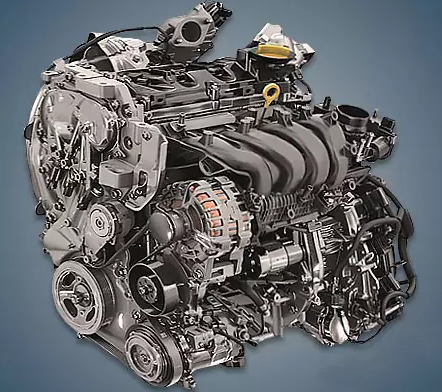
The engines in the TCe line are H4Bt, H4Dt, H5Dt, D4Ft, H5Ft, H5Ht, H4Jt, M5Mt, M5Pt, and F4Rt.
The Clio 4 RS model, a replica of the MR16DDT engine already well-known for the turbo version of the Juke crossover, introduced the company’s new turbo engine with a 1.6 TCe index in 2013. This is a Mitsubishi-made aluminum 4-cylinder, 16-valve power unit with direct fuel injection, timing chain drive, dephasers on both shafts, and a turbine. The R.S. TCe 200 and R.S. Trophy TCe 220 models had 200 and 220 horsepower, respectively.
Two years later, the Espace, Megane, and Talisman models were equipped with civilian versions of the engine. This unit was offered with the following modifications: TCe 150, TCe 165, TCe 200, and TCe 205.
Specifications
| Production years | 2013-2018 |
| Displacement, cc | 1618 |
| Fuel system | direct injection |
| Power output, hp | 150 – 205 (civilian) 200 – 220 (sports) |
| Torque output, Nm | 220 – 280 (civilian) 240 – 280 (sports) |
| Cylinder block | aluminum R4 |
| Block head | aluminum 16v |
| Cylinder bore, mm | 79.7 |
| Piston stroke, mm | 81.1 |
| Compression ratio | 9.5 |
| Hydraulic lifters | no |
| Timing drive | chain |
| Phase regulator | on both shafts |
| Turbocharging | yes |
| Recommended engine oil | 5W-30, 5W-40 |
| Engine oil capacity, liter | 4.8 |
| Fuel type | petrol |
| Euro standards | EURO 5/6 |
| Fuel consumption, L/100 km (for Renault Megane 2017) — city — highway — combined |
7.8 4.9 6.0 |
| Engine lifespan, km | ~300 000 |
| Weight, kg | 137 |
The engine was installed on:
- Renault Clio 4 (X98) in 2013 – 2018;
- Renault Espace 5 (JFC) in 2015 – 2017;
- Renault Kadjar 1 (HA) in 2016 – 2018;
- Renault Megane 4 (XFB) in 2016 – 2018;
- Renault Talisman 1 (L2M) in 2015 – 2018.
Disadvantages of the Renault M5Mt engine
Low temperatures cause this motor to freeze the crankcase gas line, which results in a significant oil leak. Occasionally, it even manages to escape through the dipstick. Traction is lost during a lengthy drive on a frozen highway because the throttle freezes.
The timing chain rapidly expands from frequent abrupt starts, typically by 100,000 kilometers.
Sensor failure is a common problem for owners of vehicles with this engine. The mass air flow sensor and boost pressure are the most common concerns.
Carbon deposits on the intake valves and contamination of the throttle assembly are the primary causes of the motor’s unstable operation, but this is only a characteristic of direct injection engines.