
24-valve, 3.0-liter In 1997, a line of V6 engines known as ESL took the place of the antiquated PRV, leading to the introduction of the Renault L7X engine. Renault models like the Safrane, Espace, Laguna, and Clio V6 were equipped with this engine.
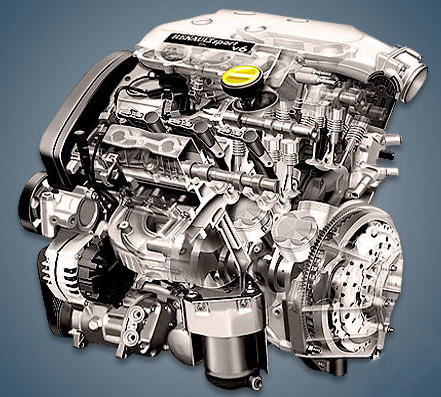
A replacement for the well-liked French V6 type PRV was released in 1997. Renault and Peugeot-Citroen engineers worked together at the same plant in the city of Douvrin to develop and assemble the engine. Unlike its predecessor, which had a camber angle of 90 degrees for V-shaped sixes, the new unit was entirely composed of aluminum.
This time, the engine was only made in a 3.0-liter 24-valve version with 194 horsepower; many other versions were not fenced. A unique modification with a phase regulator at the inlet of 207 and 211 horsepower was made for Peugeot-Citroen models.
The Clio V6, one of the hottest small hatchbacks available, stands out from the crowd. The power unit was positioned in place of the back seats and was enormous for such a small car. Its power was 230 horsepower due to a minor adjustment, and it reached 255 horsepower following a redesign in 2003.
Specifications
| Production years | since 1997 |
| Displacement, cc | 2946 |
| Fuel system | injector |
| Power output, hp | 190 – 194 230 – 255 (Clio) |
| Torque output, Nm | 267 300 (Clio) |
| Cylinder block | aluminum V6 |
| Block head | aluminum 24v |
| Cylinder bore, mm | 87 |
| Piston stroke, mm | 82.6 |
| Compression ratio | 9.6 11.4 (Clio) |
| Hydraulic lifters | yes |
| Timing drive | belt |
| Phase regulator | since 2000 |
| Turbocharging | no |
| Fuel type | petrol |
| Euro standards | EURO 3/4 |
| Engine lifespan, km | ~300 000 |
| Weight, kg | 200 |
Disadvantages of the Renault L7X engine
The engine’s ignition system varies slightly due to its multiple revisions; in one instance, it uses six individual coils, while in another, it uses a triple block with six leads. Nevertheless, regardless of performance, coils are most frequently linked to engine tripping.
Overheating of the motor is frequently caused by air pockets in the cooling system and an unreliable thermostat. Keep a close eye on the instrument readings because high temperatures can quickly cause the control unit to fail.
Small electrical component malfunctions frequently overwhelm owners. This is usually caused by an oxidized terminal or a chip that has fallen out of the connector.