
From 1997 to 2016, the company’s factory assembled the 1.4-liter 8-valve Renault K7J engine, which was fitted to several of its low-cost models, including the Logan, Sandero, and Symbol. The motor was first released in the Turkish Bursa and subsequently in Pitesti, Romania.
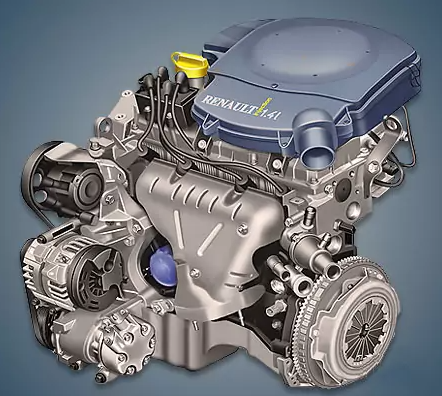
The K-series consists of K4J, K7J, K4M, K7M, and K9K.
The weakest 1.4-liter engine was added to the K-series engine lineup in 1997. It was a straightforward engine with a single coil for four cylinders, a timing belt drive, an eight-valve cylinder head without hydraulic lifters, and a cast-iron block. Distributed fuel injection. A 72-hp gas version was available in several markets in addition to the standard 75-hp modification.
This engine was initially manufactured at the company’s plant in Bursa, Turkey, and later assembled at the Dacia subsidiary in Pitesti, Romania.
The engine was mounted on:
- Renault Clio 2 (X65) in 1998 – 2001;
- Renault Logan 1 (L90) in 2005 – 2016;
- Renault Kangoo 1 (KC) in 1997 – 2001;
- Renault Sandero 1 (B90) in 2009 – 2014;
- Renault Symbol 1 (L65) in 1999 – 2008;
- Dacia Logan 1 (L90) in 2004 – 2008;
- Dacia Logan 1 MCV (R90) in 2006 – 2008;
- Dacia Sandero 1 (B90) in 2008 – 2009.
Specifications
| Production years | 1997-2016 |
| Displacement, cc | 1390 |
| Fuel system | injector |
| Power output, hp | 75 |
| Torque output, Nm | 114 |
| Cylinder block | cast iron R4 |
| Block head | aluminum 8v |
| Cylinder bore, mm | 79.5 |
| Piston stroke, mm | 70 |
| Compression ratio | 9.5 |
| Hydraulic lifters | no |
| Timing drive | belt |
| Phase regulator | no |
| Turbocharging | no |
| Recommended engine oil | 5W-30, 5W-40 |
| Engine oil capacity, liter | 3.8 |
| Fuel type | petrol |
| Euro standards | EURO 2/3/4 |
| Fuel consumption, L/100 km (for Renault Logan 2005) — city — highway — combined |
9.5 5.5 6.8 |
| Engine lifespan, km | ~400 000 |
| Weight, kg | 125 |
Disadvantages of the Renault K7J engine
The K-series 8-valve units had an ineffective ignition coil that frequently cracked until 2012. The engine started operating erratically as soon as moisture seeped into the cracks.
Floating idle is the second most common motor issue. Usually, the throttle assembly, fuel injectors, and idle speed controller are contaminated.
This series’ units frequently experience lubrication leaks from the oil separator, valve cover, and front crankshaft oil seal. Usually, the thermostat housing is covered in antifreeze.
Here, the timing belt travels far beyond the allotted 60,000 kilometers, but it frequently breaks because of a tension roller or pump wedge. The valves nearly always bend as a result of a break.
In this engine, the crankshaft damper pulley and bearings have relatively low resources. Additionally, you should remember to periodically adjust the valves’ thermal clearances.