
Since 2012, the group’s well-known models produced under the Renault, Nissan, and Dacia brands have been equipped with the 0.9-liter 3-cylinder Renault H4Bt or 0.9 TCe 90 engine. Modern Smarts, which are Twingo clones, also have this motor under the hood.
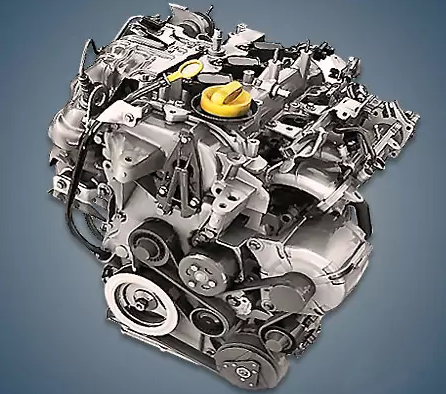
The engines in the TCe line are H4Bt, H4Dt, H5Dt, D4Ft, H5Ft, H5Ht, H4Jt, M5Mt, M5Pt, and F4Rt.
Renault debuted the TCe family’s new 0.9-liter turbocharged engine in 2012. It is a three-cylinder all-aluminum engine with a timing chain drive, Mitsubishi low-response turbocharger, intake camshaft dephaser, 12-valve DOHC cylinder head, and an advanced variable displacement oil pump. All internal surfaces are coated with an anti-friction material to lessen friction.
This power unit has distributed fuel injection because it was initially intended to be installed on less expensive models, such as those made under the Dacia brand. Apart from engines with an index of 400 for Clio, 401 for Twingo, or 410 for Dacia, there is now a more efficient version of the 450 with 110 horsepower and 170 Nm.
Specifications
| Production years | since 2012 |
| Displacement, cc | 898 |
| Fuel system | distributed injection |
| Power output, hp | 90 – 93 |
| Torque output, Nm | 135 – 140 |
| Cylinder block | aluminum R3 |
| Block head | aluminum 12v |
| Cylinder bore, mm | 72.2 |
| Piston stroke, mm | 73.1 |
| Compression ratio | 9.5 |
| Hydraulic lifters | no |
| Timing drive | chain |
| Phase regulator | on the intake manifold |
| Turbocharging | yes |
| Recommended engine oil | 5W-30, 5W-40 |
| Engine oil capacity, liter | 4.1 |
| Fuel type | petrol |
| Euro standards | EURO 5/6 |
| Fuel consumption, L/100 km (for Renault Clio 2014) — city — highway — combined |
5.7 4.1 4.7 |
| Engine lifespan, km | ~200 000 |
| Weight, kg | 86 |
The engine was installed on:
- Renault Captur 1 (J87) in 2018 – 2019;
- Renault Clio 4 (X98) in 2012 – 2020;
- Renault Twingo 3 (C07) in 2014 – 2020;
- Dacia Logan 2 (L52) since 2012;
- Dacia Logan 2 MCV (R52) since 2012;
- Dacia Sandero 2 (B52) since 2012;
- Dacia Sandero 2 Stepway (B52x) since 2012.
Disadvantages of the Renault H4Bt engine
Numerous instances of engine failure after up to 150,000 kilometers have been documented on specialized forums. It just turns the liners after a brief period of oil consumption.
For a run of 100–150 thousand kilometers, a thin timing chain is frequently already stretched. Even earlier, though, the phase regulator might crack here, and replacing it would be very costly.
Due to floating rpm and challenging starting in the winter, there were several engine firmware issues. There are occasionally complaints regarding the oil burner or the oil pump chain’s rapid wear. Additionally, the pulley on the crankshaft is rapidly destroyed when the ribbed belt breaks.