
From 1986 until 2001, the company produced the 2.0-liter 8-valve Renault F3R engine, which was fitted to well-known vehicles like the Laguna, Megane, and Volvo 440, 460, and 480.
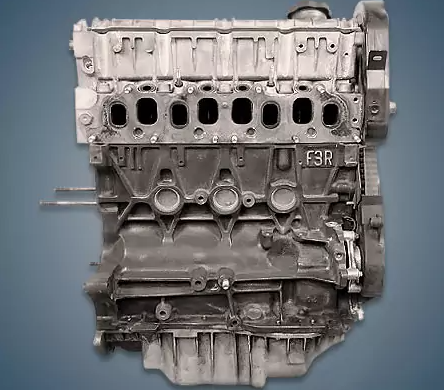
F3P, F4P, F7P, F2R, F3R, F4R, F4Rt, F5R, and F7R are all part of the F-series.
In 1986, the F3R engine was first modified for the US market on the Alliance model. This 95-hp engine, which only lasted a year on the assembly line, was basically an F2R engine with a single injection in place of a carburetor.
The engine’s European version made its debut on the Laguna’s first generation in 1993. With a timing belt drive, an aluminum 8-valve cylinder head without hydraulic lifters, and an in-line cast-iron block for four cylinders, it was a fairly standard unit for the time. The engine for Europe had distributed injection, in contrast to the American modification.
This motor was installed on Volvo vehicles under the B20F index and Moskvich Svyatogor, in addition to a few Renault models. A longitudinally arranged version of the F3R 272 was created for the latter.
The engine was mounted on:
- Renault Espace 3 (J66) in 1996 – 2000;
- Renault Laguna 1 (X56) in 1993 – 2001;
- Renault Megane 1 (X64) in 1995 – 2000;
- Renault Scenic 1 (J64) in 1996 – 1999;
- Volvo 440 in 1993 – 1996 (as B20F);
- Volvo 460 in 1993 – 1996 (as B20F);
- Volvo 480 in 1992 – 1995 (as B20F);
- Moskvich Svyatogor in 1997 – 2001.
Specifications
| Production years | 1986-2001 |
| Displacement, cc | 1998 |
| Fuel system | injector |
| Power output, hp | 109 – 114 (European ver.) 95 (US ver.) |
| Torque output, Nm | 165 – 168 (European ver.) 145 (US ver.) |
| Cylinder block | cast iron R4 |
| Block head | aluminum 8v |
| Cylinder bore, mm | 82.7 |
| Piston stroke, mm | 93 |
| Compression ratio | 9.5 – 9.8 (European ver.) 9.4 (US ver.) |
| Hydraulic lifters | no |
| Timing drive | belt |
| Turbocharging | no |
| Recommended engine oil | 5W-40, 5W-50 |
| Engine oil capacity, liter | 5.5 |
| Fuel type | petrol |
| Euro standards | EURO 2 (European ver.) EURO 1 (US ver.) |
| Fuel consumption, L/100 km (for Renault Laguna 1997) — city — highway — combined |
11.3 6.1 7.7 |
| Engine lifespan, km | ~400 000 |
| Weight, kg | 136 |
Disadvantages of the Renault F3R engine
Here, you must keep a close eye on the cooling system because any overheating could damage the cylinder head. Additionally, every 10,000 kilometers, the gasket will burst. For the same reason, rings lie down, caps tan, and oil consumption manifests.
This unit is well-known for its frequent electrical failures, much like many French motors. In addition to sensors, a system consisting of two ignition coils also frequently malfunctions.
The throttle or idle speed controller contamination is the primary cause of the motor’s unstable operation, but fuel pump malfunctions or filter contamination are also frequently to blame.
The timing belt here is supposed to change every 60,000 kilometers, but if oil gets on it, for instance, it may burst sooner. The valves nearly always bend when it breaks.
This unit’s pillows and attachments are also weak points. There are no hydraulic lifters here, so don’t forget to periodically adjust the valves.