
From 2001 to 2016, the Cleon plant produced the Renault F4Rt 2.0-liter turbo engine, which was installed on charged versions of well-known models like the Laguna, Megane, and Espace. Forced versions of this engine up to 275 horsepower were installed in the Megane RS sports coupe.
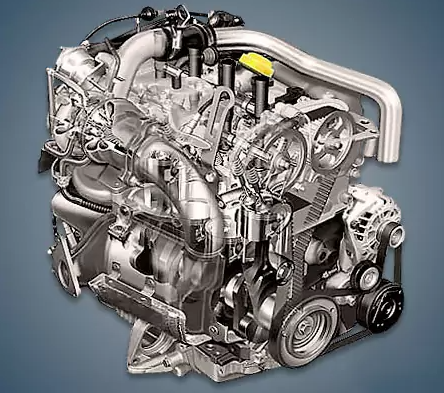
The engines in the TCe line are H4Bt, H4Dt, D4Ft, H5Ft, H5Ht, H4Jt, M5Mt, M5Pt, and F4Rt.
A 2.0-liter turbocharged 16-valve engine made its debut on the Avantime minivan in 2001. Using the well-known atmospheric unit F4R as a model, the designers redesigned the cylinder head, added additional camshafts, added a reinforced connecting rod piston group, eliminated the phase regulator, and, of course, added a turbine—the standard model has a TwinScroll MHI TD04 turbocharger. The timing belt drive and in-line cast-iron four-cylinder block did not change.
Forced versions of this engine were installed in charged versions of the Renault Megan. This turbo engine developed from 225 to 230 horsepower and 300 to 310 Nm of torque on the Megane II RS. The Megane III RS was modified to produce 250, 265, and 275 horsepower and 340 to 360 Nm of torque.
Specifications
| Production years | 2001-2016 |
| Displacement, cc | 1998 |
| Fuel system | injector |
| Power output, hp | 163 – 190 (civilian) 204 – 220 (sports) 225 – 275 (Megane RS) |
| Torque output, Nm | 250 – 300 (civilian) 300 – 340 (sports) 300 – 360 (Megane RS) |
| Cylinder block | cast iron R4 |
| Block head | aluminum 16v |
| Cylinder bore, mm | 82.7 |
| Piston stroke, mm | 93 |
| Compression ratio | 9.3 – 9.8 (civilian) 9.0 (sports) 8.5 – 9.0 (Megane RS) |
| Hydraulic lifters | yes |
| Timing drive | belt |
| Phase regulator | no |
| Turbocharging | yes |
| Recommended engine oil | 5W-30, 5W-40 |
| Engine oil capacity, liter | 5.9 |
| Fuel type | petrol |
| Euro standards | EURO 3/4/5 |
| Fuel consumption, L/100 km (for Renault Megane 2012) — city — highway — combined |
11.5 6.7 8.2 |
| Engine lifespan, km | ~350 000 |
| Weight, kg | 149 |
The engine was installed on:
- Renault Avantime 1 (D66) in 2001 – 2003;
- Renault Espace 4 (J81) in 2002 – 2013;
- Renault Laguna 2 (X74) in 2003 – 2007; Laguna 3 (X91) in 2007 – 2013;
- Renault Megane 2 (X84) in 2004 – 2008; Megane 3 (X95) in 2009 – 2016;
- Renault Scenic 2 (J84) in 2004 – 2006;
- Renault Vel Satis 1 (B73) in 2002 – 2009.
Disadvantages of the Renault F4Rt engine
This engine’s turbine is unreliable and operates normally up to 150,000 kilometers. After that, the rotor frequently exhibits radial play, which causes the lubricant to be forced into the exhaust. Leaks can occasionally ruin it because the oil supply tube’s sealing ring bursts.
A lubricant consumption of roughly one liter per 1000 kilometers is not unusual after 150,000 kilometers of operation. This could be caused by hardened caps or stuck rings in addition to the turbine.
This is a typical French power unit that frequently experiences electrical malfunctions. Ignition coils, a lambda probe, an ECU, and a crankshaft sensor are some of its weak points.
Floating speeds are typically caused by injector or throttle contamination, but they can also be caused by numerous intake pipes not being tight.
Here, lubrication leaks frequently happen from the turbine bypass valve, the oil separator, under the valve cover, or the seals, particularly the crankshaft seals.