
From 2002 to 2014, the company produced the 1.1-liter 12-valve Hyundai G4HD engine, which was only fitted to the Atos Prime and the Getz hatchback with minor modifications prior to restyling. The unit came in two different power versions; the older, 46 kW model was commonly referred to as the G4HD-46.
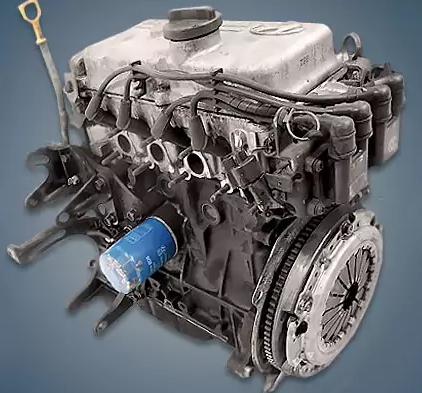
G3HA, G4HA, G4HC, G4HE, G4HD, and G4HG are members of the Epsilon family.
The engine was mounted on:
- Hyundai Atos 1 (MX) in 2003 – 2014;
- Hyundai Getz 1 (TB) in 2002 – 2005.
Specifications
| Production years | 2002-2014 |
| Displacement, cc | 1086 |
| Fuel system | distributed injection |
| Power output, hp | 59 – 62 |
| Torque output, Nm | 89 – 94 |
| Cylinder block | cast iron R4 |
| Block head | aluminum 12v |
| Cylinder bore, mm | 67 |
| Piston stroke, mm | 77 |
| Compression ratio | 9.6 |
| Features | SOHC |
| Hydraulic lifters | no |
| Timing drive | belt |
| Phase regulator | no |
| Turbocharging | no |
| Recommended engine oil | 5W-40 |
| Engine oil capacity, liter | 3.1 |
| Fuel type | petrol |
| Euro standards | EURO 3 |
| Fuel consumption, L/100 km (for Hyundai Getz 2004) — city — highway — combined |
6.9 4.7 5.5 |
| Engine lifespan, km | ~250 000 |
| Weight, kg | 84 |
Disadvantages of the Hyundai G4HD engine
Despite not being a resource, this motor has no structural issues;
The most important thing is to keep an eye on the radiators’ cleanliness because overheating causes the block head to instantly
Because the throttle and idle speed controller are contaminated, engine speed frequently floats;
Here, candles are hardly useful, and the wire insulation is also rapidly degraded;
There are repair dimensions and an overhaul is frequently already necessary after 250 thousand kilometers.