
Since 2017, a variety of rear-wheel drive models, including the Kia Stinger and Genesis sedans, have been equipped with the 2.2-liter Hyundai-Kia D4HC or 2.2 CRDi diesel engine. For vehicles with longitudinal engines, this motor is an adaptation of the D4HB.
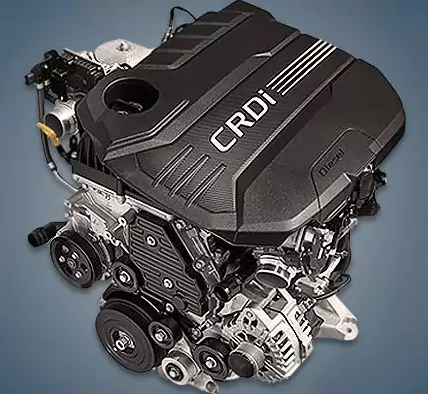
Diesels D4HA, D4HB, D4HD, D4HE, and D4HF are also members of the R family.
The engine was mounted on:
- Genesis G70 1 (IK) since 2017;
- Genesis G80 1 (DH) in 2018 – 2020;
- Kia Stinger 1 (CK) in 2017 – 2020.
Specifications
| Production years | since 2017 |
| Displacement, cc | 2199 |
| Fuel system | Common Rail |
| Power output, hp | 202 |
| Torque output, Nm | 441 |
| Cylinder block | aluminum R4 |
| Block head | aluminum 16v |
| Cylinder bore, mm | 85.4 |
| Piston stroke, mm | 96 |
| Compression ratio | 16.0 |
| Features | intercooler |
| Hydraulic lifters | yes |
| Timing drive | chain |
| Phase regulator | no |
| Turbocharging | Garrett GTD1752VZLKM |
| Recommended engine oil | 5W-30 |
| Engine oil capacity, liter | 6.8 |
| Fuel type | diesel |
| Euro standards | EURO 5 |
| Fuel consumption, L/100 km (for Kia Stinger 2018) — city — highway — combined |
6.9 4.9 5.6 |
| Engine lifespan, km | ~300 000 |
| Weight, kg | 215.7 |
Disadvantages of the Hyundai D4HC engine
Low-quality fuel is not tolerated by this diesel engine, and the high-pressure fuel pump is rapidly worn out;
The pump instantly starts driving chips and dispersing them throughout the fuel system in the event of a breakdown;
Here, the turbine has a long lifespan, but frequently the stem’s geometry shifts;
Here, crankshaft damper pulleys and glow plugs have a limited resource;
This includes the traditional issues with diesel engines that have an EGR valve and a particulate filter.