
Popular concern models like the Terracan, Santa Fe, and Kia Sorento were equipped with the 3.5-liter V6 Hyundai Kia G6CU engine, which was manufactured in South Korea between 1999 and 2007. By its very nature, this power unit is merely a replica of the popular Mitsubishi 6G74 engine.
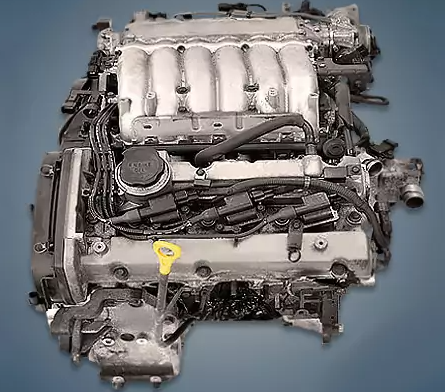
The Sigma family: G6AV (2.5 L); G6AT, G6CT (3.0 L); G6AU, G6CU (3.5 L).
Although the G6AU unit was given a new G6CU index and updated to EURO 3 environmental standards in 1999, it was essentially still a replica of the well-liked Mitsubishi 6G74 gasoline engine. This engine is a straightforward V-twin by design, featuring two 24-valve aluminum DOHC heads with hydraulic compensators and a cast-iron block with a 60° camber angle. This power unit also featured a timing belt drive and distributed fuel injection.
Specifications
| Production years | 1999-2007 |
| Displacement, cc | 3497 |
| Fuel system | distributed injection |
| Power output, hp | 195 – 220 |
| Torque output, Nm | 290 – 315 |
| Cylinder block | cast iron V6 |
| Block head | aluminum 24v |
| Cylinder bore, mm | 93 |
| Piston stroke, mm | 85.8 |
| Compression ratio | 10.0 |
| Hydraulic lifters | yes |
| Timing drive | belt |
| Turbocharging | no |
| Recommended engine oil | 5W-30, 5W-40 |
| Engine oil capacity, liter | 5.5 |
| Fuel type | petrol |
| Euro standards | EURO 3 |
| Fuel consumption, L/100 km (for Kia Sorento 2004) — city — highway — combined |
17.6 9.7 12.6 |
| Engine lifespan, km | ~350 000 |
| Weight, kg | 199 |
The engine was installed on:
- Hyundai Equus 1 (LZ) in 1999 – 2003;
- Hyundai Grandeur 3 (XG) in 2002 – 2005;
- Hyundai Santa Fe 1 (SM) in 2003 – 2006;
- Hyundai Terracan 1 (HP) in 2001 – 2007;
- Kia Carnival 1 (GQ) in 2001 – 2005;
- Kia Opirus 1 (GH) in 2003 – 2006;
- Kia Sorento 1 (BL) in 2002 – 2006.
Disadvantages of the Hyundai G6CU engine
The intake manifold swirl flaps are one of this engine’s known weak points. Here, they quickly loosen up, causing air leaks in the intake. Later, they totally unwind, causing their bolts to fall into the cylinders and destroy them.
Since the oil burner is frequently used here, the rotation of the crankshaft liners is a common occurrence. This power unit is extremely demanding on the degree of lubrication and the condition of the oil pump. It is recommended to use a thick oil and to change it frequently for extended periods of time.
The crankshaft pulley is characterized by a low resource; sensors frequently malfunction, hydraulic lifters are ineffective, and they frequently start to knock after 100,000 kilometers. Because the throttle, idle speed controller, or fuel injectors are contaminated, the engine speed is always floating.