
The hybrid versions of the 7th generation Sonata and the comparable 4th generation Optima were equipped with the 2.0-liter Hyundai G4NG or Sonata 2.0 GDi Hybrid engine, which was manufactured between 2015 and 2020.
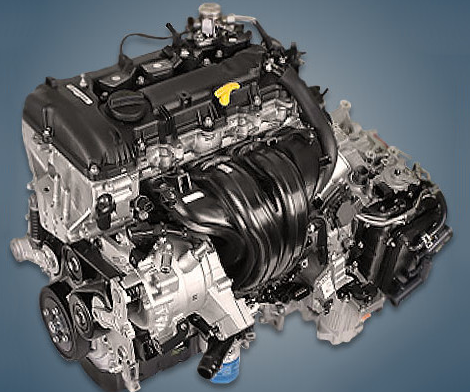
The engines in the Nu family are G4NB, G4NA, G4NC, G4ND, G4NE, G4NH, G4NG, G4NL, and G4NN.
The engine was mounted on:
- Hyundai Sonata 7 (LF) in 2015 – 2019;
- Kia Optima 4 (JF) in 2016 – 2020.
Specifications
| Production years | 2015-2020 |
| Displacement, cc | 1999 |
| Fuel system | direct injection |
| Power output, hp | 154 (205 with electrical component) |
| Torque output, Nm | 190 (375 with electrical component) |
| Cylinder block | aluminum R4 |
| Block head | aluminum 16v |
| Cylinder bore, mm | 81 |
| Piston stroke, mm | 97 |
| Compression ratio | 13.5 |
| Features | Atkinson cycle |
| Hydraulic lifters | yes |
| Timing drive | chain |
| Phase regulator | Dual CVVT |
| Turbocharging | no |
| Recommended engine oil | 5W-30 |
| Engine oil capacity, liter | 4.3 |
| Fuel type | petrol |
| Euro standards | EURO 6 |
| Fuel consumption, L/100 km (for Hyundai Sonata PHEV 2017) — city — highway — combined |
4.9 4.5 4.8 |
| Engine lifespan, km | ~250 000 |
Disadvantages of the Hyundai G4NG engine
Reliability is not the primary issue; rather, it is the absence of required experts and replacement parts;
They frequently complain about various electrical issues on specialized forums;
Scuffing is likely due to the catalytic converter’s proximity to the cylinder block; the generator, which has its own cooling system, frequently fails.