
From 1996 to 2002, the 2.0-liter gasoline-powered Hyundai G4GF was assembled in South Korea and fitted to the redesigned Lantra J2, Coupe model, and American Tiburon. Such a power unit is frequently swapped out for other vehicles of the same kind.
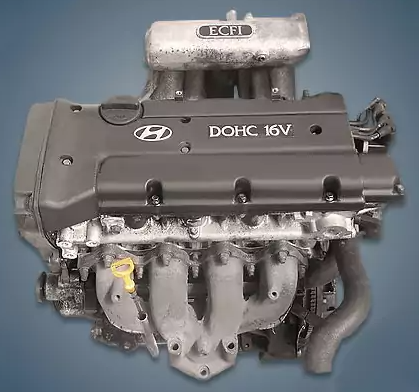
The engines in the Beta family are G4GR, G4GB, G4GM, G4GC, and G4GF.
The engine was mounted on:
- Hyundai Coupe 1 (RD) in 1996 – 2002;
- Hyundai Lantra 2 (RD) in 1998 – 2000.
Specifications
| Production years | 1996-2002 |
| Displacement, cc | 1975 |
| Fuel system | distributed injection |
| Power output, hp | 139 |
| Torque output, Nm | 182 |
| Cylinder block | cast iron R4 |
| Block head | aluminum 16v |
| Cylinder bore, mm | 82 |
| Piston stroke, mm | 93.5 |
| Compression ratio | 10.3 |
| Features | DOHC |
| Hydraulic lifters | yes |
| Timing drive | chain & belt |
| Phase regulator | no |
| Turbocharging | no |
| Recommended engine oil | 5W-40 |
| Engine oil capacity, liter | 4.0 |
| Fuel type | petrol |
| Euro standards | EURO 2 |
| Fuel consumption, L/100 km (for Hyundai Tiburon 2001) — city — highway — combined |
11.4 7.3 8.8 |
| Engine lifespan, km | ~330 000 |
| Weight, kg | 144 |
Disadvantages of the Hyundai G4GF engine
Low build quality and certain of their components plagued the engines of the early years;
Hydraulic lifters can already knock 100,000 kilometers due to inadequate lubrication;
When the timing belt breaks, the valves bend; on runs exceeding 200,000 kilometers, ring and cap wear and oil consumption are frequent;
Additionally, there was a recall campaign because the exhaust manifold frequently bursts.