
From 2004 to 2010, the company produced the 2.4-liter Hyundai G4KC gasoline engine, which was fitted to the American version of the Carens compact van as well as the Sonata and Magentis sedans. The presence of a block of balancing shafts distinguishes this unit from its 2.0-liter equivalent.
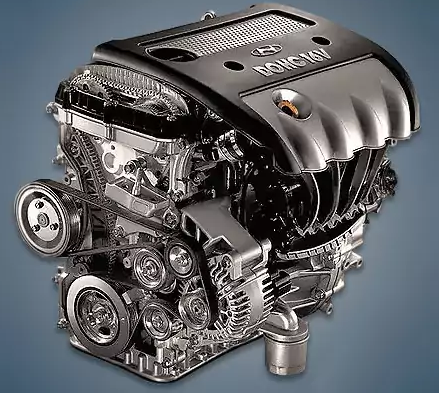
A series of engines with a single design were developed in 2004 as part of the Global Engine Alliance. They feature an aluminum cylinder block with cast-iron liners and an open cooling jacket, an aluminum 16-valve head without hydraulic lifters, a timing chain drive, and a proprietary CVVT type variable valve timing system on the intake camshaft. The 2.4-liter engine was known as the Chrysler ED3, Mitsubishi 4B12, or Hyundai-Kia G4KC.
The presence of balance shafts, which are integrated into a single unit with an oil pump, was the primary distinction between the 2.4-liter power unit and its 2.0-liter Theta I series counterpart.
G4KC, G4KE, G4KG, G4KJ, and G4KK are members of the Theta 2.4L family.
The engine was mounted on:
- Hyundai Grandeur 4 (TG) in 2005 – 2009;
- Hyundai Sonata 5 (NF) in 2004 – 2008;
- Kia Carens 3 (UN) in 2006 – 2010;
- Kia Magentis 2 (MG) in 2005 – 2008.
Specifications
| Production years | 2004-2010 |
| Displacement, cc | 2359 |
| Fuel system | distributed injection |
| Power output, hp | 160 – 165 |
| Torque output, Nm | 219 – 226 |
| Cylinder block | aluminum R4 |
| Block head | aluminum 16v |
| Cylinder bore, mm | 88 |
| Piston stroke, mm | 97 |
| Compression ratio | 10.5 |
| Hydraulic lifters | no |
| Timing drive | chain |
| Phase regulator | yes |
| Turbocharging | no |
| Recommended engine oil | 5W-30, 5W-40 |
| Engine oil capacity, liter | 5.3 |
| Fuel type | petrol |
| Euro standards | EURO 3/4 |
| Fuel consumption, L/100 km (for Hyundai Sonata 2006) — city — highway — combined |
12.3 7.0 8.9 |
| Engine lifespan, km | ~350 000 |
| Weight, kg | 146.1 |
Disadvantages of the Hyundai G4KC engine
The motor was fitted with an oil pump and a block of balancing shafts to lessen vibrations, but the pressure-reducing valve clogs with chips and the liners deteriorate rapidly. Cranking of the liners and an engine wedge are frequently caused by a decrease in lubrication pressure.
Wear and the ellipse of weak cast iron liners are the primary causes of oil consumption in these engines; scuffing caused by catalyst crumbs entering the cylinders is uncommon. The aluminum cylinder block with an open cooling jacket has a low degree of rigidity.
This timing chain is made to last the engine’s whole life, but for extremely active drivers, it can stretch up to 100,000 kilometers, which causes the valves to jump and bend. They are frequently swapped out together because the phase regulator is a small resource.
Weak oil seals and gaskets are additional weak points in this power unit. Here, the lubricant typically climbs through the crankshaft oil seals or from beneath the valve cover.