
From 1997 to 2003, the company produced the 0.8-liter 12-valve Hyundai G4HA engine, which was used in models like the Atos, Atos Prime, Amica, and Kia Visto for the Asian market. Both a gas version of the L4HA and an atmospheric and supercharged version of this engine are available.
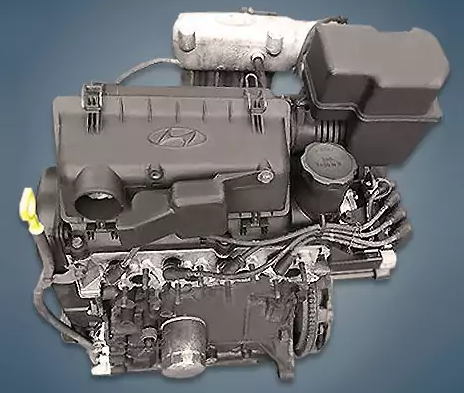
G3HA, G4HA, G4HC, G4HE, G4HD, and G4HG are members of the Epsilon family.
The engine was mounted on:
- Hyundai Atos 1 (MX) in 1997 – 2003.
Specifications
| Production years | 1997-2003 |
| Displacement, cc | 798 |
| Fuel system | distributed injection |
| Power output, hp | 52 (atmospheric G4HA) 70 (turbocharged G4HA-TC) |
| Torque output, Nm | 70 (atmospheric G4HA) 103 (turbocharged G4HA-TC) |
| Cylinder block | cast iron R4 |
| Block head | aluminum 12v |
| Cylinder bore, mm | 63 |
| Piston stroke, mm | 64 |
| Compression ratio | 9.5 (atmospheric G4HA) 8.0 (turbocharged G4HA-TC) |
| Features | SOHC |
| Hydraulic lifters | no |
| Timing drive | belt |
| Phase regulator | no |
| Turbocharging | no (atmospheric G4HA) MHI TD025MR (G4HA-TC) |
| Recommended engine oil | 5W-30 |
| Engine oil capacity, liter | 3.1 |
| Fuel type | petrol |
| Euro standards | EURO 2 |
| Fuel consumption, L/100 km (for Hyundai Atos 2002) — city — highway — combined |
7.9 5.2 6.1 |
| Engine lifespan, km | ~200 000 |
| Weight, kg | 97.5 |
Disadvantages of the Hyundai G4HA engine
Although there are no design issues with this unit, it cannot be considered a resource.
The throttle and idle speed controller contamination are the primary issues.
The breakdown of the wiring insulation is another frequent cause of engine tripping.
The fuel filter will rust and become difficult to remove if you don’t replace it frequently.
A significant overhaul with a bore to the repair size is typically necessary closer to 200,000 kilometers.