
From 1999 to 2012, the company manufactured the 1.5-liter 16-valve Hyundai G4EC engine, which was fitted to the second generation Hyundai Accent and its licensed equivalents. This engine was only installed on regional Accent models prior to restyling in the majority of other nations.
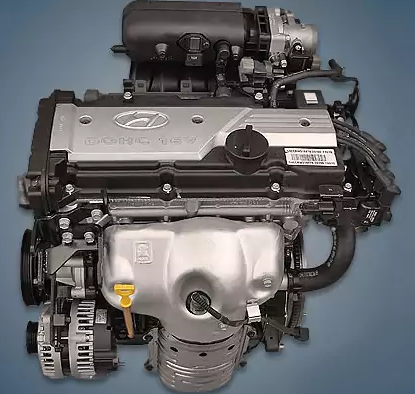
Two 1.5-liter power units with different block heads—one 12-valve SOHC and the other 16-valve DOHC—appeared on the second generation of the Accent model in 1999. The G4EC motor featured a short chain and timing belt between the camshafts, an aluminum 16-valve head with hydraulic lifters, and a cast-iron block. It also featured a dual coil ignition system and multiport fuel injection.
This engine was only installed on European and Korean versions of the Accent until the 2003 restyling, but it was installed in some other markets until the model’s production ended in 2012.
G4EA, G4EH, G4EE, G4EB, G4EC, G4ER, G4EK, and G4ED comprise the Alpha series.
The engine was mounted on:
- Hyundai Accent 2 (LC) in 1999 – 2012.
Specifications
| Production years | 1999-2012 |
| Displacement, cc | 1495 |
| Fuel system | distributed injection |
| Power output, hp | 102 |
| Torque output, Nm | 134 |
| Cylinder block | cast iron R4 |
| Block head | aluminum 16v |
| Cylinder bore, mm | 75.5 |
| Piston stroke, mm | 83.5 |
| Compression ratio | 10.0 |
| Features | DOHC |
| Hydraulic lifters | yes |
| Timing drive | chain & belt |
| Turbocharging | no |
| Recommended engine oil | 5W-40, 10W-40 |
| Engine oil capacity, liter | 3.8 |
| Fuel type | petrol |
| Euro standards | EURO 2/3 |
| Fuel consumption, L/100 km (for Hyundai Accent 2008) — city — highway — combined |
9.9 6.1 7.5 |
| Engine lifespan, km | ~350 000 |
| Weight, kg | 115.1 |
Disadvantages of the Hyundai G4EC engine
The engine speed floats due to contamination of the throttle, idle speed controller, or injectors, and it frequently begins to triple due to a cracked ignition coil or broken wires. This motor has no unique weak points.
The modest hydraulic lifter resource is a distinguishing characteristic of Alpha engines. They will travel up to 100,000 kilometers if they don’t replace their oil on a regular basis. Some claim that the cause is a decrease in lubricant pressure and wear on the oil pump plunger.
The Accent TagAZ handbook states that the timing belt should be changed every 50,000 kilometers; however, there are testimonials from people who have had their belts torn, and the valve is bent in this instance. The chain between the camshafts also needs to be changed once every 100,000 kilometers because it doesn’t last very long.
A tiny bit of lubricant frequently shows up after 200,000 kilometers, and it increases with mileage. The most common cause is hardened valve stem seals, which can usually be replaced. If not, the rings become stuck and the unit will require more costly repairs.
Complaints about short-lived engine mounts and attachments, frequent lubricant leaks, and the appearance of a Check Engine because of a burned muffler corrugation are also common. Checking the emergency fuel shut-off system is worthwhile if the engine won’t start.