
From 1995 to 2000, the company produced the 1.5-liter 16-valve Hyundai G4ER engine, which was fitted to the original Accent model and its variations, including Excel and Verna. Numerous sources refer to this type of power unit under an entirely different G4FK index.
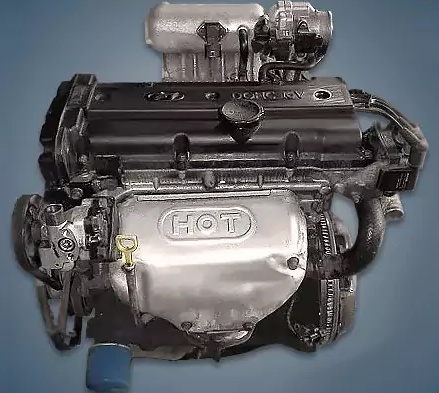
G4EA, G4EH, G4EE, G4EB, G4EC, G4ER, G4EK, and G4ED are members of the Alpha series.
The engine was mounted on:
- Hyundai Accent 1 (X3) in 1995 – 1999.
Specifications
| Production years | 1995-2000 |
| Displacement, cc | 1495 |
| Fuel system | distributed injection |
| Power output, hp | 99 |
| Torque output, Nm | 134 |
| Cylinder block | cast iron R4 |
| Block head | aluminum 16v |
| Cylinder bore, mm | 75.5 |
| Piston stroke, mm | 83.5 |
| Compression ratio | 9.5 |
| Features | DOHC |
| Hydraulic lifters | yes |
| Timing drive | chain & belt |
| Phase regulator | no |
| Turbocharging | no |
| Recommended engine oil | 5W-40 |
| Engine oil capacity, liter | 3.3 |
| Fuel type | petrol |
| Euro standards | EURO 2 |
| Fuel consumption, L/100 km (for Hyundai Accent 1997) — city — highway — combined |
9.7 5.7 7.3 |
| Engine lifespan, km | ~300 000 |
| Weight, kg | 114.3 |
Disadvantages of the Hyundai G4ER engine
Although the unit is dependable overall, the build quality and certain parts frequently let it down; they frequently only complain about floating engine speeds because the throttle or idle speed controller is contaminated;
The timing belt and the chain between the camshafts are replaced once every 60,000 and 120,000 kilometers, respectively;
Hydraulic lifters wear out and start to knock violently after 100,000 kilometers; near 200,000 kilometers, valve stem seals become tanned and lubricant consumption starts to show.