
From 2008 to 2016, the company produced the 2.0-liter Hyundai G4KF or Genesis Coupe 2.0 Turbo engine, which was limited to the coupe version of the original Genesis model. This turbo engine came in two versions with very different power levels.
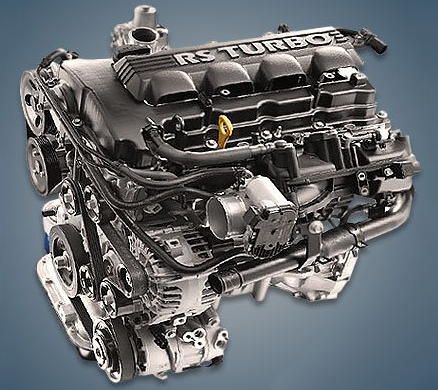
Theta 2.0L family: G4KA, G4KD, G4KF, G4KH, G4KL.
The engine was mounted on:
- Hyundai Genesis Coupe 1 (BK) in 2008 – 2016.
Specifications
| Production years | 2008-2016 |
| Displacement, cc | 1998 |
| Fuel system | distributed injection |
| Power output, hp | 213 (2008 – 2012) 250 – 275 (2012 – 2016) |
| Torque output, Nm | 302 (2008 – 2012) 353 – 373 (2012 – 2016) |
| Cylinder block | aluminum R4 |
| Block head | aluminum 16v |
| Cylinder bore, mm | 86 |
| Piston stroke, mm | 86 |
| Compression ratio | 9.5 (2008 – 2012) 9.0 (2012 – 2016) |
| Features | T-MPi |
| Hydraulic lifters | no |
| Timing drive | chain |
| Phase regulator | Dual CVVT |
| Turbocharging | MHI TD04L-13T (2008 – 2012) MHI TD04HL-19T (2012 – 2016) |
| Recommended engine oil | 5W-30 |
| Engine oil capacity, liter | 5.3 |
| Fuel type | petrol |
| Euro standards | EURO 4 (2008 – 2012) EURO 5 (2012 – 2016) |
| Fuel consumption, L/100 km (for Hyundai Genesis Coupe 2010) — city — highway — combined |
12.3 7.0 9.0 |
| Engine lifespan, km | ~220 000 |
| Weight, kg | 135.7 |
Disadvantages of the Hyundai G4KF engine
The crankshaft liners’ rotation is this unit’s most well-known issue.
Additionally, pistons frequently burst or rods broke off in the early engine modifications.
Phase regulators and timing chains are used for a considerable amount of time—sometimes less than 100,000 kilometers.
Oil consumption appears and increases after 100,000 km because of the cylinders’ ellipse.
Most significantly, stock engines are hard to come by because nearly all of them are tuned.