
From 2005 to 2013, the 2.0-liter Hyundai G4KA gasoline engine was manufactured and fitted to several popular models of the Korean company, including the Sonata, Magentis, and Carens. This motor was modified with gas for use by taxi companies under the L4KA index.
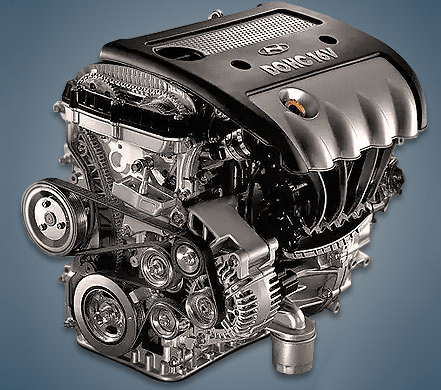
Hyundai-Kia, Mitsubishi, and Chrysler Group formed the Global Engine Alliance in 2002. Two years later, a whole line of gasoline internal combustion engines with comparable designs was released. The Hyundai-Kia G4KA, Mitsubishi 4B11, or Chrysler ECN indices were applied to 2.0-liter units. They have a timing chain drive, a CVVT type variable valve timing system on the intake camshaft, a 16-valve cylinder head without hydraulic lifters, an aluminum cylinder block with cast-iron liners and an open cooling jacket, and distributed fuel injection.
A gas version of the engine, which was identified by the lack of a camshaft position sensor and an inlet phase regulator, was distributed under the L4KA index in the Asian market. Additionally, a block of balancers is installed in several variations of this motor, such as the Kia Carens.
G4KA, G4KD, G4KF, G4KH, and G4KL are members of the Theta 2.0L family.
The engine was mounted on:
- Hyundai Sonata 5 (NF) in 2004 – 2010;
- Kia Carens 3 (UN) in 2006 – 2013;
- Kia Magentis 2 (MG) in 2005 – 2010.
Specifications
| Production years | 2005-2013 |
| Displacement, cc | 1998 |
| Fuel system | distributed injection |
| Power output, hp | 144 – 151 |
| Torque output, Nm | 187 – 194 |
| Cylinder block | aluminum R4 |
| Block head | aluminum 16v |
| Cylinder bore, mm | 86 |
| Piston stroke, mm | 86 |
| Compression ratio | 10.5 |
| Hydraulic lifters | no |
| Timing drive | chain |
| Phase regulator | CVVT |
| Turbocharging | no |
| Recommended engine oil | 5W-30, 5W-40 |
| Engine oil capacity, liter | 4.7 |
| Fuel type | petrol |
| Euro standards | EURO 3/4 |
| Fuel consumption, L/100 km (for Kia Carens 2008) — city — highway — combined |
10.8 6.6 8.1 |
| Engine lifespan, km | ~350 000 |
| Weight, kg | 134.3 |
Disadvantages of the Hyundai G4KA engine
Compared to Theta II engines, scuffing caused by catalyst crumbs entering the cylinders is far less frequent in the first generation of Theta engines, which are incredibly dependable. However, because of the engine’s open-jacketed aluminum block design, thin cast-iron sleeves frequently cause an ellipse to form over time and lubricant consumption.
This timing chain’s resource is heavily reliant on the owners. When driven aggressively, it can travel up to 100,000 kilometers, which is risky due to valve bending and jumping. It is frequently necessary to replace the phase regulator in addition to the circuit, which doubles the cost of repairs.
The constantly flowing gaskets and oil seals in this motor are another weak point; lubricant typically seeps out of the crankshaft oil seals and from beneath the valve cover gasket.