
Since 2010, the Hyundai-Kia G4KH 2.0-liter turbo engine, also known as the 2.0 Turbo GDi, has been manufactured. Charged versions of the Sonata, Optima, Sorento, and Sportage are equipped with this engine. This unit has a longitudinal arrangement version with the index G4KL.
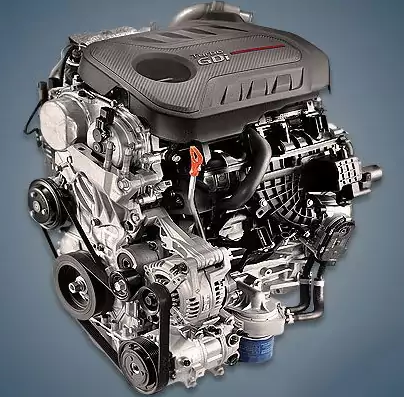
A 2.0-liter Theta II turbo engine with GDi type direct fuel injection was introduced in 2010 for the Sportage 3 crossover and the American versions of the Sonata and Optima sedans. It features an aluminum block with cast-iron liners, a 16-valve cylinder head without hydraulic lifters, a dual CVVT phase control system on both shafts, a timing chain drive, and a balancer shaft block integrated into a single housing with an oil pump, all of which are fairly standard for the series.
The first generation of these engines produced 260–280 horsepower and 365 Nm of torque with a compression ratio of 9.5 and a Mitsubishi TD04HL4S–19T–8.5 turbocharger. The second generation, which debuted in 2015, had a slightly more straightforward Mitsubishi TD04L6–13WDT–7.0T turbocharger, an E-CVVT intake phase shifter, and a compression ratio of 10. Such a unit’s power has dropped to 240–250 horsepower and 353 Nm of torque.
Theta 2.0L family: G4KA, G4KD, G4KF, G4KH, G4KL.
The engine was mounted on:
- Hyundai Santa Fe 3 (DM) in 2012 – 2018; Santa Fe 4 (TM) in 2018 – 2020;
- Hyundai Sonata 6 (YF) in 2010 – 2015; Sonata 7 (LF) in 2014 – 2020;
- Hyundai i30 3 (PD) in 2018 – 2020;
- Hyundai Veloster 2 (JS) in 2018 – 2020;
- Kia Optima 3 (TF) in 2010 – 2015; Optima 4 (JF) in 2015 – 2020;
- Kia Sportage 3 (SL) in 2010 – 2015; Sportage 4 (QL) in 2015 – 2021;
- Kia Sorento 3 (UM) in 2014 – 2020.
Specifications
| Production years | since 2010 |
| Displacement, cc | 1998 |
| Fuel system | direct injection |
| Power output, hp | 240 – 280 |
| Torque output, Nm | 353 – 365 |
| Cylinder block | aluminum R4 |
| Block head | aluminum 16v |
| Cylinder bore, mm | 86 |
| Piston stroke, mm | 86 |
| Compression ratio | 9.5 – 10.0 |
| Hydraulic lifters | no |
| Timing drive | chain |
| Phase regulator | Dual CVVT |
| Turbocharging | yes |
| Recommended engine oil | 5W-20, 5W-30 |
| Engine oil capacity, liter | 6.1 |
| Fuel type | petrol |
| Euro standards | EURO 5/6 |
| Fuel consumption, L/100 km (for Kia Optima 2017) — city — highway — combined |
12.5 6.3 8.5 |
| Engine lifespan, km | ~200 000 |
| Weight, kg | 135.5 |
Disadvantages of the Hyundai G4KH engine
The risk of cranking the liners on a run of roughly 100,000 kilometers is very high because these turbo engines have very strict requirements regarding the quality of the oil and the process for changing it. Even in auto repair shops, an oil pump and an unsuccessful block of balancers cause the engine lubrication system’s pressure to drop as a result of the liners’ quick wear.
A campaign to replace the E-CVVT phase regulator included a recall of the second generation units. Installing a new cover was the most common solution, but in more complex situations, the entire assembly had to be replaced.
First-generation units lacked oil nozzles and had scuffs, but the banal ellipse of the cylinders is typically the reason for oil consumption. The aluminum block’s low rigidity causes overheating very quickly.
The intake valves rapidly fill with soot, just like in any direct-injection engine. Additionally, the timing chain performs comparatively little, the temperature sensor frequently malfunctions, different air pipes frequently burst, and oil leaks through the oil seals happen.