
From 1995 to 2001, the company manufactured the 1.6-liter 16-valve Hyundai G4GR engine and fitted it to two of the Korean company’s models, the Coupe and the Lantra J2. A 90-hp version was available in some markets in addition to the standard 114-hp modification.
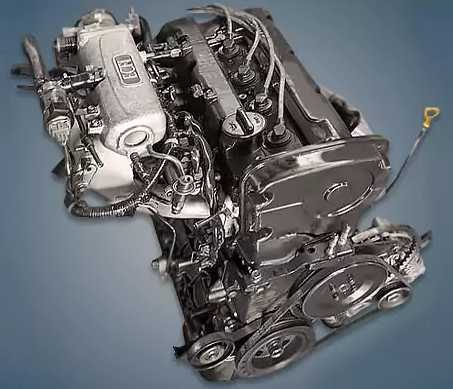
The engines in the Beta family are G4GR, G4GB, G4GM, G4GC, and G4GF.
The engine was mounted on:
- Hyundai Coupe 1 (RD) in 1996 – 2001;
- Hyundai Lantra 2 (RD)in 1995 – 2000.
Specifications
| Production years | 1995-2001 |
| Displacement, cc | 1599 |
| Fuel system | distributed injection |
| Power output, hp | 114 |
| Torque output, Nm | 145 |
| Cylinder block | cast iron R4 |
| Block head | aluminum 16v |
| Cylinder bore, mm | 77.4 |
| Piston stroke, mm | 85 |
| Compression ratio | 9.85 |
| Features | DOHC |
| Hydraulic lifters | yes |
| Timing drive | chain & belt |
| Phase regulator | no |
| Turbocharging | no |
| Recommended engine oil | 5W-40 |
| Engine oil capacity, liter | 4.0 |
| Fuel type | petrol |
| Euro standards | EURO 2 |
| Fuel consumption, L/100 km (for Hyundai Lantra 1997) — city — highway — combined |
10.7 6.7 8.4 |
| Engine lifespan, km | ~300 000 |
| Weight, kg | 136 |
Disadvantages of the Hyundai G4GR engine
There were numerous issues with build quality and certain components in the initial years of production;
Hydraulic lifters can travel up to 100,000 kilometers and cannot withstand inadequate lubrication;
The exhaust manifold, which frequently cracks, is another weakness; on long runs, an oil burner is frequently discovered due to wear of rings and caps; the timing belt does not always serve the necessary 60 thousand kilometers, and when it breaks, the valves bend.