
Since the 1.6-liter Hyundai G4CR engine was essentially a replica of the Mitsubishi 4G61 engine, it was manufactured under license from 1990 to 1995 and fitted the original Lantra model. This power unit never had balance shafts, in contrast to other units in this series.
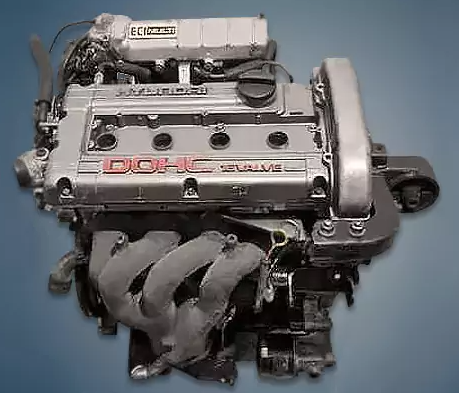
Sirius family: G4CR (1.6 L); G4CN, G4CM, G4JN (1.8 L); G4CP, G4JP (2.0 L); G4JS, G4CS (2.4 L).
The engine was mounted on:
- Hyundai Lantra 1 (J1) in 1990 – 1995.
Specifications
| Production years | 1990-1995 |
| Displacement, cc | 1596 |
| Fuel system | injector |
| Power output, hp | 105 – 115 |
| Torque output, Nm | 130 – 140 |
| Cylinder block | cast iron R4 |
| Block head | aluminum 16v |
| Cylinder bore, mm | 82.3 |
| Piston stroke, mm | 75 |
| Compression ratio | 9.2 |
| Features | no |
| Hydraulic lifters | yes |
| Timing drive | belt |
| Phase regulator | no |
| Turbocharging | no |
| Recommended engine oil | 15W-40 |
| Engine oil capacity, liter | 3.7 |
| Fuel type | petrol |
| Euro standards | EURO 1/2 |
| Fuel consumption, L/100 km (for Hyundai Lantra 1992) — city — highway — combined |
10.6 6.7 8.5 |
| Engine lifespan, km | ~250 000 |
| Weight, kg | 142.2 (without attachments) |
Disadvantages of the Hyundai G4CR engine
A sudden break in the timing belt with bent valves is the most frequent issue.
Floating idle speeds brought on by throttle contamination come in second.
Additionally, electrical outages are frequent, particularly during rainy seasons.
Hydraulic lifters frequently fail due to the use of cheap oil.
Weak pillows and an unreliable gas pump are the unit’s weaknesses.