
From 2004 until 2011, the company produced the 3.3-liter gasoline V6 Hyundai G6DB engine, which was fitted to both front-wheel drive vehicles like the Santa Fe and rear-wheel drive vehicles like the Sorento. Such a power unit came in two generations with notable variations.
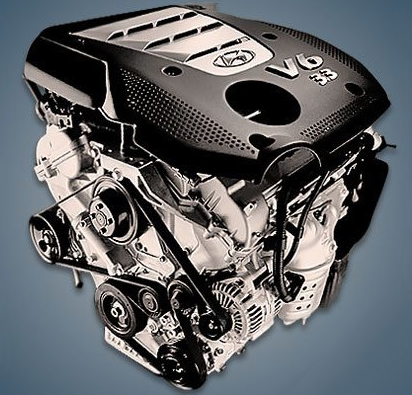
The Lambda I series’ 3.3-liter V6 engine made its debut on the Sonata’s fifth generation in 2004. This is a standard V-engine with an aluminum block, a 60° cylinder angle, multipoint fuel injection, two DOHC cylinder heads without hydraulic lifters, a timing chain, and an aluminum intake manifold with a two-stage VIS geometry change system. Only the intake camshafts of the engine’s initial generation had CVVT phase shifters installed.
The redesigned Sonata debuted the second generation of V6 or Lambda II engines in 2008. These power units were identified by having a plastic intake manifold with a three-stage geometry change system and CVVT phase regulators already installed on all camshafts.
G6DB, G6DF, G6DH, G6DM, and G6DP make up the Lambda 3.3L family.
The engine was mounted on:
- Hyundai Grandeur 4 (TG) in 2005 – 2011;
- Hyundai Santa Fe 2 (CM) in 2005 – 2009;
- Hyundai Sonata 5 (NF) in 2004 – 2010;
- Kia Opirus 1 (GH) in 2006 – 2011;
- Kia Sorento 1 (BL) in 2006 – 2009.
Specifications
| Production years | 2004-2011 |
| Displacement, cc | 3342 |
| Fuel system | distributed injection |
| Power output, hp | 233 – 259 |
| Torque output, Nm | 304 – 316 |
| Cylinder block | aluminum V6 |
| Block head | aluminum 24v |
| Cylinder bore, mm | 92 |
| Piston stroke, mm | 83.8 |
| Compression ratio | 10.4 |
| Features | DOHC, VIS |
| Hydraulic lifters | no |
| Timing drive | chain |
| Phase regulator | CVVT |
| Turbocharging | no |
| Recommended engine oil | 5W-30, 5W-40 |
| Engine oil capacity, liter | 6.0 (there are versions with a 6.8 liter pallet) |
| Fuel type | petrol |
| Euro standards | EURO 3/4 |
| Fuel consumption, L/100 km (for Hyundai Sonata 2007) — city — highway — combined |
14.8 7.4 10.1 |
| Engine lifespan, km | ~300 000 |
| Weight, kg | 212 (with attachments) |
Disadvantages of the Hyundai G6DB engine
The most well-known issue with this line of motors is a progressive oil burner, which is primarily caused by the relatively quick development of oil scraper rings. Decarbonization is something that owners of cars with such engines do on a regular basis, but it doesn’t help for very long.
The oil level that has drastically dropped as a result of the oil burner is typically the cause of the numerous instances of these motors jamming because of the cranking of the liners that are reported in the specialized forums. However, well-maintained engines also wedge; it seems that these engines’ liners are just not very strong.
This timing chain is unreliable and only lasts between 100,000 and 150,000 kilometers. Replacing it is very costly, especially if you also need to replace the phase regulators. The chains on second-generation motors are now more dependable, but the hydraulic tensioner breaks down.
Additionally, lubricant leaks from beneath plastic valve covers, throttle issues, and intake manifold geometry change system malfunctions are common. Additionally, remember that the valve clearance may need to be adjusted every 60,000 kilometers.