
From 1990 to 2006, the company produced the Hyundai G6CT 3.0-liter V6 gasoline engine, which was first used in the Grandeur, Dynasty, Starex, and Kia Opirus models. This power unit is actually a replica of the Mitsubishi 6G72 engine’s 24-valve variant.
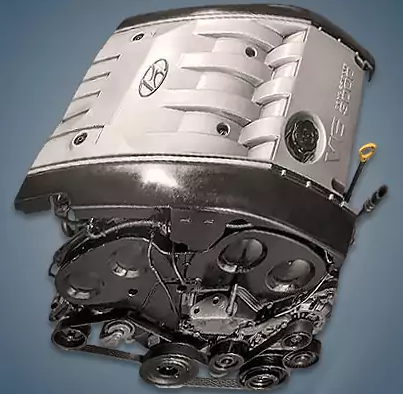
The 2.5 L G6AV, 3.0 L G6AT, G6CT, and 3.5 L G6AU, G6CU engines were also part of the Sigma family.
The engine was mounted on:
- Hyundai Dynasty 1 (LX) in 1996 – 2005;
- Hyundai Equus 1 (LZ) in 1999 – 2005;
- Hyundai Grandeur 1 (L) in 1990 – 1992; Grandeur 2 (LX) in 1992 – 1998; Grandeur 3 (XG) in 1998 – 2005;
- Hyundai Starex 1 (A1) in 1999 – 2003;
- Kia Opirus 1 (GH) in 2003 – 2006.
Specifications
| Production years | 1990-2006 |
| Displacement, cc | 2972 |
| Fuel system | distributed injection |
| Power output, hp | 185 – 205 |
| Torque output, Nm | 250 – 280 |
| Cylinder block | cast iron V6 |
| Block head | aluminum 24v |
| Cylinder bore, mm | 91.1 |
| Piston stroke, mm | 76 |
| Compression ratio | 10.0 |
| Features | DOHC |
| Hydraulic lifters | yes |
| Timing drive | belt |
| Phase regulator | no |
| Turbocharging | no |
| Recommended engine oil | 5W-40 |
| Engine oil capacity, liter | 4.6 |
| Fuel type | petrol |
| Euro standards | EURO 2/3 |
| Fuel consumption, L/100 km (for Hyundai Grandeur 2000) — city — highway — combined |
16.9 9.6 12.3 |
| Engine lifespan, km | ~250 000 |
| Weight, kg | 191.9 |
Disadvantages of the Hyundai G6CT engine
Early on, motors and some of their parts had extremely subpar construction.
There are numerous examples of engine wedge caused by liners being cranked for 50,000 kilometers.
After that, the quality improved, and now oil consumption is the main cause of complaints.
Additionally, contamination of the throttle, injectors, or idle speed controller frequently causes engine speed to float.
The ignition system and short-lived hydraulic lifters are among the weaknesses.