
From 2001 to 2012, nearly all of the manufacturer’s mid-size models were equipped with the 2.0-liter diesel Hyundai D4EA or Santa Fe Classic 2.0 CRDi. This motor, which is referred to as the Z20S on GM Korea models, was created by VM Motori.
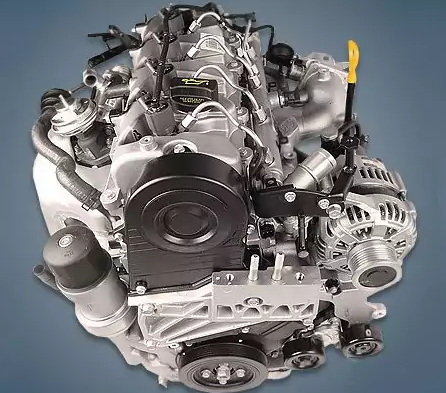
Developed for the Hyundai Group and GM Korea, the RA 420 SOHC 2.0 liter common rail diesel engine (also known as the D4EA and Z20DMH) was first introduced by VM Motori in 2000. With a cast-iron block, a timing belt, an aluminum cylinder head with a single camshaft for sixteen valves, and hydraulic compensators, this unit is structurally typical for its era. A block of balancing shafts is included in the pallet to reduce excessive engine vibrations. The first generation of these engines came in two different power modifications: the D4EA-V with a variable geometry turbine Garrett GT1749V producing 125 horsepower and 285 Nm of torque, and the conventional turbocharger MHI TD025M producing 112 horsepower and 235 to 255 Nm of torque.
The second generation of these diesel engines, which produced 140–150 horsepower and 305 Nm, debuted in 2005. They received a slightly more potent Garrett GTB1549V variable geometry turbocharger and a new Bosch fuel system with a pressure of 1600 bar rather than 1350 bar.
Diesels D3EA and D4EB are also members of the D family.
The engine was mounted on:
- Hyundai Elantra 3 (XD) in 2001 – 2006;
- Hyundai i30 1 (FD) in 2007 – 2010;
- Hyundai Santa Fe 1 (SM) in 2001 – 2012;
- Hyundai Sonata 5 (NF) in 2006 – 2010;
- Hyundai Trajet 1 (FO) in 2001 – 2006;
- Hyundai Tucson 1 (JM) in 2004 – 2010;
- Kia Carens 2 (FJ) in 2002 – 2006; Carens 3 (UN) in 2006 – 2010;
- Kia Ceed 1 (ED) in 2007 – 2010;
- Kia Cerato 1 (LD) in 2003 – 2006;
- Kia Magentis 2 (MG) in 2005 – 2010;
- Kia Sportage 2 (KM) in 2004 – 2010.
Specifications
| Production years | 2001-2012 |
| Displacement, cc | 1991 |
| Fuel system | Common Rail |
| Power output, hp | 112 – 150 |
| Torque output, Nm | 235 – 305 |
| Cylinder block | cast iron R4 |
| Block head | aluminum 16v |
| Cylinder bore, mm | 83 |
| Piston stroke, mm | 92 |
| Compression ratio | 17.3 – 17.7 |
| Hydraulic lifters | yes |
| Timing drive | belt |
| Turbocharging | yes |
| Recommended engine oil | 5W-30, 5W-40 |
| Engine oil capacity, liter | 6.5 |
| Fuel type | diesel |
| Euro standards | EURO 3/4 |
| Fuel consumption, L/100 km (for Hyundai Santa Fe Classic 2009) — city — highway — combined |
9.3 6.4 7.5 |
| Engine lifespan, km | ~400 000 |
| Weight, kg | 195.6 |
Disadvantages of the Hyundai D4EA engine
Due to the demanding nature of this diesel engine’s maintenance schedule and oil quality, owners who are particularly frugal frequently experience camshaft cam wear. It is typically required to replace the valve rockers in addition to the camshaft.
The timing belt is supposed to change every 90,000 kilometers, but it frequently breaks even sooner. Owners frequently push to the last because replacing it is costly and challenging. The water pump’s wedge may also cause it to break, and the valves in this area typically bend.
Although this diesel engine has a very dependable Common Rail Bosch CP1 fuel system, the nozzles soon break down and start to leak inferior diesel fuel. Additionally, a single malfunctioning nozzle can cause significant engine damage.
The turbine typically runs less than 150,000 kilometers, glow plugs last a long time, and basic 112 horsepower modifications lack an oil separator and frequently use lubricant. Additionally, the crankshaft is simply lifted when the oil receiver mesh becomes clogged.