
Since 2010, the company’s Chinese plant has produced the 1.6-liter Hyundai G4FG engine, which powers numerous well-known models like the Elantra, Creta, Rio, and Solaris. This unit is an upgraded version of the G4FC engine and is part of the Gamma II line.
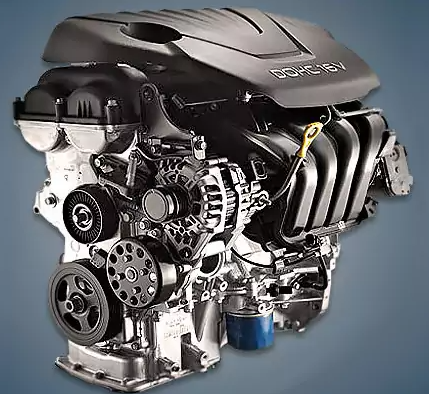
G4FA, G4FL, G4FS, G4FC, G4FD, G4FG, G4FJ, G4FM, G4FP, G4FT, and G4FU are members of the Gamma family.
The first of the Gamma II family’s engines, a power unit with distributed fuel injection under the G4FG index, made its debut on the fifth generation Elantra model in 2010. The second phase regulator at the outlet and the oil pump’s design, which is integrated into the front cover, set this motor apart from the G4FC, which was essentially an upgraded version of it. Additionally, a new intake manifold with a VIS geometry change system is installed. The engine is identical except for the aluminum block, thin-walled cast-iron sleeves, open cooling jacket, 16-valve head without hydraulic lifters, and timing chain.
This engine underwent numerous upgrades during production, the most significant of which was the introduction of a dependable bush-roller timing chain in 2014 rather than a lamellar one.
Specifications
| Production years | since 2010 |
| Displacement, cc | 1591 |
| Fuel system | distributed injection |
| Power output, hp | 123 – 132 |
| Torque output, Nm | 150 – 158 |
| Cylinder block | aluminum R4 |
| Block head | aluminum 16v |
| Cylinder bore, mm | 77 |
| Piston stroke, mm | 85.4 |
| Compression ratio | 10.5 |
| Features | VIS |
| Hydraulic lifters | no |
| Timing drive | chain |
| Phase regulator | yes |
| Turbocharging | no |
| Recommended engine oil | 0W-30, 5W-30 |
| Engine oil capacity, liter | 3.7 |
| Fuel type | petrol |
| Euro standards | EURO 4/5 |
| Fuel consumption, L/100 km (for Hyundai Elantra 2014) — city — highway — combined |
8.6 5.2 6.4 |
| Engine lifespan, km | ~300 000 |
| Weight, kg | 98.7 |
The engine was installed on:
- Hyundai Accent 5 (YC) since 2017;
- Hyundai Creta 1 (GS) since 2015; Creta 2 (SU2) since 2021;
- Hyundai Elantra 5 (MD) in 2010 – 2016; Elantra 6 (AD) since 2015; Elantra 7 (CN7) since 2020;
- Hyundai i30 2 (GD) in 2011 – 2017; i30 3 (PD) since 2016;
- Hyundai Solaris 2 (HC) since 2017;
- Hyundai Veloster 1 (FS) in 2011 – 2017;
- Kia Cerato 3 (YD) in 2014 – 2020; Cerato 4 (BD) since 2018;
- Kia Rio 4 (FB) since 2017; Rio 4 (YB) since 2017;
- Kia Rio X-Line 1 (FB) since 2017;
- Kia Rio X 1 (FB) since 2020;
- Kia Ceed 2 (JD) in 2012 – 2018;
- Kia ProCeed 2 (JD) in 2013 – 2018;
- Kia Soul 1 (AM) in 2011 – 2014; Soul 2 (PS) in 2014 – 2019;
- Kia Seltos 1 (SP2) since 2020.
Disadvantages of the Hyundai G4FG engine
Seizures in the cylinders are the most well-known issue with the units in this family. Near the engine is a small catalytic converter for its rapid warm-up; if the catalyst is destroyed, its particles frequently find their way into the combustion chambers.
This aluminum cylinder block has thin, low-rigidity sleeves and an open cooling jacket. Additionally, the cylinders frequently go in an ellipse with frequent overheating or active use, which is followed by a progressive lubricant consumption.
Up until 2014, engines had an unreliable lamellar timing chain that frequently extended to 150,000 kilometers. The bush-roller chain followed.
This motor’s drawbacks include the nozzles’ loud operation, the engine mounts’ low resource, frequent leaks from under the valve cover, and floating speed brought on by throttle contamination.