
Since 1997, the Korean company has assembled the 2.5-liter Hyundai D4BH diesel engine, which is well-known from the H1 and Starex minibuses as well as the Galloper and Terrakan SUVs. The Mitsubishi 4D56 turbocharged diesel engine with an intercooler served as the model for this power unit.
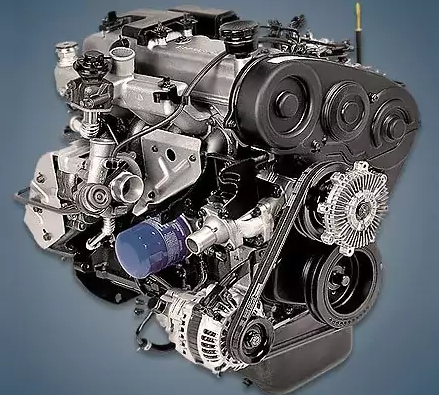
The Hyundai diesel family saw the introduction of a turbocharged engine with an intercooler in 1997. This engine was actually merely a copy of the popular Mitsubishi 4D56 prechamber turbodiesel. A timing belt drive, a fuel pump belt drive, a block of two balancers with their own belt, and a cast-iron cylinder block with an aluminum 8-valve head without hydraulic lifters are all included. It was equipped with a variety of turbines, most frequently the Garrett GT1749S or Mitsubishi TD04-11G-4.
There are numerous models and modifications of this diesel engine, many of which are very different from one another.
Diesels D4BA, D4BB, and D4BF are also members of this family.
The engine was mounted on:
- Hyundai Galloper 2 (JK) in 1997 – 2003;
- Hyundai Starex 1 (A1) in 1997 – 2007;
- Hyundai Terracan 1 (HP) in 2001 – 2006.
Specifications
| Production years | since 1997 |
| Displacement, cc | 2477 |
| Fuel system | prechambers |
| Power output, hp | 100 – 105 |
| Torque output, Nm | 225 – 240 |
| Cylinder block | cast iron R4 |
| Block head | aluminum 8v |
| Cylinder bore, mm | 91.1 |
| Piston stroke, mm | 95 |
| Compression ratio | 21 |
| Hydraulic lifters | no |
| Timing drive | belt |
| Turbocharging | yes |
| Recommended engine oil | 5W-40, 10W-40 |
| Engine oil capacity, liter | 7.2 |
| Fuel type | diesel |
| Euro standards | EURO 2/3 |
| Fuel consumption, L/100 km (for Hyundai Starex 2005) — city — highway — combined |
12.4 8.9 9.9 |
| Engine lifespan, km | ~450 000 |
| Weight, kg | 226.8 |
Disadvantages of the Hyundai D4BH engine
The most common issues with these diesel engines are related to fuel system failures, even though the engine has a dependable Bosch VE injection pump of the distribution type. Low-quality fuel causes the high-pressure fuel pump’s mechanical components to deteriorate, making it difficult for the unit to start when it’s hot. The injector nozzles are replaced for the same reason.
The timing belt is supposed to be replaced every 90,000 kilometers, but it frequently breaks much sooner. All because many people disregard the handbook, which states that it must be tightened every 30,000 kilometers. Additionally, the timing belt is sucked under the balancer shaft belt, which frequently breaks. The fact that it usually just breaks the rocker is a good thing.
This line of diesels dislikes overheating, and the gasket frequently breaks through them. Replacing the gasket is insufficient; you also need to grind the mating surfaces. In the most severe situations, fissures develop around the prechambers and in between the valves. As a result, cylinder heads for these engines are extremely rare and costly.
The remaining malfunctions are listed in a single list: oil continuously rises from the oil seals, frequently cuts off the crankshaft key, which instantly stops the drive of attachments, and the crankshaft can simply burst even after a very long movement at low speeds. Additionally, remember to periodically adjust the valve clearance to prevent them from burning out.