
From 1991 to 2004, the company assembled and installed the Hyundai D4BF 2.5-liter turbo diesel engine on Galloper SUVs and the well-known H1, Starex, and Grace minibuses. Essentially, this motor was just one of the Mitsubishi 4D56 turbodiesel’s modifications.
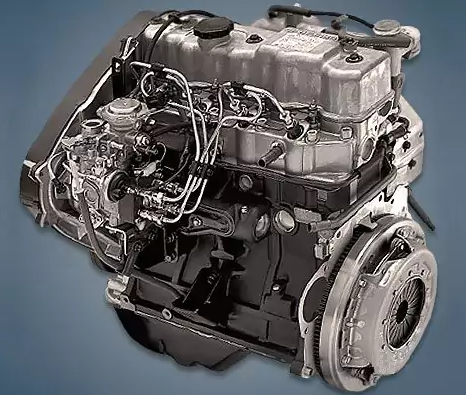
The Hyundai diesel family introduced a turbocharged power unit in 1993. This engine was actually a replica of the Mitsubishi 4D56 prechamber diesel engine. It features a timing belt drive, a fuel pump from Zexel, an aluminum 8-valve head without hydraulic lifters, a block of balancers with its own belt, and a cast-iron cylinder block. This unit was typically supercharged by the Garrett GT1749S turbine, though analogues were also installed.
This diesel engine underwent numerous modifications, particularly for commercial vehicles.
Diesels D4BA, D4BB, and D4BH are also members of this family.
The engine was mounted on:
- Hyundai Galloper 1 (JI) in 1993 – 1997; Galloper 2 (JK) in 1997 – 2003;
- Hyundai Grace 1 (P1) in 1993 – 2003;
- Hyundai Starex 1 (A1) in 1997 – 2004.
Specifications
| Production years | 1991-2004 |
| Displacement, cc | 2477 |
| Fuel system | prechambers |
| Power output, hp | 80 – 85 |
| Torque output, Nm | 194 – 208 |
| Cylinder block | cast iron R4 |
| Block head | aluminum 8v |
| Cylinder bore, mm | 91.1 |
| Piston stroke, mm | 95 |
| Compression ratio | 21 |
| Hydraulic lifters | no |
| Timing drive | belt |
| Turbocharging | yes |
| Recommended engine oil | 5W-40, 10W-40 |
| Engine oil capacity, liter | 6.5 |
| Fuel type | diesel |
| Euro standards | EURO 1/2 |
| Fuel consumption, L/100 km (for Hyundai Grace 2000) — city — highway — combined |
12.6 9.0 10.3 |
| Engine lifespan, km | ~450 000 |
| Weight, kg | 204.8 |
Disadvantages of the Hyundai D4BF engine
The Zexel VE4 distribution injection pump, a replica of the dependable Bosch VE fuel pump, was installed in the majority of these diesel engine models. However, banal mechanical wear frequently causes issues when starting a warm engine at high mileage. Additionally, owners frequently have to replace injector nozzles.
The timing belt is supposed to change every 90,000 kilometers according to official regulations, but it frequently bursts much earlier, especially if you don’t tighten it every 30,000 kilometers. Additionally, the timing belt typically breaks when it falls beneath the balance shaft belt, which can also break here. The fact that only the rocker breaks off when it breaks is a good thing.
Overheating is simply not tolerated by this diesel, and the cylinder head gasket bursts right away. In this instance, it is essential to replace the gasket and grind the mating surfaces. Additionally, long runs frequently have cracks around the prechambers or valves, which are typically impossible to weld. Additionally, the cost of such a cylinder head is very high.
A vacuum pump, a crankshaft that frequently bursts when driving for extended periods of time at low engine speeds, a crankshaft key that simply cuts off and the attachment drive stops, and unreliable seals that cause the oil to constantly climb and come from everywhere are further weak points of such a diesel power unit. Additionally, remember to check the valve clearance every 20,000 kilometers to prevent them from burning out.