
Popular concern models like the Lancer, Galant, Cordia, and Delica were equipped with the 1.8-liter Mitsubishi 4G62 (or G62B) gasoline engine, which was manufactured between 1979 and 1989. After that, Hyundai vehicles had this unit installed for nearly a decade.
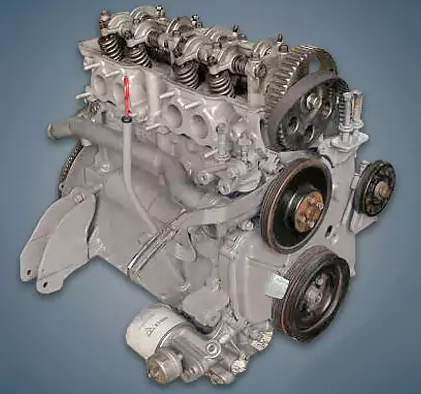
The engines 4G61, 4G63, 4G63T, 4G64, 4G67, and 4G69 are also part of the 4G6 family.
The engine was mounted on:
- Mitsubishi Cordia A210 in 1982 – 1989;
- Mitsubishi Chariot D03 in 1983 – 1987;
- Mitsubishi Delica II in 1979 – 1986;
- Mitsubishi Galant E10 in 1983 – 1988;
- Mitsubishi Lancer A170 in 1979 – 1987;
- Mitsubishi Tredia A210 in 1982 – 1989;
- Hyundai Lantra 1 (J1) in 1993 – 1995;
- Hyundai Sonata 2 (Y2) in 1988 – 1993; Sonata 3 (Y3) in 1993 – 1998.
Specifications
| Production years | 1979-1989 |
| Displacement, cc | 1795 |
| Fuel system | carburetor (Carburetor SOHC) injector (MPFI SOHC) single injection (4G62T ECI TURBO) |
| Power output, hp | 85 – 100 (Carburetor SOHC) 90 – 110 (MPFI SOHC) 135 – 160 (4G62T ECI TURBO) |
| Torque output, Nm | 135 – 145 (Carburetor SOHC) 140 – 150 (MPFI SOHC) 200 – 220 (4G62T ECI TURBO) |
| Cylinder block | cast iron R4 |
| Block head | aluminum 8v |
| Cylinder bore, mm | 80.6 |
| Piston stroke, mm | 88 |
| Compression ratio | 8.5 (Carburetor SOHC) 8.8 (MPFI SOHC) 8.0 (4G62T ECI TURBO) |
| Features | no |
| Hydraulic lifters | yes |
| Timing drive | belt |
| Phase regulator | no |
| Turbocharging | no (Carburetor SOHC) no (MPFI SOHC) TC05-12A (4G62T ECI TURBO) |
| Recommended engine oil | 5W-30 |
| Engine oil capacity, liter | 4.0 |
| Fuel type | petrol |
| Euro standards | EURO 1 (Carburetor SOHC) EURO 2 (MPFI SOHC) EURO 2 (4G62T ECI TURBO) |
| Fuel consumption, L/100 km (for Mitsubishi Lancer 1985) — city — highway — combined |
10.9 6.5 8.4 |
| Engine lifespan, km | ~250 000 |
| Weight, kg | 160 |
Disadvantages of the Mitsubishi 4G62 engine
Unreliable belts, particularly balance shaft belts, are the primary cause of the issues;
Here, hydraulic lifters are quickly disabled by low-quality or outdated oil; a dirty throttle or idle speed controller is typically the cause of floating engine speeds;
The destruction of the power unit’s pillows is typically the cause of its vibrations;
Cracks in the intake and exhaust manifolds are a common complaint on specialized forums.