
From 1986 to 2016, the company assembled the 2.5-liter Mitsubishi 4D56 diesel engine, which was fitted to Delica minibuses, L200 pickups, and Pajero and Pajero Sport SUVs. The popular Hyundai D4BA, D4BF, and D4BH diesel engines were built using this power unit.
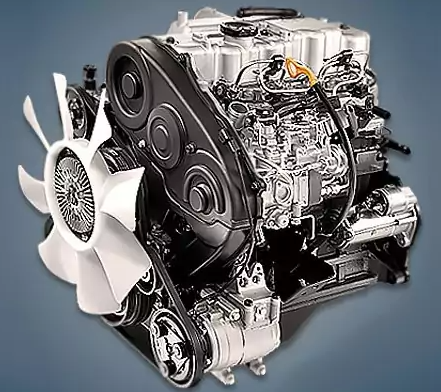
The Japanese automaker Mitsubishi created the 4D56 engine in 1986. Japanese engineers worked on it for ten years after that. To ensure normal maintainability, the designers’ primary goal was to extend the power and service life.
The block is made of cast iron, the cylinder heads are made of aluminum, and 4D56 is designed in accordance with the standard layout. The smallest mass and superior thermal stability were made possible by the use of these alloys. Production of 4D56 using a Common Rail fuel system started in 2001. The compression ratio was lowered to 17 by using new pistons. All of this made it possible to boost torque and power.
4D55 and 4D56 belong to the 4D5 family.
Specifications
| Manufacturer | Kyoto engine plant Hyundai Ulsan Plant |
| Production years | 1986-2016 |
| Displacement, cc | 2477 |
| Fuel system | vortex chamber Common Rail |
| Power output, hp | 74/4200 84/4200 90/4200 104/4300 114/4000 136/4000 178/4000 178/4000 |
| Torque output, Nm | 142/2500 201/2000 197/2000 240/2000 247/2000 324/2000 350/1800 400/2000 |
| Cylinder block | cast iron R4 |
| Block head | aluminum 8v / 16v |
| Cylinder bore, mm | 91.1 |
| Piston stroke, mm | 95 |
| Compression ratio | 21.0 17.0 16.5 |
| Features | no |
| Hydraulic lifters | no |
| Timing drive | belt |
| Turbocharging | no yes |
| Recommended engine oil | 5W-30, 5W-40 |
| Engine oil capacity, liter | 6.5 |
| Fuel type | diesel |
| Euro standards | Euro 2 Euro 3 Euro 4 Euro 5 |
| Fuel consumption, L/100 km (for Mitsubishi Pajero Sport 2004) — city — highway — combined |
12.6 8.5 10.1 |
| Engine lifespan, km | ~400 000 |
| Weight, kg | 193 |
The engine was installed on:
- Mitsubishi Delica 3 (P03) in 1986 – 1999; Delica 4 (PA4) in 1994 – 2007;
- Mitsubishi L200 2 (K10) in 1986 – 1996; L200 3 (K70) in 1996 – 2006; L200 4 (KB) in 2006 – 2016;
- Mitsubishi Pajero 1 (L040) in 1986 – 1991; Pajero 2 (V30) in 1990 – 2000; Pajero 3 (V70) in 1999 – 2006;
- Mitsubishi Pajero Sport 1 (K90) in 1996 – 2008; Pajero Sport 2 (KH) in 2008 – 2016.
Modifications 4D56
Non-Turbo:
- Power – 74 hp (55 kW) at 4200 rpm;
- Torque – 142 Nm @ 2500 rpm;
- The Compression ratio is 21.0: 1.
Non-intercooled Turbo:
- Power – 84 HP (62 kW) at 4200 rpm;
- Torque – 201 Nm @ 2000 rpm;
Intercooled Turbo (TD04 Turbo):
- Power – 90 HP (67 kW) at 4200 rpm;
- Torque – 197 Nm @ 2000 rpm;
- The Compression ratio is 21.0: 1.
Intercooled Turbo (TD04 water-cooled Turbo)*:
- Power – 99 HP (74 kW) at 4300 rpm;
- Torque – 240 Nm @ 2000 rpm;
- The Compression ratio is 21.0: 1.
*Also known as Hyundai D4BH.
Intercooled Turbo TF035HL2 (1st Generation DI-D):
- Power – 114 hp (84 kW) at 4000 rpm;
- Torque – 247 Nm @ 2000 rpm;
- The Compression ratio is 17.0: 1.
Intercooled Turbo (2nd Gen DI-D):
- Power – 136 HP (100 kW) at 4000 rpm;
- Torque – 320 Nm @ 2000 rpm;
- The Compression ratio is 17.0: 1.
Intercooled Turbo (3rd Gen with DI-D variable geometry turbine)
With manual transmission:
- Power – 178 hp (131 kW) at 4000 rpm;
- Torque – 400 Nm @ 2000 rpm;
- Compression ratio – 16.5: 1.
With automatic transmission:
- Power – 178 hp (131 kW) at 4000 rpm;
- Torque – 350 Nm @ 1800 rpm;
- Compression ratio – 16.5: 1.
Disadvantages of the Mitsubishi 4D56 engine
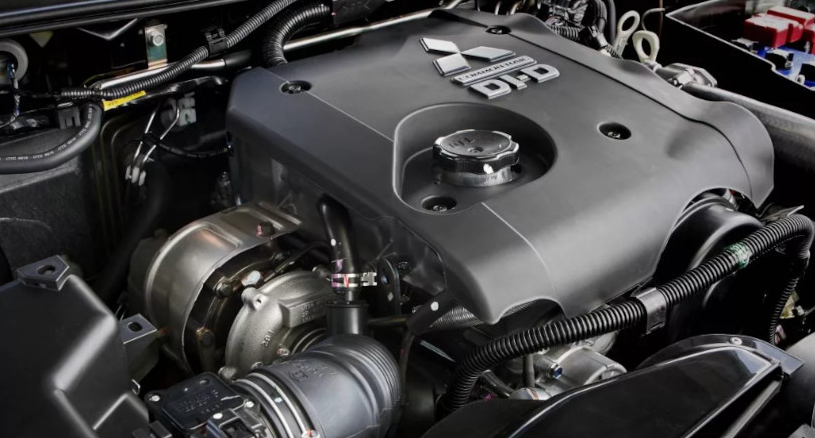
The cylinder head gasket frequently breaks, and this diesel unit is terrified of overheating. However, simply changing the gasket is insufficient; you also need to grind the mating surfaces. Cracks are frequently discovered close to valves or prechambers after a few failures.
Crankshaft failure, which occurs particularly frequently during extended movement at low engine speeds, is another significant issue with this engine. Crankshaft journals are thicker and breakdown is less frequent in engines with a Common Rail system.
Both vortex chamber and Common Rail versions of these diesel engines have fuel systems that, for obvious reasons, cause the majority of the problems for their owners.
If you don’t tighten the timing belt every 30,000 kilometers, it doesn’t always run the necessary 90,000 kilometers. In the Common Rail version of the engine, it frequently pulls out the mounting bolts of the camshaft yokes, but with a break, it only breaks off the rocker. When a balancer belt breaks, it typically falls beneath the timing belt, shattering it as well.
Additionally, the crankshaft pulley and vacuum pump have low resources, the EGR valve clogs, oil leaks are frequent, pistons burst at the slightest tuning, and nearly all gaskets and seals sweat. Additionally, remember to check the valve clearance every 20,000 kilometers to prevent them from burning out.