
Since 1985, the 2.4-liter Mitsubishi 4G64 (also known as G64B) gasoline engine has been manufactured. It is installed on vehicles from other manufacturers in addition to several models of the Japanese company. Hyundai used this power unit for a while under the name G4JS.
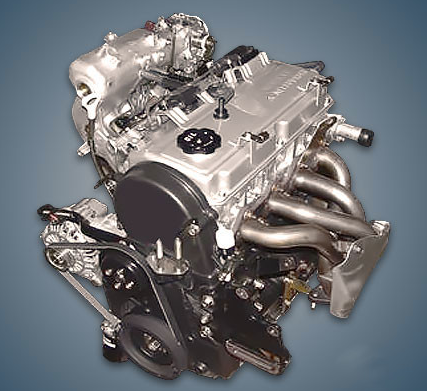
This engine used traditional multipoint fuel injection with a single camshaft until 1997. However, he was ultimately impacted by advanced technologies, specifically GDI. An additional camshaft and direct fuel injection added 37 horsepower, along with the GDI system’s inherent complications.
The engines 4G61, 4G62, 4G63, 4G63T, 4G67, and 4G69 are also part of the 4G6 family.
The engine was mounted on:
- Mitsubishi Eclipse 2G in 1997 – 1999; Eclipse 3G in 1999 – 2005;
- Mitsubishi Delica III in 1988 – 1994; Delica IV in 1994 – 2007;
- Mitsubishi Galant E10 in 1985 – 1989; Galant E30 in 1987 – 1993; Galant E50 in 1992 – 1998; Galant EA0 in 1996 – 2003;
- Mitsubishi L200 K34 in 1986 – 1996; L200 K74 in 1996 – 2006; L200 KB4 in 2006 – 2014; L200 KK4 since 2015;
- Mitsubishi Outlander CU0 in 2001 – 2004;
- Mitsubishi Pajero V30 in 1991 – 1999;
- Mitsubishi Space Wagon N30 in 1993 – 1997; Space Wagon N50 in 1997 – 2003.
Specifications
| Production years | since 1985 |
| Displacement, cc | 2351 |
| Fuel system | injector (MPFI SOHC 8V) injector (MPFI SOHC 16V) injector (MPFI DOHC 16V) direct injection (GDI SOHC 16V) |
| Power output, hp | 112 (MPFI SOHC 8V) 125 – 145 (MPFI SOHC 16V) 140 – 155 (MPFI DOHC 16V) 150 – 165 (GDI SOHC 16V) |
| Torque output, Nm | 183 (MPFI SOHC 8V) 190 – 210 (MPFI SOHC 16V) 215 – 225 (MPFI DOHC 16V) 225 – 235 (GDI SOHC 16V) |
| Cylinder block | cast iron R4 |
| Block head | aluminum 16v |
| Cylinder bore, mm | 86.5 |
| Piston stroke, mm | 100 |
| Compression ratio | 8.5 (MPFI SOHC 8V) 9.5 (MPFI SOHC 16V) 9.0 (MPFI DOHC 16V) 11.5 (GDI SOHC 16V) |
| Features | no |
| Hydraulic lifters | yes |
| Timing drive | belt |
| Phase regulator | no |
| Turbocharging | no |
| Recommended engine oil | 5W-30 |
| Engine oil capacity, liter | 4.0 |
| Fuel type | petrol |
| Euro standards | EURO 2 (MPFI SOHC 8V) EURO 2 (MPFI SOHC 16V) EURO 2/3 (MPFI DOHC 16V) EURO 4 (GDI SOHC 16V) |
| Fuel consumption, L/100 km (for Mitsubishi Outlander 2003) — city — highway — combined |
13.8 8.1 10.2 |
| Engine lifespan, km | ~330 000 |
| Weight, kg | 180 |
Disadvantages of the Mitsubishi 4G64 engine
This power unit’s primary issues are all related to inadequate or outdated lubrication.
Here, dirty oil soon causes the balance shafts to become wedged and their belt to break.
The timing belt typically breaks after the balancer belt, causing the valves to bend.
Both engine mounts and hydraulic lifters are used here for a brief period of time.
A dirty throttle, injectors, or idle speed controller are typically the cause of floating speed.